
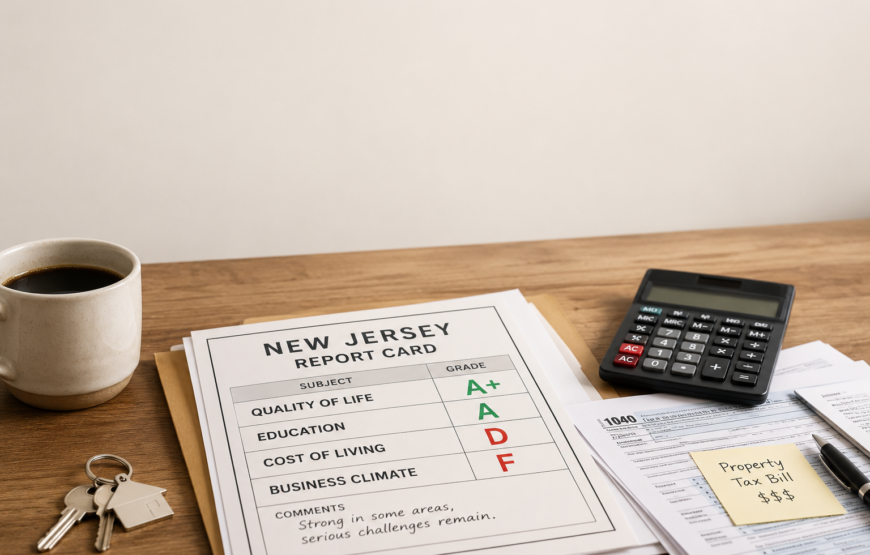
New Jersey just got graded, and the results read like two report cards stapled together, one covered in A’s, the other barely passing. The state earned some of the best marks in the country for quality of life. It also earned some of the worst for what it costs to live and do business here. According to CNBC’s 2026 America’s Top States for Business study, an annual ranking that scores all 50 states across 10 economic categories, New Jersey placed No. 31 overall, a ranking that perfectly captures what it feels like to live in New Jersey.
How Does New Jersey Rank for Cost of Living in 2026?
CNBC gave New Jersey an A-plus for quality of life, ranking the state No. 3 nationally. Education came in at No. 2, with an A grade. Cost of living ranked No. 39. Neither number surprises anyone, but seeing them side by side on a national scorecard makes the trade-off explicit.
It amounts to almost the perfect New Jersey paradox, one that applies just as much to Montclair. The complaints about cost here are real, from housing to property taxes to childcare to the price of a dinner out. But the same things that make Montclair expensive are what keep people from leaving: schools that get by despite their struggles, a strong restaurant scene, a walkable downtown, six train stops, the Wellmont, a full calendar of festivals.
That is not a defense of the cost. It is an explanation of why people keep paying it anyway.
Why Montclair Feels the New Jersey Paradox First
New Jersey is not expensive despite having a great quality of life. In many ways, it is expensive because it has one, and people are willing to pay a premium to live in communities like Montclair.
For a town that has spent the past year working through a nearly $20 million school deficit and a real estate market where the median home sale hit roughly $1.38 million in May, up more than 14 percent year over year according to local market data, that premium is not an abstraction. It shows up on the tax bill every quarter, and again on the closing statement.
CNBC’s data suggests the state’s affordability problem is not really about people disliking New Jersey. It is about the price of staying somewhere everyone wants to be. Housing costs hit homeowners hardest, but affordability is not the only place the state’s report card gets ugly.
Why Did New Jersey Rank Last for Business Friendliness?
If cost of living stings residents, business friendliness is where the state’s grade turns genuinely bad. CNBC ranked New Jersey No. 50 out of 50 for business friendliness, an F, alongside. Dead last. No. 38 for cost of doing business. Even as residents love living here, it is often harder and more expensive to run a business here, and the for rent signs across Montclair’s own business districts make the case without much help.
The New Jersey Business and Industry Association wasted no time connecting the dots. In a public statement, president and chief executive Michele Siekerka called the rankings a warning sign, pointing to a run of recent policy changes she says have made the state harder to plan around. Among them: the Corporate Transit Fee, a surcharge on the state’s largest corporations; changes to the rules determining whether a worker counts as an independent contractor; a proposed Climate Superfund bill, which would let the state seek damages from fossil fuel companies for past emissions but has not been enacted — it was pulled from a legislative voting session in late June and has not advanced since; and a new assessment on employers whose workers rely on Medicaid. She also cited more than 9,000 jobs affected by WARN Act notices, the federal law requiring companies to give advance notice of mass layoffs, so far this year.
Gov. Mikie Sherrill’s office pushed back. A spokesperson noted the administration has been meeting with business organizations and chambers of commerce since January as part of a broader permitting overhaul, an effort to speed up approvals for new construction and business permits across the state.
That fight over who is responsible is not going away, and it is one Montclair has a direct stake in.
What Happens Next for New Jersey’s Business Climate
Montclair has been living this story long before CNBC put a number on it. Consider the running list the Pod has covered since it started: the Montclair Math behind what it costs to build or sell property here, the liquor license fights, permitting delays, small business rents, public transportation, taxes, the school budget, infrastructure. All of it is the cost of doing business stories playing out at the hyperlocal level.
A similar pattern showed up again this summer with the World Cup, where Montclair had a geographic advantage — proximity to MetLife Stadium — but no coordinated plan to capitalize on it before the moment arrived. For the full story on how that played out downtown, read our reporting on Montclair’s World Cup letdown.
The state’s report card is in. Montclair’s response to it is still being written.
Got a story about what Montclair’s cost of living or business climate looks like from where you sit, a shuttered storefront, a tax bill that finally broke you, a business you almost didn’t open? Email us at hello@montclairpod.com. We read everything, and some of the best Pod stories start there.