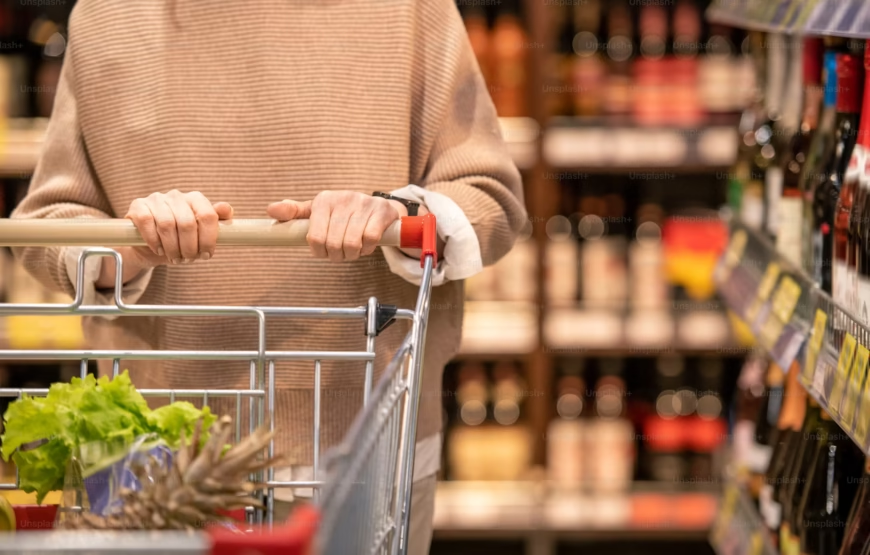
The next time you order groceries through Instacart or check prices on a store’s app, the price you see should be the same price the shopper right next to you sees, not a number quietly calculated from your browsing history, your location or what you bought last week.
Governor Mikie Sherrill made that promise official on July 23, signing the Fair Price Protection Act into law. The law bans surveillance pricing. That’s when retailers use your personal data, your browsing history, location or past purchases, to calculate the highest price you personally will accept, then charge you that price while the shopper next to you pays less for the same item. New Jersey becomes the third state in the country to outlaw the practice, joining Maryland and Connecticut.
“Companies figure out where you live, where you shop and even what you’re Googling and they use that data to calculate specific, often higher prices for items you need, without your knowledge,” Sherrill said at the signing. “Surveillance pricing essentially gives Big Brother a look into your shopping cart.”
Here is what the law actually changes and what it leaves alone.
What Is New Jersey’s Fair Price Protection Act?
The law stops grocery stores and third party delivery platforms, think Instacart and similar apps, from using your data to set an individualized price for a product two shoppers are buying at the exact same time. It does not stop every deal you get at checkout.
“New Jersey families are already feeling the pressure of higher costs,” Sherrill said. “The last thing they need is companies secretly using their personal data to charge them more than someone else for the exact same product. If businesses want to compete, they should do so by offering better prices, not by finding new ways to squeeze shoppers.”
The state claims that the law carves out exceptions for genuine loyalty programs, promotional pricing and prices offered to broadly defined groups like seniors, veterans or teachers. Those discounts stay legal.
That distinction raises an obvious question: how does a store’s software actually make that call in the first place?
How Does Surveillance Pricing Actually Work?
An algorithm does the work. It watches what a shopper has browsed online, where their phone says they’re standing and what they’ve bought before, then estimates the highest price that specific person will pay without walking away. Right now, the clearest examples involve the gap between walking into a store and shopping through an app. The governor pointed to a carton of eggs priced at 99 cents for anyone who walks in the door, while a delivery platform might charge more for the same carton simply because it knows a shopper buys eggs every week or has been searching for breakfast recipes that call for them.
The law also pauses new electronic shelf labels for one year. These are digital price tags, similar to the screens some stores already use for sale signage, that let a chain change prices instantly across a location at once. Regulators want time to study whether that technology makes surveillance pricing easier to run at scale before more stores install it.
What Are Businesses and Consumer Advocates Saying?
Business groups warn the law could sweep up discounts shoppers actually rely on. NJBiz reported that the New Jersey Business and Industry Association raised concerns after the signing, while Chamber of Progress, a national tech-industry policy group, had criticized the bill’s discount provisions throughout the legislative process.
“Gov. Sherrill had an opportunity to protect New Jersey consumers from unfair price increases but instead signed a bill that will also take away the discounts families use every day,” said Chamber of Progress policy manager Drew Ambrogi in a statement. “Unless the Legislature fixes this bill later this year, New Jersey families could wake up in 2027 to find that everyday discounts available across state lines are no longer available at home.”
Consumer advocates reject that framing entirely. New Jersey Citizen Action executive director Dena Mottola Jaborska called the law a restoration of basic fairness, not a threat to it, according to NJBiz.
“Surveillance-based pricing is a threat to marketplace fairness, consumer privacy, and affordability,” Mottola Jaborska said. “At a time when families across New Jersey are struggling to make ends meet, the idea that the price of something as essential as groceries could be manipulated, often based on information that isn’t even reliable, just to maximize profits, is unacceptable. The Fair Price Protection Act restores a basic principle of consumer fairness.”
When Does New Jersey’s Surveillance Pricing Law Take Effect?
Both the pricing ban and the electronic shelf label moratorium take effect on the same date: February 1, 2027, the first day of the seventh month following the law’s July 23, 2026 enactment. That gives retailers roughly six months, not over a year, to adjust their systems before enforcement begins.
Once the ban takes effect, a violation counts as a breach of the state’s Consumer Fraud Act, the law that governs unfair business practices in New Jersey. That means a shopper who believes they were overcharged based on their personal data can sue a retailer directly in court, rather than filing a complaint with the attorney general and waiting for the state to act on their behalf.
Violations carry Consumer Fraud Act civil penalties of up to $10,000 for a first offense and $20,000 for each subsequent offense. Separately, the attorney general can pursue actual damages or $50,000 per violation, whichever is greater, plus cease-and-desist orders and punitive damages. Willful violations can also bring treble damages to the injured consumer, meaning a court can award three times the actual amount a shopper was overcharged.
That combination gives an individual shopper real leverage, not just a complaint form that may or may not lead anywhere.
Start paying attention now. Screenshot prices when you shop online, especially if you notice the same item priced differently depending on whether you’re logged in, browsing in the app or comparing on a second device. That kind of documentation is exactly what a shopper would need if they ever had to prove a violation once the law takes effect.
Image credit: Unsplash