
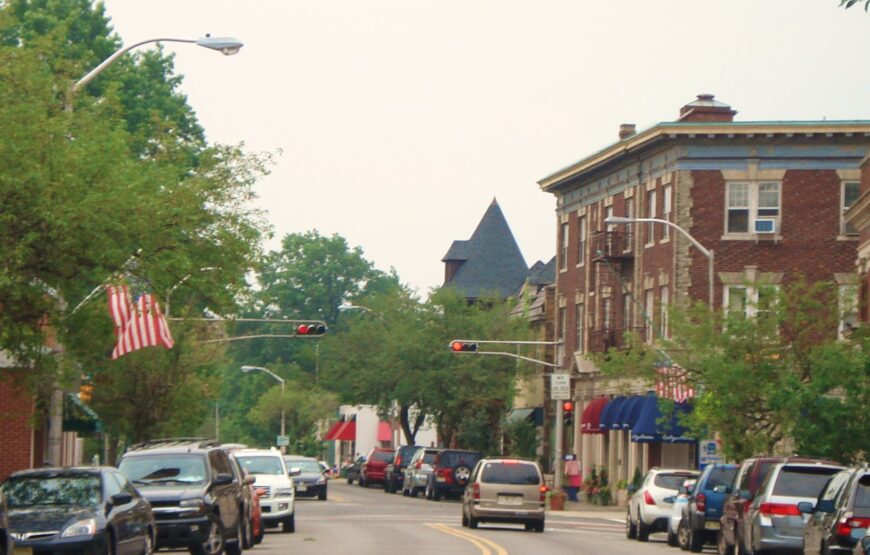
If you’re narrowing a shortlist of NYC suburbs, you’ve probably already run every combination of these towns through Google. This piece cuts through the real estate copy and the forum noise. It covers Montclair vs. Maplewood, South Orange, Glen Ridge, Hoboken and Westfield across the five things that actually decide where people land: price, commute, schools, culture and fit. No boosterism, no false balance.
How Home Prices Compare Across These Towns
Montclair’s median sale price for all home types hit nearly $1.38 million in May 2026, up more than 14% year over year, according to Redfin. Homes routinely sell above asking and the bidding process moves fast. That number is among the highest in this group, but sticker price alone doesn’t tell the full story. For a deeper look at what’s driving the market, follow The Pod’s real estate coverage.
Glen Ridge, Montclair’s quieter neighbor to the south, has a median home value around $1.2 million – that is 10.2% higher than last year. Glen Ridge and Montclair are the only two Essex County towns consistently commanding premiums of 20% or more above asking. Buyers who assume Glen Ridge is the budget-friendly alternative to Montclair often discover that once they’re inside a house they want, the final sale price looks very similar.
Westfield, in Union County about 20 miles southwest of Montclair, matches Montclair’s median at roughly $1.3 million as of May 2026, up 8.4% from May 2025. It earns that price on the strength of its schools and Main Street. The commute is longer and the cultural infrastructure is thinner, but the market is just as competitive.
South Orange comes in around $1.1 million at the median, up 5.8% from a year earlier. Maplewood’s median home sale price has generally ranged from the high six figures to just over $1 million, reaching $1.24 million in May 2026, 20.9% higher than in 2025. While still less expensive than Montclair, the gap has narrowed considerably. Both are in Essex County and share the same general commuter corridor. Maplewood has been drawing buyers priced out of Montclair for years, and for good reason. The value is real. Hoboken’s median sits near $999,000, nearly 20% higher than a year ago. But most of that inventory is condos and co-ops rather than single-family houses with yards, which matters if outdoor space is part of what you’re leaving the city to find.
If budget is a hard constraint, Hoboken, South Orange, and Maplewood generally offer lower median sale prices than Montclair, Glen Ridge, or Westfield, though the housing stock differs significantly from one town to another.
Which Town Has the Best Commute to New York City?
Hoboken operates by different rules than the rest of this group. The PATH train, a rapid transit line separate from NJ Transit’s commuter rail network, puts Midtown Manhattan about 15-20 minutes away and lower Manhattan in 10-15, running 24 hours a day. If your office is in the Financial District or Hudson Yards, Hoboken isn’t a suburb so much as a city with more square footage per dollar.
Maplewood and South Orange both run on NJ Transit’s Morris and Essex line with Midtown Direct service, meaning one train, no transfers, directly into Penn Station in 30 to 35 minutes. South Orange’s express runs about two to three minutes faster than Maplewood’s, which in practice means nothing. Both towns offer a community jitney shuttle for residents who live farther from the station. Fares and annual pass rates are subject to change, so prospective residents should check the municipalities’ official Maplewood and South Orange websites for the latest pricing and route information.
Montclair is a different story. If you have followed our coverage of NJ Transit, you already know train service has become a growing frustration for many residents. The town has six NJ Transit stations on the Montclair-Boonton Line, a genuine advantage on weekday mornings when trains run frequently and the ride to Penn Station takes 35 to 50 minutes depending on your station. The catch comes on weekends. Service drops to every two hours and terminates at Bay Street, the first of six Montclair stations, meaning five of them go unserved entirely. Residents heading into the city on a Saturday are either driving to Bay Street or driving somewhere else. Glen Ridge shares the same line and the same limitation. If you rely on the train for weekend trips into the city, factor that into your decision before you fall in love with a house.
Westfield’s peak commute to Penn Station runs 45 to 50 minutes, the longest ride in this group. That puts it squarely in hybrid-commuter territory: a strong fit for buyers in the office two or three days a week who want space and schools the rest of the time.
How Do the Schools Stack Up?
Each district is structured differently, and a simple ranking misses most of what matters.
Montclair’s public schools are in the middle of a financial crisis that buyers with children need to understand before relying on rankings or reputation alone. The trouble traces back to years of poor financial management that left the district carrying a roughly $20 million deficit. In a special March 2026 referendum, voters approved a one-time tax levy to retire the accumulated debt but rejected a permanent annual increase to shore up ongoing operations. That split decision didn’t close the book on taxes: the approved 2026-27 budget still carries an additional estimated $851 school tax increase for the average homeowner, driven by rising healthcare and pension costs the district says are outside its control. Staff reductions, program cuts and a forensic audit that has yet to be completed round out the picture.
That financial backdrop matters because Montclair runs one of the few magnet school systems in the New Jersey suburbs, meaning students don’t attend a neighborhood school based on where they live. Families apply to themed programs across the district, organized around subjects like environmental science, global studies and the arts. The system was designed during the desegregation era of the 1970s to integrate schools voluntarily, replacing a history of deliberate segregation that dated back decades. It has produced one of the most genuinely diverse public school districts in the region, and that diversity is a real part of what draws families here. To fully understand where things stand today, the Pod’s coverage of the district’s financial crisis and school referendum is the place to start.
Glen Ridge’s setup is the opposite of Montclair’s in almost every way. It is a small, single-borough district with about 1,810 students and a 12.3-to-1 student-teacher ratio. No lottery, no themed applications. Your child attends the school for their zone. That simplicity is a selling point for families worn down by more complex systems, and the schools carry none of Montclair’s current financial pressure. The tradeoff is context worth naming: Glen Ridge is one of the least economically diverse districts in Essex County, which means the school experience reflects that.
The South Orange-Maplewood School District covers both towns and feeds into Columbia High School for grades 9 through 12. It holds an A-minus rating on Niche and ranks sixth in Essex County. About 95% of Columbia graduates go on to college, including 86% to four-year universities. The shared district produces a genuinely integrated school experience across two towns, which is notable in a state where suburban school segregation remains persistent. Buyers should know, though, that South Orange-Maplewood is navigating its own fiscal strain: the district faces a projected $8 million budget gap, compounded by a prior $8.5 million deficit. It hasn’t reached referendum territory, but it’s a story worth following.
Westfield’s schools rank 18th in New Jersey on Niche with an A+ overall grade, among the strongest in the state. The district is well-funded and well-run, and in April 2025 voters backed a nearly $190 million bond to fund building improvements and expand full-day kindergarten, a signal of strong community investment.
Hoboken’s public schools are a known variable. The district holds an A-minus overall on Niche, but many families there choose private options instead. That’s an openly discussed tradeoff in the market. Buyers should price it in.
Where’s the Best Food, Culture and Weekend Life?
On this question, Montclair wins and there is no close second. Maybe we’re biased, but our town’s event lineup speaks for itself.
The Wellmont Theater has hosted major national acts in an intimate 2,000-seat setting since 1922. The Montclair Film Festival runs 10 days each fall with screenings and director Q&As. The Montclair Art Museum, founded in 1914, holds nationally recognized American and Native American collections and added a new Indigenous Art Gallery in 2025. The Jazz Festival takes over Lackawanna Plaza every summer. The Literary Festival runs 10 days each May and marked its 10th anniversary in 2026. None of the other five towns on this list have anything that competes with that concentration of cultural infrastructure.
The food scene earns the same description. Bloomfield Avenue and its side streets run deep with independent restaurants spanning Ethiopian, North Indian, Yemeni, French and Latin American cooking, at a range that would hold its own in a bigger city. For specific recommendations, Farnoosh and Mike have been eating their way through town: their Farnoosh and Mike Eat Food series covers everything from decades-old neighborhood counters to newer spots that have quietly become essential. The Pod’s arts and culture coverage are also worth bookmarking before your first weekend here.
Maplewood has a genuinely good food and community scene along Springfield Avenue, and {Words} bookstore is a real anchor. Its Friday night downtown has the kind of social energy that turns renters into buyers. The scale is smaller than Montclair’s, but it is not a consolation prize.
South Orange’s downtown is compact, walkable and increasingly restaurant-dense, with everything close to the station. Hoboken’s Washington Street corridor is dense with bars and restaurants, and the waterfront parks are excellent. What Hoboken has is nightlife. What it lacks is the arts and culture calendar that Montclair has built over decades.
Westfield’s Main Street is the best commercial downtown in Union County: independent shops, a solid restaurant row, genuine walkability. Glen Ridge has almost no independent food or culture scene of its own. Its residents use Montclair, which is immediately adjacent, and proximity to Montclair is part of the town’s explicit pitch to buyers.
Which Town Is Right for You?
Price, commute, schools and culture are all measurable. What’s harder to put in a table is the question of which town fits how you actually want to live.
Hoboken might be the right call if you haven’t fully committed to leaving the city. The commute is unmatched, the density is urban, and the path to a larger life is clear if you need it later. If a yard and a public school district are the immediate priorities, Hoboken tends to be a transitional stop rather than a long-term destination for families.
Maplewood offers the most potential value in this group. Buyers who treat it as a fallback for people who couldn’t afford Montclair are misreading the town. Good train, solid schools, a real downtown, strong community identity. The price gap with Montclair is real and it shows up in what you can buy.
South Orange offers Midtown Direct service, a walkable downtown with more urban texture than Maplewood and a price point that has been closing the gap with Montclair steadily since 2022. The shared school district with Maplewood is a genuine asset.
Glen Ridge is quiet, architecturally beautiful and more expensive per square foot than most buyers expect. The schools are strong and uncomplicated, the streets are lined with gas lamps and the town’s deliberate resistance to density is itself a draw for the right buyer. Buyers who want Montclair’s bones without its energy tend to be happy here.
Westfield may be the answer for buyers who want top-ranked schools and a walkable downtown and can absorb the longest commute in this group. The lifestyle is genuinely good. It is Union County, not Essex, and the two feel like different regions of New Jersey entirely.
Montclair has the most of everything on this list: most cultural infrastructure, most dining, most school complexity right now, most competition at every price point. The school situation requires real due diligence in 2026. The housing stock, the walkability, the density of cultural life, none of that has changed. Neither has the reason people choose it when they can.
If you want to go deeper, the Pod has carefully and closely covered Montclair’s real estate market, school budget and neighborhood life. Read our real estate outlook for the full market picture, our school budget reporting for what the referendum result actually means for families and our neighborhood guides to understand which part of Montclair fits your life. Then come back with questions.
Image Credit: Wikimedia Commons


.jpg#/media/File:Street_in_Upper_Montclair,_NJ_(2006).jpg)