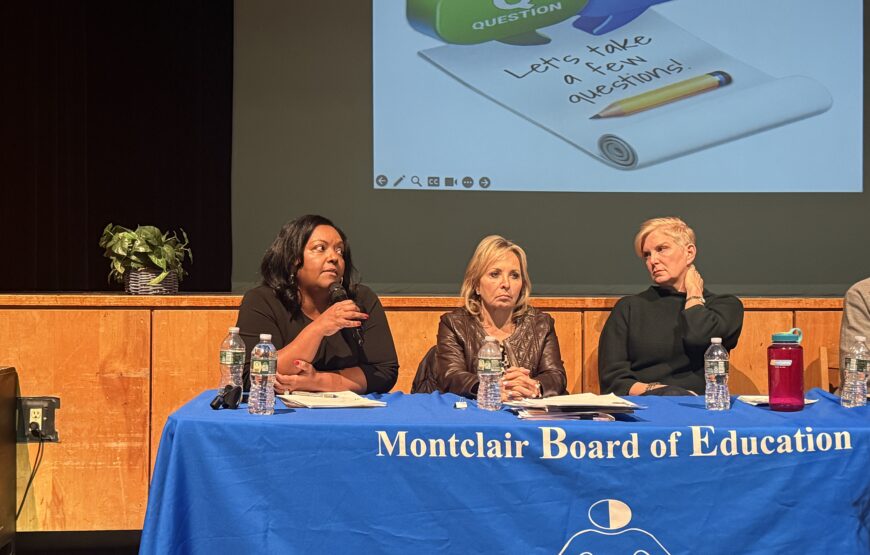
The window to run for Montclair’s school board closed at four o’clock this afternoon. Whoever wins those three open seats in November will inherit a board that a new report from the civic group MPACT says has repeatedly approved budgets and adopted financial policies without ever checking whether either one was actually followed.
MPACT, which stands for Montclair Partnership for Accountability, Clarity and Trust, published the report on July 24, three days before the filing deadline. The timing was not an accident. The nine-member Board of Education is still recovering from a fiscal crisis that forced a special election in March, when voters narrowly approved a one-time $12.6 million tax levy to cover the district’s budget deficit after officials disclosed millions in previously unbudgeted spending.
“With Board candidates filing on Monday and voters heading to the polls in November, this is an important moment for the community to understand what good governance looks like, including the often misunderstood line between what the board oversees and what the administration manages day-to-day,” said Michael Crowley, a district parent and the report’s lead author. “This Explainer is meant as a resource for the current board as it works to rebuild trust, and for candidates and voters deciding who’s next.”
How Montclair’s Fiscal Crisis Led to This Report
MPACT formed after that crisis raised questions about whether the Board of Education had exercised adequate financial oversight. The report doesn’t treat the deficit as one bad decision. It treats the deficit as a symptom of a board that adopted internal control policies on paper, then never checked whether the district was following them.
That distinction matters, because the report’s authors say the same pattern shows up across other parts of the board’s work, not just the budget.
“After a turbulent and challenging year, the community is hungry for improvement, and that starts with the Board of Education,” said Dan Hafetz, MPACT’s founder and a Montclair Public Schools parent. “We created this Explainer to give the board practical guidance on how to build its capacity for quality oversight, and to help the community do its part to hold the board accountable.”
Where MPACT Says Montclair Board of Education Oversight Fell Short
The report describes a board that approves budgets and adopts policies, then rarely checks whether either one actually gets carried out. Spending cuts get approved on paper and quietly reversed. Audit findings and major financial presentations get less board scrutiny than routine items further down the agenda. MPACT’s authors say this isn’t one lapse. It’s a pattern that shows up whenever the board’s oversight gets tested.
The report’s clearest example comes from May 2022, when the district issued non-renewal notices to 83 staff members to close a budget gap. By that July, the district had rehired roughly half of them. MPACT found no public record of the board asking why, or whether the money to bring those employees back actually existed.
A more recent example is just as pointed. At the February 25 board meeting this year, the district’s auditors presented findings, administrators laid out proposed budget cuts tied to the March special election, and the superintendent walked through her instructional vision along with a draft school calendar. It was one of the most consequential meetings of the year. According to the report, the board’s questions that night focused mostly on which holidays would appear on next fall’s calendar.
MPACT doesn’t argue the board is acting in bad faith. It argues the board hasn’t developed the habit of asking hard questions in public, even when members already know the answers, because the public has no other way to see that oversight happened at all.
What MPACT Wants to See: Stronger Financial Oversight
The report calls for monthly public financial reports, written in plain language, with clear explanations for any variance from the adopted budget. It also wants the board to stop bundling major financial decisions into what’s known as a consent agenda, a single vote used to approve routine, uncontested items all at once without individual discussion. MPACT’s research found that in over seventy percent of school board meetings nationally, consent agendas swallowed up spending decisions that deserved real debate.
The board’s stalled search for a forensic auditor, an independent accountant brought in to trace exactly how and where the district’s money went wrong, shows the problem in real time. At the June 10 meeting, the district’s interim business administrator reported that only four firms had responded to the request for proposals, none with much experience auditing New Jersey school districts. The scope of the audit still hadn’t been defined. MPACT says that work should have been settled before the request ever went out.
Financial literacy training for all nine board members, not just the ones with finance backgrounds, is another recommendation. The report is careful to note that board members don’t need to be accountants. They need to be willing to ask what a number means and whether last year’s spending got the results it promised.
Closing Montclair’s Achievement Gap
Financial oversight isn’t the only place MPACT says the board has looked away. The district’s overall test scores beat the state average, but that number hides a gap that has persisted for decades. On the New Jersey Graduation Proficiency Assessment, 44 percent of Black students and 55 percent of Hispanic students were graduation ready in math, compared with 81 percent of white students and 79 percent of Asian students. The English language arts gap is smaller but still wide, 73 percent versus 96 percent for Black and white students respectively.
The district presented this breakdown, meaning the scores split out by race, income and other student groups rather than reported as one districtwide average, at a board meeting last November. MPACT’s point isn’t that the board doesn’t know the gap exists. It’s that knowing isn’t the same as acting on it.
The report wants the board to require this kind of breakdown on a regular public schedule, set specific numeric targets for closing the gap and tie those targets directly to the superintendent’s annual evaluation. Right now, none of that is standard practice.
Making Board Meetings More Transparent
Montclair’s board currently follows an unwritten rule that only the board president speaks publicly on the board’s behalf. That practice traces back to a 2022 advisory opinion from the New Jersey School Ethics Commission, the state body that enforces ethics rules for school board members, which warned that even a board member’s personal social media post about school business could be read as an official statement and expose them to a complaint.
MPACT argues that opinion has had a chilling effect the law never required. The report recommends the board work with its attorney to figure out where the real legal lines sit, rather than defaulting every member to silence.
The report also pushes for regular town halls, a defined process for answering questions raised during public comment and a review of the board’s practice of never releasing executive session minutes, even after the confidential matters they cover are resolved. Under the state’s Open Public Meetings Act, the law that requires most government business in New Jersey to happen in public view, those minutes are supposed to become public once the reason for keeping them closed no longer applies.
The board doesn’t need permission from Trenton to make any of these changes. It needs to decide to make them.
What Happens Next
MPACT’s report covers three areas where it says Montclair’s board has room to improve: tighter financial reporting, real accountability for the achievement gap, and more transparency around how decisions get made. None of it requires new law. All of it requires a board willing to do it.
The full Explainer, along with MPACT’s supporting research, is available at mpactnj.org.
The Pod plans to bring these findings directly to Superintendent Ruth Turner on an upcoming episode of Supper with the Super, and we’ll follow up once this year’s candidate list is finalized. If you want a say in how closely the next board gets watched, the first step is showing up to vote in November.