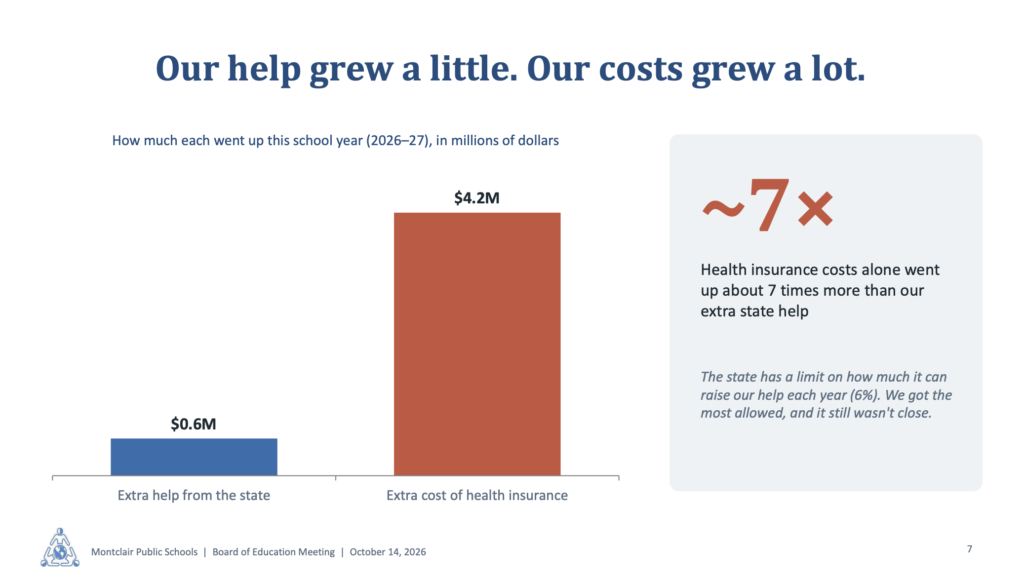
Montclair’s public schools got the largest aid increase the state allows this year: about $600,000. Their health insurance costs rose $4.2 million. Superintendent Ruth B. Turner says that gap shows what’s broken in the New Jersey school funding formula, and she is asking Montclair residents to tell the state so in person at a public forum in Newark on October 27.
Turner made the case at the October 14 Board of Education meeting with a presentation titled “Why Montclair Schools Need a Fairer Share of State Money.” She followed it the next morning with a letter to families. Both carry the same message. The district has tightened its books since last year’s deficit crisis, but in the presentation’s words, “Even when we spend wisely, our costs are growing faster than the help we get from the state.”
Now the state wants to hear about it.
How the New Jersey School Funding Formula Leaves Montclair Out
The formula, written into law in 2008, starts with two estimates. The first is what it should cost to educate a district’s students. The second is what the community can afford to pay toward that cost, based on its property values and its residents’ incomes. When the first number is bigger, the state covers the difference with what it calls equalization aid.
Montclair gets none of it.
The state money Montclair does receive is restricted to three uses: special education, school buses and security. Everything else falls on local taxpayers, because the state’s math concludes they can carry it.
Turner disputes that assumption.
“Montclair’s reputation as an affluent community does not reflect every family’s circumstances,” she wrote in her letter. “A home’s rising value does not necessarily mean a larger paycheck or more income for a retiree. Our families experience different financial realities, and local taxpayers face real limits.”
Montclair’s median home sale price reached about $1.24 million in September, up 12.4% from a year earlier, according to Redfin. In the formula’s math, that makes the town look more able to pay.
Turner’s presentation names who pays the price for that math. Longtime homeowners have houses worth more than ever on the same salaries. Retirees live on fixed monthly incomes. Working families face the same rising prices as everyone else. One slide put it in a single line: “A student’s chances should never depend on what people think of their town.”
The formula’s blind spots show up fastest in the district’s biggest bills.
Health Insurance Alone Outran Montclair’s State Aid by $3.6 Million
Montclair’s schools are in better shape than they were a year ago, when the district faced a deficit of nearly $20 million. In May, the board approved a $179 million budget for this school year after roughly $6 million in cuts. The district also ended 2025-26 with about $1 million in fund balance, the money left over after the year’s bills are paid.
The squeeze, though, is built into the system. Under state law, Montclair can raise its school tax levy, the amount collected from local property taxes, by no more than 2% a year. Costs don’t follow that cap. Turner made the point bluntly at last month’s Supper with the Super, The Pod’s regular sit-down with the superintendent.
“I don’t need to tell you about the cost-of-living increase our staff gets, minimum three percent, while the tax levy cap is two percent,” she told hosts Mike Schreiber and Farnoosh Torabi.
State aid has its own ceiling. A district’s aid can grow by no more than 6% in a single year, according to the presentation. Montclair received the maximum, and it covered about one-seventh of the new health insurance bill alone.
“At the end of the day, there is not much the Board of Education or myself can do to create money, find money, grow money,” Turner said at the meeting, as reported by Montclair Local.
In her letter, Turner spelled out where the shortfall lands.
“These funding gaps affect decisions about staffing, class sizes, and the range of opportunities we can provide,” she wrote. “Behind each budget decision are students who deserve the support they need to thrive.”
Nowhere does the gap cut deeper than in special education.
What Montclair Wants Trenton to Fix, and What Sherrill Says Is Coming
About one in five Montclair students receives special education services, according to the district.
“We remain committed to ensuring that every student receives the individualized support they need and deserve,” Turner wrote.
The state helps with the most expensive cases through extraordinary special education aid. It reimburses part of a student’s costs once services pass $40,000 a year in a public school or $55,000 for a student the district places in a private special education school. The state’s pool of money for those reimbursements hasn’t kept pace with costs, according to the presentation. So every district receives only a portion of what it qualifies for, and Montclair’s share keeps shrinking.
Turner’s letter lays out four asks:
- She wants the state to review whether its estimates of what a community can pay match what families earn.
- She wants its cost estimates updated to reflect what educating a student costs now.
- She wants extraordinary special education reimbursements fully funded.
- And she wants aid predictable enough that districts can plan more than a year ahead.
The state has opened the door to all of it. In August, the New Jersey Department of Education launched the School Funding Outreach Project, a yearlong review of the system, including the formula itself, with a steering committee led by Education Commissioner Lily Laux.
Gov. Mikie Sherrill told Mike and Farnoosh at Montclair State University that rethinking the formula was among the first jobs she gave Laux. Laux found the state lacked the data to do it, Sherrill said, so the department is building a database that shows where each district spends its money. Then she explained what the state wants to learn from it.
“So really apples to apples and putting schools in kind of a grouping that makes sense and determining where are the outliers, which schools in this grouping are performing above where we would expect them to be and why, and how can we take that and really give those resources to all the schools across the state,” she said.
That review is taking public comment now, and Montclair’s turn comes in Newark.
How to Speak at the Oct. 27 School Funding Forum in Newark
The regional forum runs from 6 to 7:30 p.m. on Tuesday, Oct. 27, at the Essex County Donald M. Payne School of Technology, 498-544 W. Market St., Newark. State officials will open with a plain-language overview of school funding, then take public comments of up to three minutes each. Speakers must register in advance. Turner and members of the Board of Education plan to attend.
Residents who can’t make it to Newark can join a virtual statewide forum on Thursday, October 22 or Thursday, Nov. 12, from 6 to 7:30 p.m., or send written comments to FundingOutreach@doe.nj.gov.
The district also urges residents to contact Montclair’s state legislators: state Sen. John McKeon and Assemblywomen Rosy Bagolie and Alixon Collazos-Gill.
If you plan to speak, you don’t need to master the formula. Turner is asking for something simpler.
“Our advocacy is strongest when we connect the numbers to the people they affect,” she wrote. “Please share what educational opportunities and student supports mean to your family.”
Registration for the Oct. 27 forum is open now on the state Department of Education’s School Funding Outreach page.
Image credit: Montclair High School