One year ago, Montclair Public Schools were staring down a state-appointed fiscal monitor, the outside official the state assigns when a district’s finances put it at risk of losing local control. This year, the numbers are finally moving in the other direction.
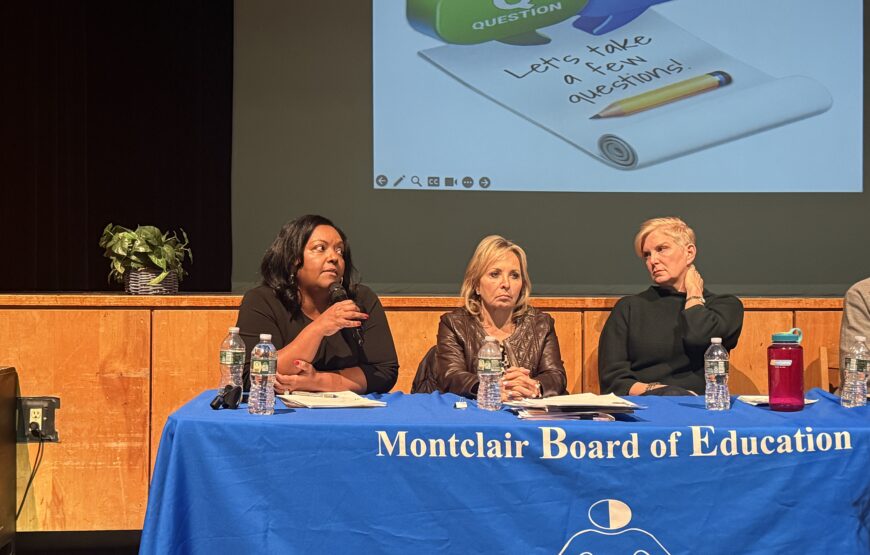
In a letter to families following the August 5 Montclair Board of Education meeting, Superintendent Ruth B. Turner announced that the district expects to close the 2025-26 fiscal year with a positive unreserved fund balance of about $1 million, a reversal from the $12.7 million unreserved fund balance deficit reported in the district’s June 30, 2025, audit. The same meeting also introduced a new communications chief, rolled out a districtwide data platform, and released the results of a survey on how Montclair students actually use artificial intelligence.
Montclair Board of Education Meeting Confirms the Budget Crisis Has a New Chapter
The $12.7 million figure is worth pausing on, because it is not the same number Montclair has been hearing since last fall. The district’s broader financial crisis eventually grew to about $19.6 million, combining roughly $12.6 million in accumulated obligations with an estimated $7 million operating shortfall. The unreserved fund balance is narrower: it is the district’s cash cushion, the number state officials watch most closely when deciding whether a school system needs outside oversight. Turning that number positive does not erase the larger crisis. It does mean Montclair bought itself room to breathe.
Turner credited two things: the $12.6 million tax levy voters approved in a special election earlier this year, and nearly $1.8 million in expenditure savings squeezed out across departments. “Those savings did not happen by chance,” she wrote. “They are the result of months of thoughtful planning, careful monitoring and responsible decision-making across every department.”
The district is not declaring victory. Turner called the progress “an important milestone” but said the work “is not finished.” Still, for a community that spent the last year debating ballot questions and the threat of losing local control over its magnet system, a fund balance in the black is the first genuinely good financial news since the crisis began.
As the district works to stabilize its books, it is also trying to rebuild trust with families, starting with who delivers the message.
Who Is Eshaya Draper, Montclair’s New Communications Director?
The board also confirmed Eshaya Draper as the district’s new Executive Director of Strategic Communications and Community Engagement, stepping into a role Turner has leaned on heavily during the fiscal crisis, when confusing or delayed information from the district became its own source of community anger.
Draper spent nearly a decade in New Jersey school district communications, most recently as Communications Director for the South Orange & Maplewood School District, where he expanded multilingual outreach and modernized how the district reaches families online. He has also held leadership roles with the state and national school public relations associations.
Turner said restoring trust with families is central to the new role. “Mr. Draper will lead our efforts to ensure families, staff, students and community members receive timely, transparent and accessible communication that reflects the outstanding work happening throughout our schools,” she wrote. Whether that promise holds will be tested fast, with a new school year starting and an AI policy rollout already on the calendar.
What Is LinkIt! and Why Is Montclair Public Schools Using It Now?
The district also introduced LinkIt!, a new data and assessment platform that pulls academic, attendance, behavior and social-emotional data into a single system for teachers and administrators. The project was funded through the Montclair Fund for Educational Excellence (MFEE), the district’s longtime local education nonprofit, though the letter did not disclose the size of that investment.
Turner said the platform is meant to do more than organize spreadsheets. It should let teachers spot a struggling student faster, strengthen the district’s tiered support system for kids who need extra help, and cut down on staff juggling multiple disconnected logins just to get a full picture of one child. The district also plans to build family-facing dashboards so parents can track progress toward the district’s strategic goals themselves, rather than waiting for a report card or a parent-teacher conference to find out how their kid is doing.
What Does Montclair’s New AI Survey Say About Students and Screens?
The most striking numbers from the meeting came from the district’s Technology and Artificial Intelligence Survey, which drew 851 responses from parents, students, teachers and administrators this spring. Nearly seven in 10 high school students said they use AI tools, a rate that climbs sharply with age. Parents, meanwhile, asked overwhelmingly for clearer district guidance on what is and is not acceptable AI use in schoolwork.
The generational split in how people talk about AI showed up clearly in the results. Teachers and parents both worried about students leaning on AI as a shortcut. Students, by and large, described it differently, as a tool that supports their learning rather than replaces it. The district says that gap is exactly why it plans to publish a formal AI policy, expand communication with families on technology expectations, build AI literacy instruction into every grade level and put more training in front of staff before the policy takes effect.
Families do not have to wait until fall to see how it plays out. Board of Education meetings remain open to public comment, and with the AI policy, LinkIt rollout and new communications team all still taking shape, they are the clearest way for parents to raise questions before decisions are finalized.