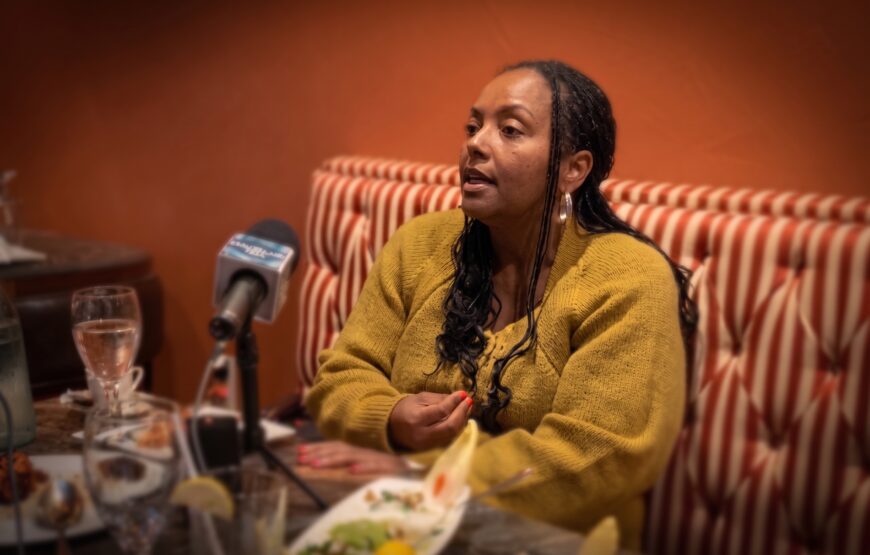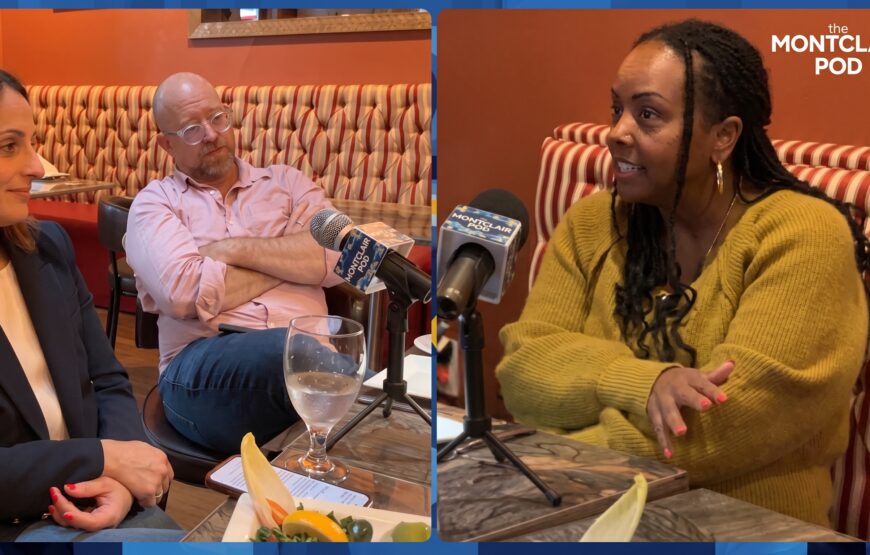
Ruth Turner had one preference for supper. “All I eat is chicken,” the superintendent told podcast co-hosts Farnoosh Torabi and Mike Schreiber at Toros in Upper Montclair on Sunday, and when the chicken arrived, she approved: “Rarely is there a time where I don’t have to put salt or pepper on food that I buy from a restaurant. This is seasoned to perfection.” Despite the deliciousness, food did not dominate the discussion. A year ago, the town was still learning how deep the hole in the Montclair schools budget went. This time Turner had better news: a budget surplus and what it actually means.
She also arrived with a new doctorate, an Ed.D. in educational leadership dedicated to her mother, who pushed her to finish it and passed before it was done. “She gave me the energy,” Turner said, the first in her family to earn a master’s degree, and now the only one with a doctorate. She promised she wouldn’t be the last.
It was the fourth Supper with the Super, the Montclair Pod’s recurring dinner with the superintendent, after Italiana by Zod, Mesob and Turtle and the Wolf in June.
Between courses, Turner said the forensic audit starts this week, explained what a $1 million cushion can and cannot cover, and took on the phone ban, the dress code, special education, the town’s money questions, and the November election.
How Is the New School Year Going in Montclair?
Referencing last September, Turner said, “it was very, very budget crisis, budget focused.” This year, she said, it feels “very, very different.” She spent the summer in the office, weekends included, and opened school before Labor Day for the first time in her career. At convocation, the all-staff gathering that starts the year, everyone fit in one room this time following the inauguration of the high school auditorium, unlike last year, when a lack of space split staff up. She built the day around a theme, “Stronger Together, Rising Higher,” and said staff have written to tell her they feel optimistic.
Her favorite part of the first day was watching students arrive at Glenfield, where community members line up to cheer them in. “We’re like, this is for you, welcome back,” she said. “It’s just the highlight. I absolutely love it.”
Is the Montclair Schools Budget Crisis Over? What the $1 Million Surplus Means
When the district closed the books on the 2025-26 school year, it finished about $1 million in the black, a figure Turner presented at the August 5 board meeting. The word “surplus,” she told the table, can mislead.
“I don’t want to use the word surplus. It is a surplus, but I want folks to know that we should have at least two percent of our budget in a fund balance, which is if you want to liken it to a savings account,” Turner said. A capital reserve for major repairs should sit behind that. “We’re not there yet.” The $1 million is the district’s fund balance now, she confirmed, a savings account it is rebuilding.
The number is not final; the auditors who review the district’s books every year, a separate exercise from the forensic audit, have not finished. Turner expects them to confirm it, but “until they finish their audit, you know, these are our numbers.”
What worries her are the lines that move. Health care is the biggest, because Montclair insures its own employees, which means the district pays their claims directly and a bad year lands on its books. Then there is arithmetic: staff raises run at least 3% while the tax levy, the total collected from property taxpayers, is capped at 2%. “You can do the math right there,” she said. The district already used a state healthcare waiver, which lets districts exceed the levy cap when employee health insurance costs rise faster than 2%, to go past that cap this year, adding about $851 to the average tax bill. In June, Turner told the Pod it might or might not qualify again next year.
“It doesn’t matter who’s sitting in my chair, right? If they’re doing their job right, there’s going to be cuts and taxes are going to have to be raised one way or the other because the system is structured that way,” Turner said. “There’s only so much you can cut.” Superintendents now get a monthly audience with the state education commissioner, she said, something that did not happen last year.
The recovery does not yet reach freshman sports, which the district had planned to eliminate until parents raised $176,000 through the Montclair Athletics Blue and White Club by a June 1 deadline. When could the district pay for programs like that itself? “Again it depends on a lot of variables, like where we are with health care,” Turner said. Folding the club’s fundraising back into the district budget is “always the long term plan,” but she expects the club to be needed for a second year.
When Does the Montclair Forensic Audit Start, and What Will It Answer?
The forensic audit was supposed to start July 1, Turner told the Pod back in April. It stalled: six firms responded to the district’s request for proposals, or RFP, but in June Turner said many lacked experience in school auditing. On August 5, the board voted unanimously to hire EisnerAmper, a firm that has investigated the finances of the Vernon, Millstone and Hillsborough school districts. Over supper, Turner said the last piece fell into place last week: “We finalized the engagement letter,” the contract that sets the terms of the work, and “they will begin engaging with us this coming week.”
How long it will take is unknown; the firm plans to evaluate before it estimates. The price is also set: the district’s $250,000 limit, half of what it originally set aside, holds. When Mike asked whether the fund balance could cover another $50,000 if the firm needed it, Turner responded sharply: “Absolutely not… unless somebody donates or a miracle happens, it stays at $250,000.”
What she hopes the audit delivers is closure. “I really mean that. And that this will allow us to close a chapter and move forward.” Some questions, she said, have already been answered through the district’s corrective action plan filed with the state, though not all of them.
The question that still circulates among residents, Mike said, is whether anyone personally benefited, was there self-dealing, graft, anything that crossed from bad budgeting into someone lining their own pocket. Turner’s own explanation relies not on missing money, but on leaders who could not bring themselves to make the cuts the books required. “There’s a lot of pressure leading in this town,” she said. When previous leaders proposed cuts to reconcile the budget, she said, they met “severe pushbacks,” and rather than hold the line, they let spending run ahead of revenue instead.
“You have to be really courageous to stand on principle and say, ‘you know what? This is the right thing to do. This is what’s going on’. And it’s really difficult. It’s a lot easier said than done… I’m in the seat now and I still have people demanding that I reinstate certain things.”
But Turner still believes that even a clean audit may not settle all the concerns. “And some will consider [it] unresolved even if the forensic audit answers questions,” Turner said.
The district is also facing lawsuits, but Turner said she cannot discuss pending cases. She could talk about what fighting them costs: “In order just to engage a law firm to fight some of those, even if you might, quote unquote, win at the end, right, you still expended cost to do that.” The district hired a new law firm to handle its legal work starting July 1, replacing one that had been in place for four or five years, a swap Turner said was about due diligence, not the litigation.
Accountability for the past is one conversation. Who holds it going forward is another, and that question is on the ballot in November.
The Upcoming Vote and the Still Vacant Permanent BA Position
With Board of Education seats on the November ballot, Turner laid out, without naming any candidate, how she sees the line between the board’s job and hers. “The board’s responsibility is governance,” like a board of directors, while the superintendent runs day-to-day operations. “The board approves a budget. It’s our job to live by that budget. If anything needs to be changed or modified, get approval.” What should a board demand so a second crisis cannot happen without its knowledge?
“You have to be competent to do the job,” she said, and then comes openness: “Do you ask questions, do you get a thorough response? Is there sharing of information even before you have to ask for it, because you don’t know everything you’re supposed to know.”
One hire that process hasn’t produced yet is a permanent business administrator. The search is still open, and Turner said New Jersey districts broadly are struggling to fill the role: “There’s a shortage, and some that are fairly new are not as well trained and experienced, and this is a tough job.”
How Is Montclair Handling the State Cell Phone Ban and Fewer Chromebooks?
New Jersey mandated a bell-to-bell phone ban and left the details to districts. Turner, who came from a district that had collected phones for years, said Montclair started ahead: “We almost essentially were there, even last year.” Under the district’s policy, devices stay powered off and stored for the entire school day.
The high school was harder, since it has an open campus and students can leave for lunch or take classes at Montclair State University. The new policy requires students power off phones and other internet-enabled devices, smartwatches included, and carry them in pouches between classes. “They are and they should be” used, Turner said, “and from what I observed, they are.”
The best evidence came at the seniors’ sunrise breakfast, an outdoor gathering around 6:15 a.m., before the school day began. Turner expected to remind students about phones. She did not have to. “They were talking with each other, they were eating their bagels. I mean, it was just remarkable,” she said.
The phone ban is not the only change. As Turner said in June, the district is ending one-to-one Chromebooks in kindergarten through fifth grade and weighing the same for middle school. Teachers and families who spoke to the Pod back the goal but say the details came late, and some teachers are waiting on textbooks. Turner had not heard that. “I can’t problem solve things I’m not aware of,” she said, and on budgeting for the extra books, she asserted: “We’ll make it happen.”
Is the Montclair Middle School Dress Code Changing?
The dress code fight started with a petition. On the second day of school, eighth grader Phoebe Chaffin watched classmates at Glenfield Middle School get disciplined over what they were wearing and went home angry. Her Change.org petition drew more than 240 verified signatures in under two weeks and a public reply from Board of Education President Yvonne Bouknight, who wrote that Turner was reviewing the matter.
But Turner clarified that the problem did not come from an updated policy. She said: “It’s the same dress code that always existed. I think what might have happened in the past was that it wasn’t enforced.” Why enforcement changed this year, she does not know, but said the push did not come from the district office. The district is now reviewing the policy itself, this time with the goal of cutting out the room for subjective interpretation that the current wording leaves open. “That’s why it’s important that if that’s the direction we end up going, it’s crystal clear,” she said.
Accounts circulating among parents and students describe staff pulling dress-coded students from class and marking them absent. Turner investigated some of them, likening the stories to a game of telephone. She acknowledged that while an incident at lunch in the first days of school did take place, students are not getting pulled out of class to address a dress code issue.
Singling a student out in front of classmates, she agreed, is a separate problem. “That should not ever happen. We know tons of research and study shows us disproportionately girls are impacted by it, and it’s even worse for girls of color.”
Her inbox holds both sides. Many parents support what the middle schools are doing, she said, while others call it “oppressive.” The district will share a process with families once its review is done.
What Happens When a Montclair Student’s IEP Is Reevaluated?
Families have described the same experience to the Pod in different ways: a child had an individualized education program, or IEP, the legal document listing a student’s special education services, last year, and does not this year. Some parents see good news. Others are alarmed, and wonder whether the district’s deficit is behind it.
Turner did not hedge. “Without a shadow of a doubt, I will firmly stand on this,” she said, “the budget has nothing to do with it.” She has felt pressure from people who say special education is draining the system, the claim she pushed back on in June, and “I make no apologies for that. Any student, if they need something to succeed academically, we have a moral obligation to provide it.”
Reevaluation timing, she said, is standard. When it shows a student no longer needs a service, that service typically ends within 30 days. “We’re not going to wait, nor should we… because of the funding that goes with that too.”
Her strongest counter is Montclair’s declassification rate, the share of students who exit special education, which she called “very, very low”: “That’s absolutely not happening in the way that families think it’s happening and for the reasons that they think it’s happening. Because if that was the case, you would see a decent level of declassification,” she said.
A separate question about students with IEPs isn’t whether they lose services, but how they’re disciplined once they have them. That work falls to Maria Francisco, former principal of Renaissance at Rand Middle School and now principal on special assignment for school climate and culture. Turner said Francisco is leading the district’s response to a disproportionality citation, a federal finding that a district disciplines or places students of one race at rates out of line with their peers, this one focused on Black students with IEPs. Montclair Local reported that state data show disproportionate suspension rates for those students in 2022-23, 2023-24 and 2024-25, and that the district must direct 15% of its federal special education funding, roughly $150,000, to the problem. Francisco presented the findings and a plan to the board on September 16.
Next comes a school climate and culture survey, aimed for mid-October and again around April, asking parents, staff and students from what she believes is third through 12th grade how they see their schools. Turner said she does not know when Montclair last did one.
Who Pays for What Between the Montclair Schools and the Town?
Mike raised a question he says he keeps getting from residents: what about PILOTs? A PILOT, or payment in lieu of taxes, is a negotiated payment a developer makes to the town instead of regular property taxes. A new building on Church Street qualified for one, and none of that revenue reaches the school budget. The question came up when the deficit did, Turner said: “The way it was explained to me is that basically there’s one pot of money, right?” If the schools received part of a PILOT, which belongs to the township’s budget, the town would need to raise taxes elsewhere.
The town and the district have at least started talking more directly about money. A working group, going through their shared services agreement, produced its first concrete result this week with the netting at Woodman Field, which the township helped secure. Snow removal is next.
Where the town can’t help, Turner is looking at what the district can do on its own. She’s still open to selling the administration building, especially if it prevents cutting staff. “We need all of our people.” She counted the reinvestment of Renaissance at Rand as a stand-alone pre-K building among her best decisions: the move let the district maximize a grant, saved “almost three million dollars,” and freed the building behind central office to be leased, now producing “a significant amount of revenue.” “Have we exhausted all of [our options]? Probably not,” she said. “But there’s only so much that we can do to generate revenue.”
What’s next
The forensic audit begins this week. The board election is in November. Both will shape how much of what Turner described at Toros still holds by the next Supper with the Super.
A SPECIAL THANK YOU TOROS IN UPPER MONTCLAIR FOR LETTING US FILM SUPPER WITH THE SUPER.
Toros is at 594 Valley Road in Upper Montclair. The restaurant’s open Monday to Sunday from noon to 10 p.m.
The conversation is on this week’s episode of The Montclair Pod, wherever you listen.