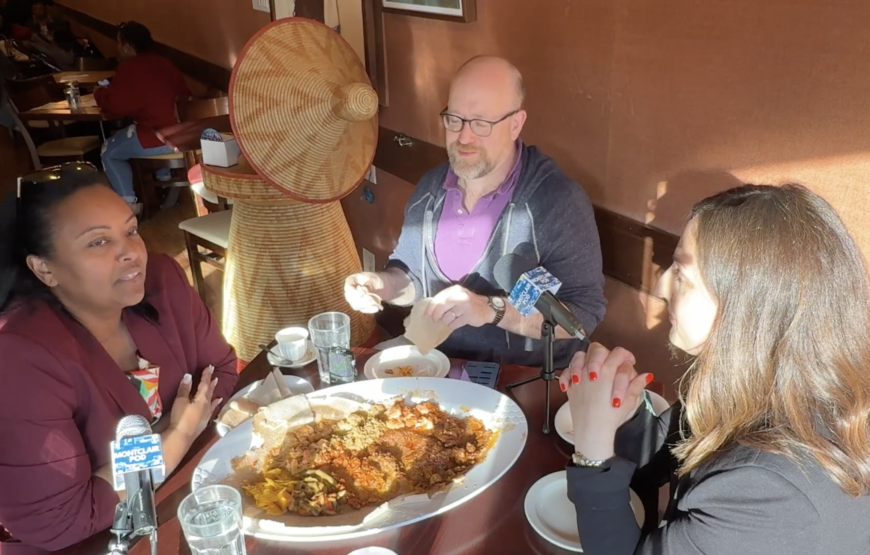
For the second installment of our Supper with the Super series, Montclair Public Schools Superintendent Ruth B. Turner chose Mesob Ethiopian Restaurant on Bloomfield Avenue — not just for the food, but because it’s personal. Turner, who is originally from Eritrea, comes here roughly twice a month when she is craving a taste of home.
“This is the food that I love, food that I grew up with — my mother and grandparents making,” she told us. “I think it’s some of the healthiest, most delicious food in the world.”
Over a communal platter of lamb, Doro Wot, red lentils, green beans and carrots, and injera — the sourdough flatbread that serves as plate, utensil, and centerpiece all at once — we spent more than an hour talking about the budget, trust, the forensic audit, and what Montclair students will actually experience differently in September. Turner also opened up about what the job is costing her personally, and whether she’s found a way to carry it.
We should note: Mesob has been a Montclair institution for more than two decades, run by two sisters and widely considered the best Ethiopian food in North Jersey. Mike has been mispronouncing the name for nearly 20 years. Turner schooled him… gently.
‘I Feel Burden, Not Power’
Before we got to policy, Turner said something that reframed the rest of the conversation. Asked about the weight of high-stakes decision-making, she pushed back on the word “power.”
“I have never felt a sense of power,” she said. “I feel burden.”
That distinction matters here. Turner arrived in July 2025 to discover a multi-year structural deficit, and has spent nine months making decisions her predecessors deferred for years. She described the experience as something beyond stress.
“It’s beyond that,” she said. “Someone said, ‘I feel like you have all the power.’ And I said — power, no. I feel burden. Never felt a sense of power, ever. I feel a burden.”
She has been intentional about self-care in recent weeks — high protein, less caffeine, more water. Her daughter Lydia, a social worker in Rochester who was visiting for Turner’s birthday weekend, has been pushing the same message. She showed up mid-meal and, when we drew her into the conversation, offered a memorable coda: “This is a survivor. She survived a war in her country. Does that show you strength? She’ll go to bat for your kids.”
Rebuilding Trust: A 75-25 Problem
Turner said rebuilding community trust has been her organizing principle since day one. The budget revelations, she told us, left people feeling “hurt, maybe even a sense of betrayal” and whatever institutional trust existed before her arrival was “compromised at best.”
Farnoosh pressed on the source of the breakdown: how much of it is systemic distrust of institutions, and how much is a communication failure? Turner put a number on it.
“Maybe 75-25,” she said. “I think more so of not trusting the system. Part of that could be that if you’ve seen information withheld or a lack of clarity over years, you begin to mistrust, whether it’s a school system or whether it’s any other institution.”
On the persistent “where’s the money?” question from some community members: Turner said the record is clear. “We’ve never reported missing money. The auditors have never reported missing money. The state has looked at our books, [and] they never reported missing money.” She acknowledged that some people remain skeptical no matter what. “There are some folks that no matter what evidence you present them, that is what they’re going to say and that’s what they’re going to think. And that’s their prerogative.”
Turner defended the district’s transparency record while acknowledging she would have liked more communications infrastructure to work with. “I will always tell the truth whether people believe it or like it,” she said. “I think we’ve done a great job [in the last six months] of being really intentional to provide that information — more so than I know for a fact that the district has ever seen.”
The Budget: What Changes in September
Turner confirmed what many have been waiting to hear: the proposed 2026-27 budget is balanced. There is no gap, even accounting for the failure of Question 2 in the special election. “There is no budget gap for 26-27,” she said flatly.
That doesn’t mean September will look like last year. She walked us through the real changes students will notice:
No freshman sports. The community is exploring alternative funding, but from the district’s perspective, incoming ninth graders will not have the experience their predecessors did.
Clubs and activities will be cut by roughly $90,000 across the middle schools and high school, meaning some programs won’t survive the consolidation.
German is being phased out at the high school due to relatively low enrollment. Students currently in German 2 and 3 will be able to complete their coursework. “We’re phasing out [German] so that it doesn’t impact current students and the college application and that experience,” Turner explained.
Both middle schools will offer two world language offerings — an improvement for one of the schools.
District funding for field trips has been eliminated. PTAs may absorb them, but Turner raised equity concerns directly with PTA leadership: “I don’t want it to be where a school that’s able to really raise funds can go to 15 field trips and another school may not be able to go to 1 or 2 or 3,” she said. Those conversations are ongoing, and suggested the Montclair Fund for Educational Excellence may be developing a broader community donation campaign.
Transportation adjustments are modest: the walk zone threshold moves from 1.5 to 1.2 miles, she noted, to avoid making it “too painful” — with some route consolidation layered on top. Courtesy busing, she was clear, was not on the table. “I do value the magnet system.”
Librarians — there were only two in the entire district — are not coming back in this budget cycle. Nurses are fully retained.
Renaissance and the Elementary Schools
The consolidation of middle schools from three to two through the closure of Renaissance is the decision Turner described as the most personally painful of her tenure. She has met with community groups and listened to the concerns. She came away with genuine admiration for how the Renaissance community has responded.
“Although they’re disappointed, and many of them would like to have seen something else,” Turner said, “I think there is a level of understanding. You can understand and not necessarily agree.”
On elementary schools: no consolidation is happening for 26-27, and Turner said it is “highly unlikely” for 27-28. The district is undertaking a 5-to-10-year enrollment projection study. Whatever the data shows, she said, “we’ll have time — unlike this.”
Edgemont parents who had been anxious leading up to a community meeting last month can stand down for now. “The reason why the meeting happened is because people were sharing information [that] was not factual.”
The Forensic Audit
The RFP for the forensic audit is being finalized and will be presented to the board at the upcoming board meeting. Turner’s timeline: board approval of a contract at the June meeting, with work beginning July 1.
She was candid about what that will mean for district staff. “It’s a lot of work on our part,” she said. “You have to be there to guide [the auditors] and give resources.” She is planning her first real summer break at the Jersey Shore. “I love the ocean, it’s my happy place,” but the audit timeline will complicate that. “That’s gonna be kind of tricky to navigate.”
What Montclair’s Students Actually Said
The most moving part of the conversation had nothing to do with spreadsheets. Turner described the student town halls held at the high school earlier this year, and the effect they had on her.
“Those are the ones that really, I gotta be honest, broke my heart,” she said. “No student should have to worry about what can we do so that there aren’t cuts.” But what struck her was not the distress — it was the maturity. “They asked questions, but there wasn’t a lot of blame. They moved into problem-solving mode.” And seniors, who would be long gone before many of the changes took effect, showed up anyway. “They said they want other students that come to have the kind of experience that they did. That was very, very moving.”
She also highlighted a junior who approached her after a town hall to volunteer his data skills and is now building a public-facing district data dashboard. A prior student designed the district’s school selection software during his senior year. “That says a lot about the school system,” Turner said. “We don’t hear enough about that.”