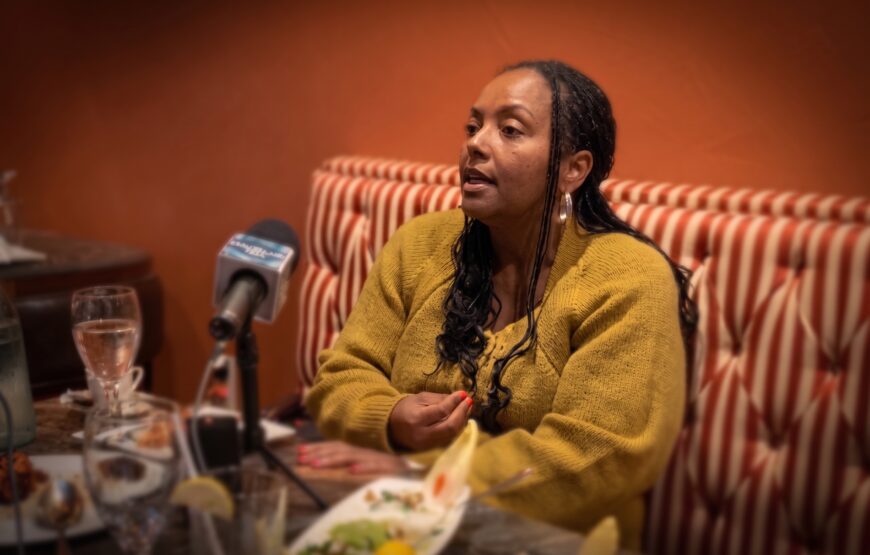
“I went to my first Board of Ed meeting against my will, actually.”
Wyatt Foster was a freshman then, there because his robotics team needed bodies in the room to argue for official team status. Three years later, he is stepping down as Montclair’s Board of Education student representative, the seat his peers elected him to fill, just as the district works through the fallout of a $19.6 million deficit that reshaped how the town thinks about its schools.
He didn’t stay because he had to.
What It’s Like Being Montclair’s Board of Education Student Representative
“Thing were definitely quieter then”, he said. That changed in May 2023, during what he calls the second big budget hurrah, a hearing that ran past midnight while the district argued over numbers that would later balloon into the current crisis.
“The meeting closed at 2:13 a.m.,” Foster said. “I left at 10:30 (…) but that was the point where I was like, this is something kind of cool that I want to spend some time on.”
He kept coming back. Eventually, his peers had elected him to the role, which includes a monthly report to the board from a student’s perspective.
“What a year to join the Board of Ed in Montclair,” Farnoosh told him.
“It’s definitely been pretty crazy,” Foster said.
Three years and one budget crisis later, Foster has strong opinions about who put the district here.
Who Foster Thinks Is Actually to Blame
He doesn’t point at the superintendent’s office.
“I think it’s a state issue, really, mostly,” Foster said. “Even though bad things did happen, those bad things are gone now, and we’re still having all these problems. I really see it as a state problem. We see a different district in the news every week. It’s the funding formula, and really the two percent cap.”
The two percent cap is the state law limiting how much a district can raise property taxes without voter approval. New Jersey allows an exception when health insurance costs rise faster than that ceiling, a mechanism the Pod has since covered in detail.
He’s careful to separate the failure from the people currently fixing it. “None of that is or should be associated with Dr. Ponds or Miss Hunt,” he said, referring to Dr. Jonathan Ponds, the district’s superintendent until his sudden death in July 2024, and Christina Hunt, the business administrator who resigned in June 2025 amid unanswered questions about the district’s debts. Both were gone before the $19.6 million deficit went public.
Mike asked Foster the question a lot of residents have quietly been asking: if the district already had a way around the cap, did voters really need to be asked to approve Question 2 at all?
“Healthcare is one of the things that is rising the most quickly, at some rate that’s multiple times the number of inflation, which is crazy,” Foster said. “There’s a limit to what just that waiver can cover, because it’s intended for a specific thing. Other things going up at really high rates, like utilities, aren’t covered by that waiver. So I do think the second question was definitely necessary.”
But voters ultimately disagreed. They rejected Question 2’s permanent $5 million increase and passed Question 1’s one-time $12.6 million debt levy. Foster had already done the math on what that would mean. “With Question 2, you buy maybe two years. It’s not a long-term fix or even a medium-term fix. It’s a very short-term thing.”
Mike had already put the same question to Superintendent Turner, in the third installment of Supper with the Super. Her answer: had Question 2 passed, the district would not have needed to exercise the waiver at all.
For all of that, Foster’s criticism never lands on a person. “I think everyone up there is really amazing,” he said, referring to the members of the Board of Education. “I’ve gotten to know a lot of them, and people who were their predecessors, over the last three years, and I’m very confident in pretty much everyone up there. They come from different backgrounds. They’re all really great at what they do.”
What Changed This Year, and What Worries Him
The interview itself happened on a night like the ones Foster kept describing. Down the hall, the board was still in session. “This meeting is going to go past midnight tonight,” Mike said, the same kind of marathon session Foster had already lived through more than once. “They’re in there right now, having a discussion of sorts about how they can be more effective and efficient, publicly, in a way that is painful to watch,” he added. But the length of the public meeting is only part of the problem. Every meeting is called for 6:30 p.m., and the board immediately goes into executive session, a closed-door meeting that often involves lawyers and is supposed to last about an hour. The night they attended, it ran two hours and 15 minutes. By the time board members walked back into the room and the public meeting began, it was pushing 9:30, with a packed room full of residents who had been waiting the whole time.
What the board was hashing out that night, Foster explained, is a separate structural question that started at the beginning of this school year and still hasn’t been settled. For years, the board handled policy details and administrative reports through small committees, three board members plus relevant staff, kept deliberately under three so the group wouldn’t trigger the quorum rules that turn a meeting into a public one. Those committees would report their findings back during the regular public session. This year, the board moved more of that work into open session directly. Some of what committees used to handle just doesn’t get done at all anymore, Foster said.
The board hadn’t fully made up its mind about the change, and neither had he. “I’ve come around to committee of the whole,” Foster said, “but I still don’t know a hundred percent how I feel. They seem to be kind of grappling with that as well.” Whatever they decided, it was happening that same night, in the meeting still running down the hall.
What worries him more is turnover. Several outgoing board members were seated when the deficit took shape. Foster sees their exit as a real loss of institutional memory, the firsthand knowledge of how the district got here that doesn’t easily transfer to whoever comes next. “If you heard the audit report a few weeks ago, the guy was saying there’s nothing you really could have done unless you’re a business administrator. And even then, this is your full-time job. If you’re not spending days pouring over this stuff, you wouldn’t have known.”
He’s also wary of Governor Sherrill’s push to consolidate small districts into larger ones. “Montclair is a really unique town, different even two miles that way,” he said. Montclair runs about 6,000 students, the only scale Foster has ever known, and he’s not sure what a merged district would actually feel like from the inside. “It scares me a little bit,” he said, “but also I could see, you know, I’ve only ever known 6,000 kids, and so maybe that is something that makes more sense and would save on state funding.”
As for what comes after the board, Foster has that figured out.
Headed to Brown, With Advice for Whoever’s Next
Foster is headed to Brown University in the fall. He didn’t apply early and didn’t have one clear top choice, just a short list he was happy with. He applied as an engineering major, though three years of late nights at Board of Ed meetings nudged him toward an interest in political science he didn’t expect to find.
Asked if Montclair schools prepared him for what’s next, Foster said they did, but didn’t credit the classroom alone.
“There’s a lot of really great opportunities, not even just in the school system but in town,” Foster said. “Take advantage of it. Try many things.”
Then he added one more thing.
“And come to Board of Ed meetings. That’s a great one too.”
Montclair’s Board of Education holds public meetings open to any resident.