A year into a fiscal crisis that forced layoffs, club cuts and tax increases, Christopher Graber, Director of the Department of Technology, presented the Board of Education with an area where the district has made real progress — and in several cases, saved money doing it.
At the June 17 Board of Education meeting, the district’s Technology Department outlined a sweeping set of infrastructure and classroom changes already underway or rolling out this fall. The upgrades span physical security, internet capacity, student device policies and artificial intelligence governance. Superintendent Ruth B. Turner summarized the scope in a community letter after the meeting. “These efforts have included enhancements to our physical security systems, cybersecurity protections, network infrastructure, and data management systems,” she wrote.
The Network Upgrade That Cost Taxpayers Nothing And Changes In The Building
The most noteworthy item in the presentation is an internet upgrade that didn’t add a dollar to the monthly bill. The district boosted its network capacity from 3 gigabytes per second to 10 gigabytes per second, tripling speed at the same monthly cost.
Alongside that, 40 new network switches were installed across all schools. Switches are the hardware that connect every device on a school’s network; aging switches slow performance and create security vulnerabilities. These were funded entirely through E-Rate, the federal program that provides schools with discounted internet access and networking equipment based on student eligibility for free and reduced-price lunch. The higher the district’s need level, the higher the discount. That single E-Rate project generated $247,940 in savings for a district working to close a nearly $20 million deficit.
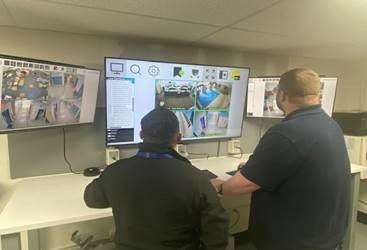
The physical security picture is expanding alongside the network. The district has now deployed 430 security cameras across 12 schools and installed 81 card-access controlled doors district-wide. Glenfield Middle School leads with 94 cameras; Buzz Aldrin Middle School has 63. The high school’s camera project was completed in 2022 and is not included in those figures.
One Domain, One Identity: District Shifts From Google to Microsoft
The technology department’s plans go beyond switches and cameras. The district is migrating its digital ecosystem from Google to Microsoft, consolidating two legacy email domains, montclair.k12.nj.us and mpsdnj.us, into one: montclairps.org.
Email is moving from Gmail to Outlook. The district’s IT team is automating what it calls a “zero data loss” transfer of existing Gmail history into staff Outlook inboxes, and mail sent to either old domain will keep forwarding to montclairps.org for two to three years after the switch. File storage is shifting from Google Drive to SharePoint Online and OneDrive, and Google Sites and Meet are being replaced by Microsoft Teams.
The district is also rolling out single sign-on through Microsoft Entra ID, giving staff and students one login across district applications, along with adaptive multifactor authentication designed to flag unusual account activity.
The migration follows a six-phase rollout that began June 17, the same day Graber presented the update to the board. A pilot group of low-risk accounts, including current 12th-grade students, started migrating June 18. Email and Drive data transfers are slated to finish by July 1, the new domain goes live July 9, and the district has set a tentative completion date of August 15. Staff training, through workshops and video tutorials, is ongoing.
What’s Changing for Students in the Classroom This Fall
The network and security changes are largely behind the scenes. What’s happening in classrooms is not.
Starting this fall, Chromebooks in kindergarten through fifth grade will move to a cart-based system, meaning devices will be shared among students rather than assigned individually. This marks a shift from the district’s previous model, in which Chromebooks were assigned to students and followed them across multiple grade years. YouTube will be blocked for students in kindergarten through eighth grade, though teachers will retain access. Predictive text has already been removed from Google for all students district-wide.
A parent portal is also in development, expected to launch with tutorials this summer, that will give families additional visibility into their children’s digital activity on district devices.
How Montclair Students Are Helping Write the District’s AI Rules
The most forward-looking piece of the presentation concerns artificial intelligence. The district is developing new AI adoption guidelines and has partnered with New York University through a targeted research investment on an initiative called “Ctrl+Alt+Design: Youth-Led Approaches to Generative AI.” Rather than handing students a finished policy, the district and NYU are positioning students as co-designers of the guidance itself, grounded in what the partnership describes as children’s digital rights.
Presented alongside the AI work: a data dashboard built by a student intern that pulls together attendance, enrollment, demographics and district operations into a single view, giving administrators a real-time picture of how the district is functioning. It is now operational.
Turner framed the broader direction plainly. “We remain committed to ensuring that technology serves learning rather than drives it,” she wrote.
The Cell Phone Policy Is Still Coming
The district offered no update on the cell phone policy at the June 17 meeting, despite expectations going into the meeting from Farnoosh and Mike that an announcement was coming.
The stakes are real. In January, Gov. Phil Murphy signed a bell-to-bell cell phone ban into law, requiring all New Jersey public school districts to adopt restricting policies for the 2026-27 school year — meaning this coming September. The law prohibits non-academic use of internet-connected devices during school hours.
Superintendent Turner supports the policy outright. “As an educator and as a parent, I gotta be honest, I do like that,” she told the Pod in the latest episode of Supper with the Super. “I am in big support of no cell phones, so that students can be present and deeply focused in the educational process.”
What worries her is implementation. Collecting and storing phones requires physical infrastructure, lockers, cubbies, dedicated systems, and the state has not indicated it will cover any of it. Turner has called these arrangements unfunded mandates and says the district has already raised the issue directly with the state Department of Education. The state did award $980,000 in Phone-Free Schools grants to 86 districts to help cover training and storage equipment, but Montclair was not among the recipients.
Montclair High School’s open campus adds another layer the district will have to work out once the state issues further guidance.
What Montclair’s policy will look like, and how the district plans to fund it, remains an open question. When that answer comes, the Pod will have it. If you have questions on the district’s planning, send it to hello@montclairpod.com.
Image credit: Montclair Public Schools