The Montclair property tax increase for 2026 did not arrive as one number. It arrived as three separate increases — municipal, school, and a one-time school referendum payment — each with its own cause and its own math, totaling roughly $1,566 in new taxes before a small county decrease brings the net increase on the average bill to about $1,540.
Township manager Stephen D. Marks laid out the full picture in a letter mailed to residents this month. Montclair already carries the 13th highest residential property tax burden among New Jersey’s 564 municipalities, with an average 2025 bill of $22,487. This year does not ease that math. It adds to it.
Why Is Montclair’s Property Tax Increase Hitting So Hard in 2026?
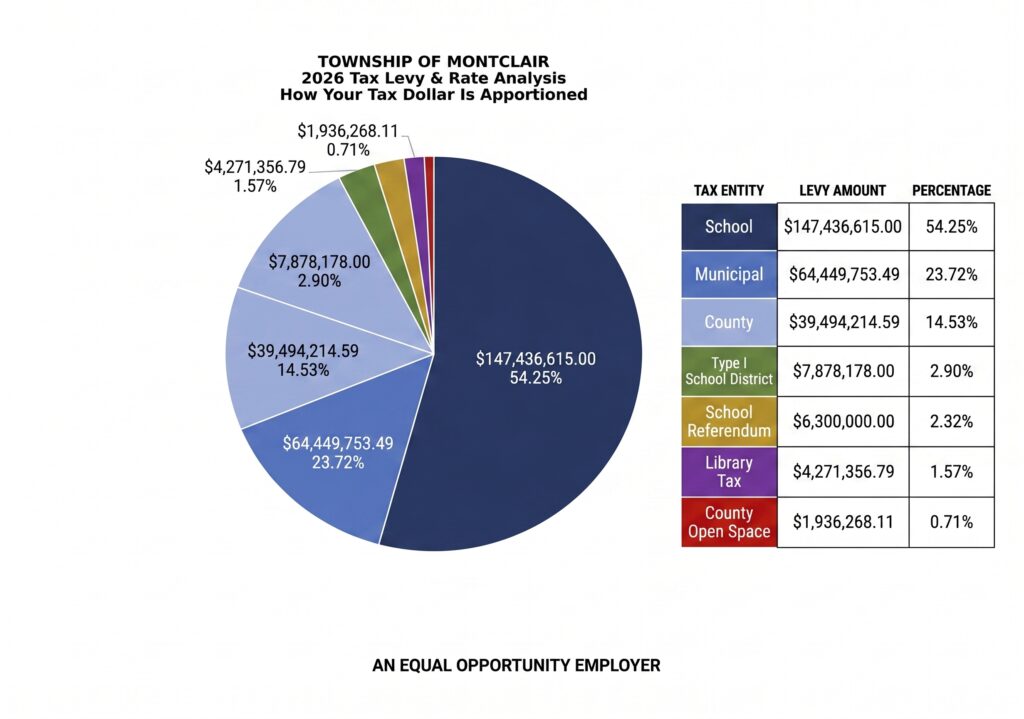
Three separate levies rose at once, on the same bill, in the same year. The 2026 total levy comes to $271,766,385.98, up 7.18% from $253,558,770.67 in 2025. That pushes the combined tax rate from $3.516 to $3.766 per $100 of assessed value, the dollar figure the town assigns your property for tax purposes. The jump is not the result of a townwide reassessment, the average assessed home value only rose $2,100, or 0.33%. It’s coming from higher tax rates and levies instead.
Marks did not soften the framing in his letter to residents. “I don’t think it would shock many people that Montclair has the 13th highest residential property tax burden among 564 municipalities in the State of New Jersey,” he wrote. “In fact, the average residential property tax bill in Montclair in 2025 was $22,487. Unfortunately, fiscal realities this year do not make matters any better.”
Of the three increases on this year’s bill, the school portion moved first and moved furthest.
How Much More Will You Pay in Montclair School Taxes?
School taxes make up 54.25% of the total levy, the largest single piece of the bill by a wide margin, and that piece grew the most in raw dollars this year. Part of that growth comes down to rising health insurance costs, the same pressure behind the municipal increase. A spike in employee health benefit costs qualified the district for a state healthcare waiver, which let the Board of Education exceed New Jersey’s usual 2% cap on school tax increases, another mark on a district still working through the $19.6 million deficit and the forensic audit that followed it. The board adopted its 2026 budget on May 6, raising the school tax levy from $137,850,631 to $147,436,615, a jump of 6.95%, which works out to $847.04 more a year for the average home assessed at $641,700.
Layered on top of that is Question No. 1, the one-time debt levy Montclair voters approved on March 10 to cover $12.6 million in accumulated school debt. Normally, a levy like that would hit in two quarters and knock homeowners flat. Instead, town and school officials worked out a plan to spread it across two years. Residents will pay about $558.27 toward the referendum this year, split between the August and November bills, with the other half deferred to 2027.
What’s Driving Montclair’s Municipal Tax Increase?
New Jersey required Montclair’s public employee health plan to raise premiums 36.5% for 2026, a statewide spike that hit towns across New Jersey, not just Montclair. Even after the township left the state health plan for what Marks called a “more cost-effective private insurance option”, employee health benefits still cost the town $2,549,994.20 more than the year before. That single line item was the biggest driver behind a $7,726,859.11 structural deficit.
The Mayor and Council adopted the municipal budget on May 5 and closed most of that gap with cuts. Nearly every department absorbed a 5% reduction, including police and fire. Salaries and wages dropped by $1,231,221.89, and operating expenses fell by $2,426,965.94. Even with those cuts, the municipal tax levy still had to rise $1,858,838.14, a 2.97% increase that adds $160.42 to the average bill. The county portion of the levy actually dropped $25.67 this year, a rare bit of relief buried in an otherwise rough bill.
How to Apply for NJ Property Tax Relief Before November
New Jersey runs three property tax relief programs that many Montclair households qualify for:
- Senior Freeze reimburses eligible seniors and disabled residents for the increase in their property taxes, not the full bill.
- ANCHOR covers both homeowners and renters based on income.
- Stay NJ is the state’s newer senior tax credit program.
All three now run through a single combined application, the PAS-1, filed at propertytaxrelief.nj.gov. The deadline for the current filing cycle is November 2, 2026.
The August Q3 tax bill is delayed this year too, and that changes when your payment clock starts. Because the state certified local budgets late, state law gives residents a 25-calendar-day grace period from the actual mailing date before interest kicks in, but that interest applies retroactively back to August 1 once the grace period ends. Marks put it plainly in his letter: “Please pay close attention to the date that interest will begin to accrue, which is listed on your tax bill.” The state sets that date, and it is not negotiable, no matter when the bill actually lands in your mailbox.
To Sum It Up
- The average Montclair home, assessed at $641,700, owes roughly $1,540 more in property taxes this year
- Municipal tax is up $160.42, driven mostly by a statewide spike in employee health insurance costs
- School tax is up $847.04, partly because a similar health insurance cost spike triggered a state waiver letting the district exceed its usual 2% cap
- The one-time school referendum (Question No. 1) adds $558.27 this year, with another $558.27 due in 2027
- County tax actually dropped $25.67, the one line moving in the other direction
- Q3 tax bills are delayed this year, so check the mailing date on your bill closely, interest accrues retroactively to August 1 once the 25-day grace period ends
- Seniors and lower-income households may qualify for Senior Freeze, ANCHOR or Stay NJ relief through the combined PAS-1 application at propertytaxrelief.nj.gov, due November 2, 2026
Image credit: Township of Montclair