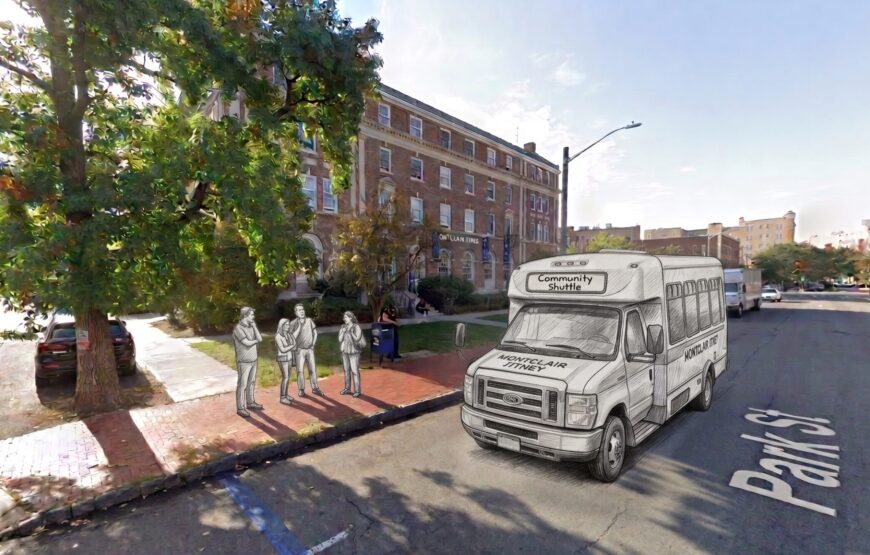
Montclair hasn’t had a jitney in years. As we noted in our guide to commuting from Montclair, the town once ran one connecting neighborhoods to Bay Street Station, but it was discontinued long ago. Anyone who has tried to reach Bay Street on a Saturday, or find parking on Bloomfield Avenue on a Friday night, knows the gap it left.
A township committee has spent much of the past two years studying whether to bring a shuttle back. On Sept. 24, it released an interim report laying out what it has learned. Here are 11 big takeaways.
1. About 9 in 10 respondents say they’d ride it
The committee’s 2025 survey drew 2,028 responses (you can view the entire survey report at the end of this article). “Roughly nine in ten respondents indicated they’d use a local shuttle service if available,” the report says. Respondents came from every corner of town, and the committee says responses “were reported from all demographic groupings, income levels, and ages.”
From our coverage: When we first reported on the shuttle survey in March, in our guide to navigating Montclair by bike, on foot and by transit, an analysis of the responses showed nearly 9 in 10 respondents were likely to use a Montclair jitney, and nearly every current NJ Transit bus rider said they’d use a local shuttle too.
2. Car owners want it too
This isn’t only about residents without a car. According to the report, “Residents both with (96%) and without (98%) access to a car indicated that they would use the service.” Many written comments say the same thing: people would happily leave the car at home if they didn’t have to hunt for parking downtown.
3. Where people want to go
Respondents most often named Montclair Center, Upper Montclair, the South End, Bay Street, Grove Street, Bloomfield Avenue, Walnut Street, grocery stores and Montclair State University. They also asked for service in residential neighborhoods, especially parts of town far from any bus or train.
4. Why they want it
The list of frustrations will sound familiar:
- the cost of Uber, Lyft and taxis
- parking scarcity
- infrequent weekend train service to New York
- the loss of commuter bus service after DeCamp
- how hard it is to reach grocery stores, pharmacies, banks and doctors without a car
Weekends came up again and again. “We are living in a million dollar travel desert,” one resident wrote.
From our coverage: The weekend problem goes beyond the shuttle. In a separate survey of more than 2,300 respondents, over 80% said they want more weekend trains. Nick Giglia of ROUTE (Restore Our Transit in Essex) broke down the results on our segment about a recent NJ Transit survey. Giglia told us, without a good weekend option, residents end up improvising: driving to Secaucus Junction, taking the light rail in Bloomfield, riding PATH from Newark, or just driving into the city.
5. Seniors, teens and food-desert residents may need it most
The written comments are the most revealing part of the report. Parents described high schoolers who live too close to qualify for busing but too far to walk. Seniors described depending on family for rides. Residents of the South End and 4th Ward described the cost of reaching a supermarket from what the state designates a food desert.
One power wheelchair user said the township’s previous shuttle refused to carry their chair. “Please, please please if this shuttle becomes a reality, kindly make sure it can accommodate power chair users who cannot transfer into a seat,” they wrote.
Not everyone is sold. “Good idea, but don’t add to municipal tax burden,” one respondent wrote. Another offered a warning: “Jitney was seriously underused last time.”
6. Will it be free? That hasn’t been decided
Most respondents are willing to chip in: 87% said they’d pay a nominal $1–2 fare. The committee lays out three options without picking one:
- Fare-free: “would serve the greatest number of passengers, and eliminate collection costs.”
- A nominal $1–2 fare: “could reinforce users’ valuation and respect for the shuttle service.”
- A “suggested” fare: “would eliminate enforcement costs, and signal trust in users.”
Nearby towns vary widely. West Orange’s train shuttle is free, South Orange charges $2, Maplewood $3 and Glen Ridge $4. As we noted when we compared Montclair with other NYC suburbs, both Maplewood and South Orange run community jitneys for residents who live farther from the train. Montclair is the outlier.
7. Five possible routes are on the table
The committee sketched five sample scenarios, each with an online map:
- Grocery runs from food-desert neighborhoods and senior housing to stores like Acme and ShopRite.
- A weekend Bay Street connection. “On weekends, trains from Bay Street run every 2 hours, and other stations in Montclair have no train service,” the report notes.
- A weekday commuter jitney to the train stations along Orange Road, Harrison Avenue, Elm Street and Grove Street, “to fill the gaps left by DeCamp Bus Lines.”
- A dining and nightlife shuttle linking business districts, neighborhoods and MSU.
- An all-town loop reaching “all corners of town lacking bus and train service.”
These are “pilot planning scenarios, not final route recommendations,” the committee stresses. It expects to combine several.
From our coverage: DeCamp ended its New York commuter routes in April 2023 and later shut down entirely. Boxcar, the private door-to-door service that filled the void, now carries an estimated 75% of weekday peak commuters between Montclair and New York, according to the township’s transit survey. But as we reported in our commuter guide, it doesn’t offer student or senior discounts and runs mainly at peak hours. That leaves exactly the kinds of gaps a local shuttle could fill.
8. The main roads may be off-limits
This is the catch. “Importantly, many grants do not fund bus services that are duplicative of existing transit,” the report says. “This means that Montclair’s shuttle bus routes may have to avoid key roads that already have NJ Transit bus service, such as Bloomfield Ave, Valley Rd, Elm St, and Orange Rd.” Those are some of the same corridors residents asked for most.
9. It could cost hundreds of thousands of dollars a year
The committee uses a preliminary operating cost of $60 to $90 per vehicle-hour. It recommends at least two buses running at once, which works out to roughly 30-minute service. As the report puts it, “We believe that hourly service intervals would feel unusable.”
The report doesn’t add up a total. By The Montclair Pod’s tally of its sample schedule, the operating cost comes to about $650,000 to $970,000 a year before fares and grants. That schedule covers:
- weekday grocery runs
- weekday rush-hour commuter service
- weekend daytime and evening service
- Thursday and Friday nightlife runs
The committee is clear that fares won’t cover the bill. “The financial plan should begin with the assumption that each concept requires an ongoing local contribution,” it writes. It estimates the annual cost to the township “will likely be in the six figures.”
10. Grants, businesses and neighbors could help pay
The report identifies federal and state grants for buying buses and running service, including programs for electric vehicles. Many require a local match and last only a few years. The committee also names possible partners:
- the Montclair Center BID and local businesses
- Montclair State University
- NJ Transit
- Essex County
- neighboring towns that might share service
Peer towns show the stakes. West Orange spent $343,000 on its shuttle in 2023. Glen Ridge describes its service in the report’s comparison as “low ridership, high costs” and is studying alternatives.
11. If it happens, it would start in 2027 as a pilot
The committee is explicit that this is “not a proposal.” Its timeline calls for defining routes, funding and approvals in 2026, launching in 2027, and measuring performance in 2028. The service would be made permanent only if it meets “certain benchmarks of ridership and cost/benefit.”
The committee is asking residents which routes matter most, whether the service should be free, and whether they’d volunteer. Send thoughts to info@montclairnjusa.org. We’ll be following up with the committee, so send your questions to us too.
Editor’s Note: Things change. If you see anything here that needs updating or correcting, email us at hello@montclairpod.com.
Image Credit: Michael Schreiber / Google Street View / Gemini