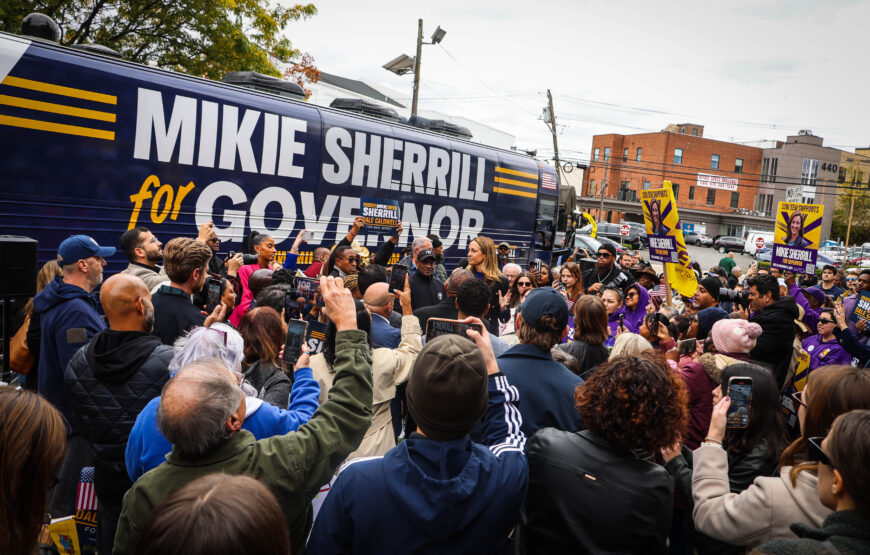
Below is the transcript of The Montclair Pod’s recent interview with Mikie Sherrill, who was elected Governor of New Jersey and will soon be the former Congressperson for NJ-11. This interview took place on Monday, November 17, which was before the recent developments relating to the Montclair school district’s financial situation became public knowledge (specifically, according to Superintendent Ruth B. Turner, should Question 2 on the upcoming referendum fail to pass, the state has agreed to supply the district with funds to cover the $7M+ budget gap currently facing the district for the current fiscal year, thereby forestalling immediate staff and program cuts). The discussion offers insight into her perspective on the local school deficit, her policy vision for the state, and her thoughts on the national political landscape.
Editor’s Note: The Governor-Elect mentioned that the district’s approximately $20 million in debt occurred over one year, and while the debt was disclosed just this year, it did not accrue in a single year. Also, there was some conflation between the roles of a state monitor and a forensic auditor. We’re sorry for not interrupting during the interview to clarify.
Michael Schreiber: All right. Governor elect Mikie Sherrill. Welcome to the Montclair pod. Thank you so much for joining us.
Mikie Sherrill: Thanks so much for having me, I appreciate it.
Michael Schreiber: You got it. Well, you’ve been a Montclair resident since 2010, we understand. You began your political career here and now you’re headed to Trenton. And we’re all wondering, when is your last day in Montclair and what do you think you’re gonna miss most about our lovely town here?
Mikie Sherrill: Well, think rumors of my departure have been greatly exaggerated. So I have kids in school here. So I don’t think I will be leaving anytime soon. I’ll be commuting, at least for the foreseeable future. then maybe figuring out the summers and stuff like that. But right now with my kids, I will be, I’ll still be in Montclair for a minute.
Michael Schreiber: Gotcha. So you’re not moving the whole family into that giant governor’s mansion. What is the mansion called again?
Mikie Sherrill: Drumthwacket. Yes, it sounds very, No, I keep saying to my friends, darling, you must visit me in Drumthwacket.
Farnoosh Torabi: It doesn’t roll off the tongue. It really, I gotta say. Will you promise us a tour though?
Mikie Sherrill: Yes, yes. Well, I will promise you a tour and I will just put out too that the mansion’s open to the public and the current First Lady has done a beautiful job of updating it and it has a lot of really impressive history. So I encourage everyone to take a tour of the property, especially as we’re coming up on our nation’s 250th. There’s so much history right here in New Jersey that I’m hoping people will be made more and more aware of as we go through the next year.
Michael Schreiber: Fantastic. Well, we’re definitely going to take you up on that. We hope others will too. All right. We’re going to just dive right in to the biggest issue in town. The one everyone is talking about, as you might have heard, our school district is facing some serious financial crises, or I guess one big crisis. And we’d love to know your perspective on all of this as a legislator, as a statewide leader, and now as governor, and obviously as a parent too.
Mikie Sherrill: Yeah, well, as I mentioned, I have kids in school. child in the high school right now who you know, loves playing sports there and we’re facing the threat that those sports are going to be canceled. He plays on the football team and we’ve heard the football team might not be able to stay intact. And right now we’re, you know, it’s not just football, it’s the arts, it’s music, it’s all the things we want our kids to do because we’re facing this mental health crisis. And now because of this poor, poor management, we’re seeing threats to those things. And it’s not as if this is a really inexpensive place to live. We are paying some of the highest property taxes, not just in New Jersey, but in the nation. And so to somehow get to this point where we’re what, 20 million in the hole? It just to me, I’m furious about it. And I’m sure most people are. And then there’s this idea that somehow we’re just gonna all agree to pay more money into the system without any accounting, without an independent audit of what happened? I’m sort of sitting here and like many people, I’ve been really busy this past year. I’ve got four kids, I was running this campaign. So you’re doing all these things and now you’re just kind of being presented like, okay, well either your kid’s gonna have no extracurricular activities and we’re gonna fire half the teachers or you’re gonna pay all this money. : On top of all the money you’re already paying, I mean, I’m talking to parents who are saying, look, I don’t know if I can keep my home. If this is, you know, I’m already paying these incredible property taxes, which have gone up this amount of money, and now they want more, I don’t know how much longer I can afford to stay here. So I’m furious about it. I think the first thing that needs to happen is an independent audit of just what went on here. And then, some support. I know the state offers support for budgeting and managing school districts, but then I also think we have to take a look at just how we’re running our schools because it also seems as if we have a lot of money going to all these administrative systems across the state and they’re not going to students, they’re not going to educators, they’re not going to the bricks and mortar of our school buildings. You know, we have these very expensive offices that house the administrators, many of them, you know, that really take tons of money to keep up. We’re running all these administrations. In some school districts, they don’t even have students. They send their students to another school district, but pay for the whole administrative system. So just to give you a sense of what this looks like, we have more municipalities than California, and we have more school districts than municipalities. That is the kind of money that’s going into this administrative system. I think we really need to address that and as governor, that is something that I really want to take a look at and how this is happening because a lot of these school districts were put in place, you know, decades ago and now we’re coming to the point where they don’t even have children anymore. So I think we really have to, people of this state deserve a better understanding because we like to say we run the nation’s best public school system, but really it’s still by zip code. And the amount of money we pay into the school system, and the fact that not every kid’s getting access to a great education is, to me, kind of a mismanagement of the system.
Farnoosh Torabi: Yeah, this issue of also the fiscal monitor. So understandably, a lot of residents would be very upset to have their taxes go up. So the alternative is to take out the advance of state aid. And that would come with a state monitor. And Montclair would not be alone in that. Obviously, our neighbor Nutley is going through that. Jersey City has done that. Other towns and cities in New Jersey, can you give us some insight into how that relationship would play out? A lot of people are nervous about someone from the outside coming in, town losing local control. Give us the honest take, the truth.
Mikie Sherrill: Well, to be frank, this is something I’d have to look in more as exactly how that operates. But I want a fiscal monitor. We just somehow got into $20 million of debt in one year. Why would we not want a fiscal monitor? I mean, there is no business that you would run. I mean, If my congressional office somehow overspent $20 million, can you imagine? My god. Why wouldn’t we want a fiscal monitor? Somebody’s got to look at these books. I’m not saying that, you know, there’s corruption, but there’s certainly incompetence. Like, How do you get $20 million in debt this quickly? And then why would we not want a professional to look at this and say, okay, here’s where you went wrong. Or either Here’s some wrongdoing that’s a problem, or here’s where you guys didn’t understand what was going on, and here’s how you can handle it how we can get you back on track. Without canceling every extracurricular activity and firing hundreds of teachers. I don’t understand why. Now, again, I’m happy to look into this more, and I will. But at the outset, why anyone would not welcome oversight into this, I don’t quite understand.
Farnoosh Torabi: Yeah, I mean, they’re throwing around expressions like threatening our magnet system. Yeah.
Michael Schreiber: Yeah. That’s what, you know, and you mentioned…
Mikie Sherrill: I’m a big proponent of the magnet system. I really think it has led to desegregation of our schools in an important way. think it keeps the town kind of, you know, I like how the kids all seem to know everybody, not just by their own little neighborhood. They seem to know everybody across the town and they all kind of mix and mingle. I like that. But nevertheless, I don’t think people should be afraid of, the only way you should be afraid of accountability is if you’re really mismanaging.
Farnoosh Torabi: Mm-hmm, mm-hmm, mm-hmm.
Mikie Sherrill: So I think maybe we know why people are afraid. I mean, look, if you’re 20 million in the hole, just can’t stop saying that number because it blows my mind. How did we get to this point? And if we’re at this point, it seems like why would we not welcome some help here with professionals to help us figure out a good pathway forward. Instead of just saying, people of Montclair, just give us more money. You know, it really feels as if we’re saying, OK, you know, you’re running a business and you tell investors, know, give me money, and you start up your business, and then you like completely mismanage the books. And you’re like, OK, just give me more money. That’s sort of how I’m feeling right now. Now, again, I I know there’s a lot of people that have been presented with this that are new and did not realize it and are trying to deal with this. And I think that’s fair. I just think there has to be an accounting so we all understand, OK, this is why this isn’t happening again. here’s why we’re putting this out. here’s what we’re going to do to ensure better fiscal responsibility. Here’s how long it’s going to take us to get out of this.
Farnoosh Torabi: Right.
Mikie Sherrill: So to the extent that will be presented, I think that’s hopeful. But again, I do worry that we haven’t seen or been willing to even have anyone inspect some of how we got here.
Farnoosh Torabi: Mm-hmm. Mm-hmm.
Michael Schreiber: And that’s, yeah, I’m sure we’re hardly alone in that. That happens all over the state. And during your campaign, you mentioned school consolidation specifically. Can you talk a little bit about your vision for that? What that might look like? What that might look like here and beyond?
Mikie Sherrill: So I think we have to look, as governor, I’m going to convene the organization so we can see. There are school systems that are running K through 12, like Montclair is running K through 12. And then there are many systems that maybe run just K through eight or smaller. And they have the full school board and administration, even though they’re going into maybe a magnet high school. So is there a way to move the administration? So you’re still going to have your elementary school down the street. It’s just the administration, you’re going to pay taxes and you’re going to see an administration that covers your high school down through. So K through 12. Now in Montclair, that would largely not, we run a pretty big school system, but I do still think that given where all this is and you’re right, this isn’t the only school system that’s struggling financially. I do think at either a county level or a state level, there needs to be some more professional support for this to manage some of how this money is spent. Because remember, your municipal government is responsible for the municipal budget. The school budget is separate and often accounts for about 70 % of your property taxes. And so and it’s separate in state government who looks over these books. The DCA looks over the municipal budget, but not the school portion of the budget. That’s education. And there seems to just be on school budgeting a real need for more professional support and expertise. And I think the state and the county could offer that to these municipalities as we look at how these school systems are running and who the administrator is. And I do think K through 12 is a good place to start looking at, we just get everyone in a K through 12? And in that way, that would really, I think, cut down on property taxes and then provide some county services for professional auditing, professional running. you’re running, if your school system and you’re a superintendent and you’re looking at the books and you’re saying, oh my God, I don’t know how to do this, get some more professional support in. Because you’re right, this seems to be now a somewhat routine problem that we’re seeing across the state. So I think there needs to be more expertise and support.
Farnoosh Torabi: Mm-hmm. Yeah. Well, we want to shift gears down to the cost of living. We talked about taxes already, but to drill a little bit further into that issue, New Jersey and of course, Montclair, we’ve got some of the highest property taxes in the nation. So how do you communicate to residents what they’re getting for these taxes compared to people in lower tax states who say, you know what, we have a great quality of life in our state. We don’t pay as much in taxes. What’s the message?
Mikie Sherrill: Well, I think that, I think this is why I’m so frustrated slash furious about what’s going on in our town is the deal is you pay these taxes so that you get a great education for your kids, so that you have a well-run government, so that you know that children who don’t have enough food at home are getting fed. So you know that you have a great sewer system and your water is clean and drinkable. And every time we see that breaking down, people start to question what is going on here. How is it that I’m paying this money and that is not the case? And so that’s why I’m so focused on how to deliver good, efficient government. And it’s become even more important right now because we see all the federal tax. I would say the, you know, the Fed, the economy, the US economy is, I don’t want to say imploding, I’m not trying to set off some huge scare, but it is, it is every single day Trump is in office, there is some attack on the way we run our economy. so 22 states are in recession already, just since Trump took office. This tariff program is raising costs on everything and he’s enriching himself to the tune of billions of dollars. So, you you really need the state to run well to continue to deliver opportunity for people and then as we work in a regional way. This might be a little too in the weeds, but photonics is this huge innovation that is really a key for some of the ways in which we’re going to move forward. The federal government’s not investing in innovation in the way they were just a year ago. We know China, for example, is putting tons of money in innovation. So we’re working regionally with Pennsylvania and Delaware on public-private partnerships so we can continue to deliver on innovation, the new jobs of the future, providing opportunity for people and being competitive even as the federal government’s withdrawing from this space. It’s why I ran for governor. Governors are so important. So it’s really, I think, incumbent upon governors, and my administration is certainly going to do this, to run a really good government so that you can say, OK, I am getting bang for my buck. OK, it’s great that there’s no taxes down in you name the state. But guess what? They’re not, know, nobody’s able to get a vaccine there anymore. You know, for MMR, for measles, mumps, and rubella. you know, this is a good deal here. And so that’s why I’m going to put the budget up so you can track it and say, here’s who holds the contract. Here’s what we’re contracted to do. Here’s what the state wants us to do. Here’s how well it’s working. And here’s the ones that aren’t working, that either need to be fixed or we need to cut that contract. And I think in too many cases here in New Jersey, and I bet it happens elsewhere,
Farnoosh Torabi: Mm-hmm.
Mikie Sherrill: We do this contract and nobody checks in. It’s a really good idea maybe. Maybe we put a contract in to help, you know, with, you know, sterilize the deer population or something. And we think, that’s great. And then suddenly we find out, it’s exploded. But nobody, we’re still just paying this money year after year after year after year. So we really have to have accountability. And that’s what I have run on. And that’s what I intend to do is make our government accountable because we don’t have money to play with. It’s too expensive to live here. Too many families are struggling. And when the state government doesn’t deliver on the services well, then middle-class families pay. And that’s what we’re seeing too much of right now. Middle-class families are just saying, look, I don’t know if I can afford to stay here. So I’m going to drive down costs.
Michael Schreiber: Yeah.
Farnoosh Torabi: Mm-hmm.
Michael Schreiber: Yeah, you know, one of the increasing costs for those middle class families is health care. Obviously, the Affordable Care Act, the subsidies have been stripped to be determined how that’s going to turn out in Congress. But it is increasingly falling on the states to fill the gap. Would New Jersey ever pursue like a Massachusetts style state health care system? Is that on the table? What is on the table?
Mikie Sherrill: So when I started this race, I kind of looked into how to do this, right? To provide better health care at more affordable prices and what the state could do. And largely, even in Massachusetts, it’s not working super well because so much of the funding comes from the federal government. It’s very hard as a state to operate in an independent health care system. So New Jersey sends $70 billion more to the federal government than we get back in our federal taxes. The way some of it comes back to us is through things like Medicare and Medicaid and Social Security, et cetera. And so that’s why this health care issue is so critical, because we’re not only seeing huge cuts to Medicare, we’re seeing now, as you mentioned, the Affordable Care Act, which will have people’s premiums going up by 175% in New Jersey. And so we’re going to see a lot of people who aren’t going to be able to pay that. So suddenly we’re seeing this crisis in how people are going to have access to health care. So I mean, certainly as a starting point, I’m going to be working to claw back as much money as possible and continue to hit the government on this so that they make some different choices. Because I disagreed with some of my colleagues in the Senate. I think we were winning the fight. I actually think you just saw Van Drew, for example, saying on, I think, Fox News that if they don’t do something about health care, they’re all going to lose. I would argue Van Drew could have voted to support health care, but nevertheless. So I do think there is some recognition in the Republican Party that they’re going to have to make some changes. And I’m happy to work with them to do that because we need more money back for health care. At the same time, I’ve gone to, for example, some of the hospital systems to say, look, how are we going to start delivering health care now in a different way? And don’t come at me and say, you’re going to build an app so people can stay on the rolls of Medicare. That’s not going to solve our problems. So one hospital system said, really think that we can get K through 12 students ⁓ an annual checkup in vaccines, basic vaccines for free. They said, I don’t think that would be too hard. It’s not the end all, but at least would flag some of the major problems, right? If you have a kid who has asthma, or if you have a kid who has a heart problem, or if you have a kid who has you know, sight, vision problems, et cetera. You could start to at least do some basic stuff because otherwise we’re just going back to this free fall where unless and until things get really bad, that’s when people go to the emergency room. It’s the worst kind of year. It gets bad outcomes. It’s, you know, really expensive. So trying to think of these new ways in which we drive in healthcare. And it’s gonna, it’s gonna be, I think we’re going to see some seismic changes. And the bad news is, right now, I think a lot of people are really scared about how they’re going to get good health care, and we’re going to lose some of the work we’ve done in preventative care. But the good news is, we need to do better.
Farnoosh Torabi: Mm-hmm.
Mikie Sherrill: You know, we were kind of limping along. We were getting a little better every year, but we need to do a lot better by people. For the money we spend for health care and what people are getting, it’s never been commensurate with what people deserve. I mean, you see the statistics, you know, how we pay more and get worse outcomes than almost anywhere, you know, some other places in the world. So we can do better.
Farnoosh Torabi: It’s kind of a tragedy. I think we can say that. We have a couple more questions. We want to talk a little bit about your promise to freeze utility rates. And then we want to talk about your campaign, which was hopeful, I think, for a lot of Democrats. And we want to understand from your perspective what the lessons and the takeaways were, but one of your major campaign promises was to freeze those utility rates. Can you share some specifics because your critics are saying this is not going to happen, that you don’t have the authority to do this. So tell us what’s going to really happen.
Mikie Sherrill: So we’re already meeting now with utility companies because we’re negotiating with them about how much lower we can get rates. And then there’s money that comes in through the BPU, the Board of Public Utilities, that we’re going to use to defray some of the costs. So that’s how we’re going to freeze utility rates on day one. The second piece of it is a longer term plan to drive utility costs down. And that involves really building an energy arsenal, like more power in the system. The fastest way to get more power into our grid is with solar and battery storage. That’s not gonna get us the power we need, but it’s the fastest and cheapest way we can immediately get some more power into the grid. Some of that’s gonna involve cutting through red tape and permitting, getting solar on cap landfills and on rooftops. And there’s certain permitting and regulatory problems with doing that quickly, which has really been, and we’re an outlier. Other states have moved far more quickly on this and we’ve left some federal money on the table because we’ve been so slow to act on this. So that is how we’re going to move that quickly. A more medium term issue is updating and upgrading our natural gas infrastructure. Modernizing the natural gas system can both drive down carbon output and drive up power production. And then in the long term, you know, looking at how we’re going to get the nuclear power in place. That’s going to be about a 10-year plan, but we’ve got to start now. We have the fourth site in Salem for a full-scale nuclear power plant. And there’s different ways in which I think we can get some economies of scale. New York, for example, also wants to build nuclear. If we do it along with certain other states, we can drive down the cost and hopefully increase the speed of how we get that done. And then we have, and this still is, this still is a newer area of what people call SMRs, small modular reactors. Everyone acts like this is new technology. I served on naval ships for years where we’ve been using SMRs on ships since the 60s. So it doesn’t feel that modern to me. But nevertheless, these can also account for some of it. We’re going to work on some of the permitting for places that have historically had nuclear so that they’re comfortable with it and we can get the permitting and regulatory work done more quickly so we can get those SMRs in place once they’re up to speed. And then looking at longer term, unfortunately wind right now because of the federal permitting needed and because of the Trump administration feels like we can prepare for it with some of the transmission lines, et cetera, that we might need in the future. But right now it’s hard to envision with Trump in office that we’re going to be able to do large scale wind. But again, I think with our power needs we can continue to push for all of the above.
Michael Schreiber: All right, let’s switch gears to kind of national a little bit. Your race and others kind of other special elections around the country were kind of considered a bellwether, maybe for the midterms and a repudiation of President Trump. Do you see it that way? What message do you think this outcome for you, for Democrats more broadly, what do you think? What message do you think that’s sending nationally?
Mikie Sherrill: Yeah, I think this is a really important race to look at because I think what we saw from the polling that if we had just maybe run a generic Democrat, what, maybe a five to seven race or something like that. the campaign that we ran, was critical to the results we saw in making sure that we saw all of the communities in New Jersey. And we have a really diverse state. So to run a campaign like this, it was important to get in front of everyone. And what we did was both, I think, consolidate the Democratic Party in a powerful way. And I think of what we, when I say we consolidated the Democratic Party, I think of it almost as a traditional roots, which is why I’m a Democrat, working for working people. So what I look at what we did is we got out working class people across this state, whether it was in the cities or the suburbs or even our more rural areas, really talking about what it was going to take to build opportunity and success. And that appeals to you know, just those key democratic constituencies, whether it’s the black vote, the Latino vote, the non-college educated white working class vote. I mean, you’re talking about people who need government to run well. I always say, if you’re rich, government can run well or not so well, right? You can always, you know, make other choices. If they’re flooding out some development, you get your landscaper in and get some pipes in and voila. It’s working class people who need government to run well because you need your schools to be really good so your kids have opportunity. You need government to get business in here so you have good jobs. You need somebody fighting for you so that all of the money isn’t just going to the top, but you have good wages and that you have good workers’ rights. Like all of these things are, this is what Democrats are so good at. You you need to afford your healthcare. You need to be able to afford those basic things that are middle class, working people values. And then if we’re doing this right, as I’m so focused on, then you have pathways into the working class from some of your poorer neighborhoods or some of areas where you haven’t traditionally seen opportunity, you build that opportunity so that you can be in the working class. All of this is what I think, when I think of all of the ways I grew up and why I’m a Democrat and what opportunity means to me, this is all why and that was what we built across the state. And we build it not by telling people, we build it by listening to everyone. You know, we were doing like, end of my race, after running for a year and talking to people over and over and over, we did a 21 county bus tour just so we could make sure that we were not leaving anybody behind or that we weren’t listening to what it was going to take to make people successful. And what I heard over and over and over again was, hey, it’s too expensive. I can’t afford my cup of coffee or grocery store prices. I need opportunity. I want my kids to have a great education. I want to have a great job. I want to have a good retirement. I want to know that at some point after working, I’m going to not work three jobs and end up with nothing. I’m going to work a job and I’m going to get to the end and I’m going to have a retirement and everybody’s going to be secure. And that shouldn’t be too much to ask in one of the wealthiest states in the wealthiest nation in the world. So that’s what I’m fighting for.
Michael Schreiber: Yeah, I mean. I hear that and that’s what a lot of people, regardless of what side of the spectrum in the Democratic Party and frankly in the Republican Party too, that’s what they’re talking about is helping all of these people that typically get overlooked and New Jersey is facing all of those issues, whether it’s education or cost of living or getting a permit for your small business to open. These are all difficult things. And it’s been very hard for members of any party to get these things across the finish line to make sustainable change. Think healthcare is probably the biggest example in this country and the most kind of rip your hair out kind of pants on fire example. And I’m wondering, you know, what’s the bridge from like hearing these people and understanding what this need is, which we all believe, you you get to actually making the change and to kind of forcing through some systemic changes, whether it’s schools or healthcare or what…
Mikie Sherrill: Well, I think it’s really making bold choices. think it’s saying, so I was talking to people about how we needed to drive more energy into the grid and what we were going to do. And yet, when I started running on the policy platform, had people who were saying, Mikie everybody says that. Everyone says they’re going to do this. Everyone says they’re going to do that. So I didn’t say fake things. I didn’t say, oh, I’m going to, like my opponent, I’m going to cut your taxes by 30 % by finding efficiencies in the budget. And then if you added up all the promises he made, it was actually going to add 8 or 9 % to the budget. I didn’t do fakey stuff. And it’s interesting because the people that are probably loudest in some of the areas of the press, et cetera, they almost want you to make the big fake promises. And when you’re like, no, I’m not going to say that, they’re kind of like, she’s boring. But what I said was, look, I get it. I’m hearing you. And so that’s why I said I’m going to declare a state of emergency, because it was both a way that people could hold me accountable on day one.
Farnoosh Torabi: Mm-hmm. Mm-hmm.
Mikie Sherrill: Like look, on day one, I’m freezing rate hikes. And so people can know right away, hey, was she just full of it or was she serious? So I think they felt like if she’s gonna say that, then she’s gonna feel compelled to do that, because that’s a pretty specific thing. So I think people felt good about that. The idea that I come from a really accountable place. I’m a veteran. The fact that I’m a mom, I think, lets people know, this isn’t just somebody that sort of has heard, it’s kind of hard. This is somebody who knows exactly what our kids and families have been through. My kids were all in that sort of tough spot during COVID. And I know the aftermath of that. And I know the mental health issues. And I know what’s going on with social media and online. I mean, all of this stuff, I think, spoke to people. And then I have a record of effectiveness. Um, in only my second term in Congress, I was the most effective member of the New Jersey delegation. So I started from a point where people who had worked with me in this area, including quite frankly, a lot of Republicans knew that when I said I was going to deliver, you know, I didn’t over promise. I had a group of mayors that came to me and said, we need a billion dollars for flooding. said, well, I can’t get you a billion dollars next year. What I can do if we lay out a plan is start to deliver on that. And sure enough, we’ve had people in the ground on desilting and desnagging the whippany and getting grant money for a whole planning commission and board to get it done and laid out the steps. people know that I don’t over promise, that I do what I say I’m gonna do, and that I’ve been very effective and I intend to continue that as governor.
Farnoosh Torabi: Well, we really appreciate your time with us. We hope this is the first of many visits to the Montclair Pod. Congratulations on your win and I guess we’ll be seeing you around town for longer than we thought.
Michael Schreiber: Yeah, you’re not going anywhere.
Mikie Sherrill: I know. I’m sorry. You’re not getting rid of me that easy. But thank you guys. I appreciate it.
Michael Schreiber: No, it’s all good.
Farnoosh Torabi: Appreciate you.