
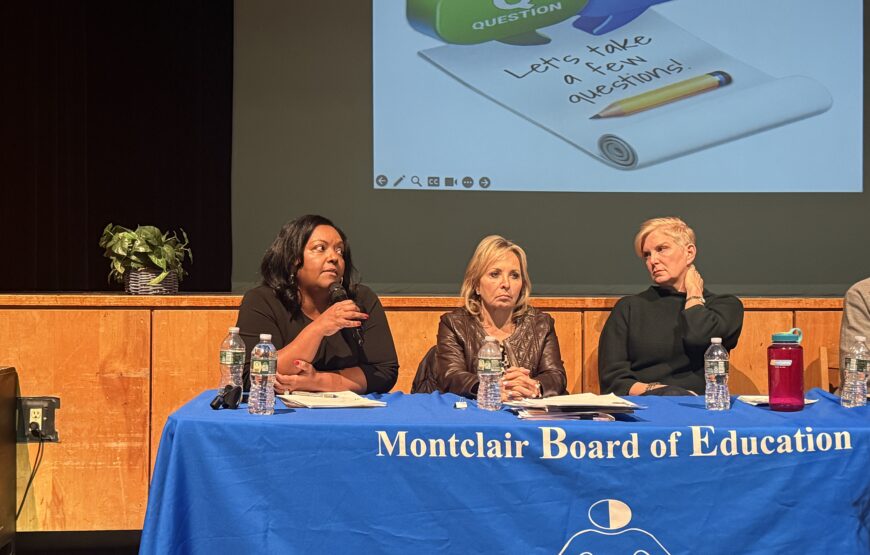
Three seats on Montclair’s Board of Education are open this November, and none of the seven candidates seeking them currently serves on the board.
The winners will join a district still emerging from a budget crisis and awaiting the results of a forensic audit. They will also inherit a broader question that has received less attention amid the financial turmoil: What, exactly, should Montclair’s schools be working toward?
Dan Hafetz has spent much of the past year examining pieces of that question through MPACT, the Montclair Partnership for Accountability, Clarity and Trust, an all-volunteer organization with more than 20 members whose backgrounds include education, law, accounting, government and data.
In July, MPACT published a report examining Board of Education governance, following earlier reports on the district’s transportation costs and the possibility of a state-appointed fiscal monitor. Hafetz, who began his career as a middle school teacher and later worked in government, including in the office of New Jersey Attorney General Matthew Platkin, recently discussed the findings with Mike Schreiber of The Montclair Pod.
What Good Board Oversight Looks Like
One of MPACT’s first challenges was determining what effective school-board governance should look like. Hafetz said the group found surprisingly little research examining the question from the perspective of educational outcomes and good government.
“This is democracy in its sort of most local form,” he said. “The stakes are very high for the people who have their kids in schools.”
MPACT ultimately assembled its recommendations from several sources rather than relying on an established model.
Hafetz’s critique of Montclair’s governance is not the same as a criticism of every decision the board has made over the past year. He credited district leaders with making difficult choices as they responded to the financial crisis.
“The district has done pretty well navigating, in my opinion, this crisis this year,” he said.
He cited the closing of Renaissance School, where he is a parent, as one example. Hafetz described it as a difficult decision and said he ultimately believed it was the right one.
For Hafetz, the larger governance issue is whether board members maintain the distinction between overseeing the district and running it.
“Their job is oversight,” he said. “Their job is not administration and operations.”
He offered an analogy: The board should remain “on the balcony and not on the dance floor.”
In Hafetz’s view, Montclair has experienced problems at both ends of that spectrum. He described periods of micromanagement followed by what he saw as a more hands-off approach under the administration of former Superintendent Jonathan Ponds.
Finding the right balance, Hafetz said, may require different levels of scrutiny at different moments. A district emerging from a financial crisis, for example, may require closer attention to its long-term finances than it would under more stable circumstances.
The answer, he said, is not necessarily to elect board members with particular professional credentials.
“They don’t need to be experts, they don’t need to be accountants, they don’t need to be a lawyer, they don’t need to have advanced degrees in education,” Hafetz said.
Instead, he said, board members should be able to dig deeply enough into complicated issues to understand what they are approving without crossing into administering the district themselves.
The Work the Public Doesn’t See
MPACT’s report also raises a transparency problem: Much of the board’s substantive questioning may occur before public meetings rather than during them.
Hafetz recalled a board meeting earlier this year that included discussion of proposed cuts and the superintendent’s academic vision. He said he believed audit findings and an issue involving the school calendar were also taken up at the meeting, though he was uncertain about the precise timing.
What stood out to him was the difference in the amount of public discussion devoted to the subjects.
“They spent no time on academic vision, they spent nearly no time on the school cuts,” Hafetz said. “They spent almost all their time on the board calendar.”
That does not necessarily mean board members failed to scrutinize the other issues, he said. Hafetz said MPACT’s conversations with board members suggested that much of their diligence takes place before meetings.
“The problem is they get into a meeting and the public is not seeing any of that diligence,” he said.
There is value in that advance work, Hafetz said. Questions from board members can help the superintendent refine presentations and prepare more complete answers. But he argues that some of that scrutiny should also take place publicly, even when members already know the answers.
Doing so, he said, could help residents understand the reasoning behind decisions and could prompt additional questions that had not surfaced in private discussions.
MPACT also identified structural obstacles to that kind of deliberation. Board members sometimes vote on bundled items, Hafetz said, making it more difficult to isolate and reconsider an individual decision. Members may also receive materials shortly before they are expected to vote.
Hafetz said he did not believe the administration was deliberately limiting the board’s review time. Instead, he attributed the problem in part to staffing shortages in the district’s central office.
“They are constantly boiling the ocean,” he said. “The board is getting matters to vote on with very little time.”
The practical problem, he said, is what happens when a legitimate question arises during a meeting and there is not enough time to reconsider the matter before a vote.
“Otherwise it’s a rubber stamp,” he said.
What Can the Forensic Audit Tell Montclair?
The district’s financial crisis has already been examined through its regular annual audit for the 2024-25 school year. Conducted by PKF O’Connor Davies and completed this spring, that audit identified seven material weaknesses in the district’s financial controls.
A separate forensic audit, for which the board hired EisnerAmper this summer at a cost of up to $250,000, is intended to examine the circumstances surrounding some of those failures.
Hafetz said the regular audit established that internal controls had failed and identified which controls were affected. What remains less clear, he said, is how and why certain decisions were made.
“What we don’t really know is what was the decision making around that,” Hafetz said. “Were there email communications between staff?”
He pointed to the district’s food-service contract as an example. Hafetz said it was already known that the usual board process had not been followed, but the reason remained unclear.
A forensic audit, he said, can examine communications, decision-making and conduct that would fall outside the scope of a conventional financial audit.
“Was there wrongdoing? We don’t know,” Hafetz said. “Could it be that there was no wrongdoing? Absolutely.”
He cautioned that the audit may not satisfy every resident, particularly those who remain convinced that additional misconduct occurred.
His hope, he said, is that residents ultimately consider both the findings already documented and whatever evidence emerges from the forensic investigation.
“Let’s get to the bottom of any wrongdoing if it was there,” Hafetz said. “And then I think we gotta start to just move on.”
Does Montclair Need an Academic Moonshot?
For Hafetz, resolving the district’s financial problems is only part of the work ahead.
Montclair also has a strategic plan that Hafetz said needs to be refreshed. He said he believes the plan is typically updated every five years.
His larger concern is that the district’s existing academic vision is too broad to serve as an effective tool for measuring progress.
Hafetz pointed to Camden as one example of a district using goals that are more specific and measurable. He cited the framework commonly known as SMART goals: specific, measurable, achievable and time-bound.
“I don’t really see that,” he said of Montclair’s current approach.
A goal of improving math performance, for example, may be too vague, Hafetz said. A strategic plan could instead establish numerical targets for particular grades and then give the board and superintendent a benchmark against which to measure progress.
“That’s really what a strategic plan is,” he said. “A strategic plan helps you move in a direction.”
The larger challenge is making that strategy consequential — something that shapes staffing, budgets and other decisions across the district.
Hafetz said that in organizations with clearly defined goals, even employees far removed from senior leadership understand the priorities.
“It might only be three or four things,” he said, “but they are all moving and they’re rowing in the same direction.”
During the conversation, Schreiber asked whether Montclair should consider an undertaking comparable in ambition to the development of its magnet-school system, which reshaped the district beginning in the late 1960s and early 1970s. With artificial intelligence changing the skills students may need, he asked whether the district had the appetite and capacity for another major educational shift.
Hafetz said he believed there was “absolutely appetite in the town,” though he was less certain that the district currently had sufficient bandwidth.
He also said the magnet system itself could be part of that conversation.
“Your thought about doing that through the magnet system, I think that’s certainly one way to do it,” Hafetz said, adding that he believes the system needs to be refreshed and rethought.
More broadly, he suggested that Montclair identify an academic goal ambitious enough to organize the community around it.
“Maybe we need something like a moonshot for the district,” he said.
Perhaps, he suggested, Montclair could aspire to have the best math program in the state or the best writing program. He emphasized that those were examples, not prescriptions.
“I’m not saying it needs to be one of those things,” Hafetz said. “But I think we need to have something that galvanizes everyone.”
MPACT plans to conduct research this fall into a broader question: what constitutes a strong education now? Hafetz said that discussion should consider not only reading, writing and mathematics but also citizenship, social-emotional development and how students learn to think in an era of artificial intelligence.
He does not see MPACT as responsible for answering the question alone.
“I think the district can do it,” Hafetz said. “I think they can be shepherds of that. I think the board can help shepherd that. I don’t know that they can totally do it on their own.”
He said Montclair should also look beyond itself, drawing on research and ideas from educators and institutions elsewhere rather than trying to reinvent education on its own.
What Hafetz ultimately wants to see is a less reactive Board of Education working with the superintendent and district to articulate a clearer long-term vision.
“All of our attention was consumed this year because of the finances,” he said. “My hope is next year is really there’s a shift there.”
The three candidates elected to the Board of Education in November will have a role in deciding how that work proceeds.
Montclair’s general election is Tuesday, Nov. 3. The voter registration deadline is Oct. 13, and early in-person voting runs from Oct. 24 through Nov. 1. MPACT’s full report on board governance is available at mpactnj.org.
Photo Source: The Montclair Pod