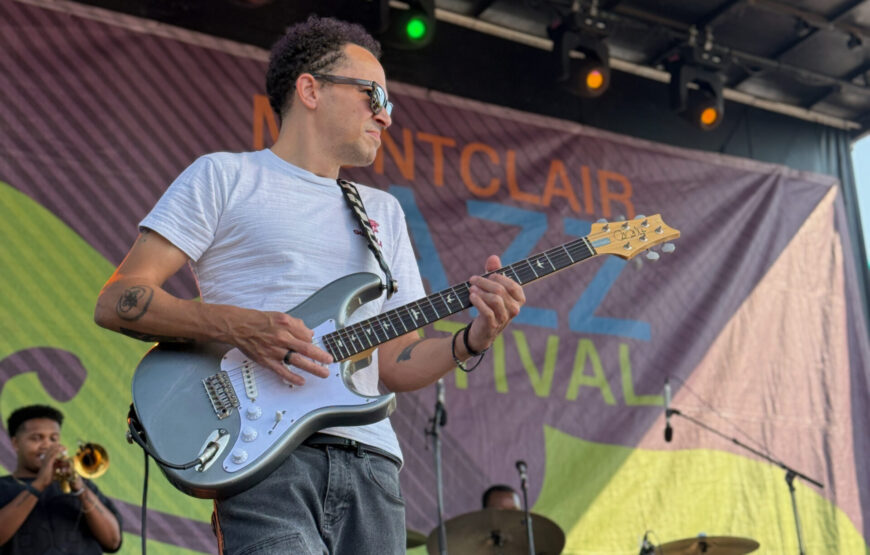
Dianne Reeves was mid-scat, trading wordless, improvised vocal runs with a crowd of thousands who did not need to be told the words, when Christian McBride climbed onto the stage to sit in with her. It was early in the afternoon, three more acts still had to play on the main stage and the crowd already filling Lackawanna Plaza was the biggest anyone running the 2026 Montclair Jazz Festival had ever seen.
By the time the Christian McBride Big Band closed the night with a medley of songs from the city of brotherly love (including, Grover Washington Jr.’s “Mister Magic,” much to Montclair Pod co-host Michael Schreiber’s delight) two stages had cycled through seven hours of music, a New Orleans-style second line parade had wound its way down Bloomfield Avenue and through Lackawanna Plaza, and dozens of vendors selling food, crafts, books and clothes had served long lines of patrons. Here is what that day actually looked like.
How Big Was the Crowd at the 2026 Montclair Jazz Festival
Dave Placek has watched this crowd build for years from the same vantage point. His firm, BDP Holdings, owns Lackawanna Plaza and has donated the space to the festival for several years running. Usually, he said, the real crowd does not show up until midafternoon.
Not this year. “I think I was here at 8:30,” Placek said. “We had people already setting up their chairs in the front row. Typically in years past, we start to see people really fill in around four o’clock. These people started filling in at one, one thirty, two. So definitely I think the largest crowd we’ve had to date.” He credited the weather, and something less measurable: a town that shows up for its own mix of everything. “Montclair’s got a little of everything,” he said. “This is what it’s all about.”
That early crowd included people who drive in for this alone. Kevin and DeWan, two friends splitting time between New York and North Jersey, said this was their third year making the trip down. “I love it,” Kevin said. “I used to live down here. Now I’m in North Jersey, but I come down here for the Jazz Festival every year.” Both were there for Dianne Reeves and Patrice Rushen specifically. The plaza they were standing in would only get fuller from there.
How the Day Unfolded, Set by Set
Lackawanna Plaza ran on two stages at once, one in each of the site’s parking lots. The main stage carried the festival’s headline arc, opening with the Gotham Kings leading a second line, the New Orleans-style brass parade built for marching a crowd through city blocks, down from Church Street. From there it moved through a lineup built around jazz’s home cities: Oscar Hernandez and the Spanish Harlem Orchestra representing New York, Dianne Reeves representing both Detroit and Denver, the Take Me to the River New Orleans All-Stars representing New Orleans, Patrice Rushen representing Los Angeles, and the Christian McBride Big Band closing out the night for Philadelphia.
While the main stage moved through Los Angeles and New York, the second stage, the Jazz House stage, told a different story, the one the whole day exists to fund. In past years this has been billed as the Emerging Musicians Stage, drawing more than 50 young performers between the ages of 14 and 25. Kaleb Garzon, a Jazz House Kids student who left for college two days later, played tenor saxophone there with the Jazz House Kids band, four years into a program he found almost by accident. Dave Placek, the same Lackawanna Plaza owner who watched the morning crowd build, is the reason Garzon ever picked up jazz in the first place. “It was actually Dave that introduced me, because my mom works with him,” Garzon said. “He saw one of my concerts and was like, let me introduce you to this amazing group in Montclair, and they play jazz… I never played jazz at that time. But he was like, you should go and give it a try.”
He went, and it rearranged how he thought about music. “The first class I saw the community and the connections that the people had with the faculty and the students, and the way that they were just playing so connected… That was life changing.” He started on clarinet before switching to tenor sax about a year ago, and he described Montclair the way a lot of musicians who move through Jazz House Kids eventually do, less as a suburb than as a scene. “It’s like a melting pot of all different kinds of musicians,” he said. “It’s a place where you can go and meet new people.” He spent his last weekend as a student performer sharing a bill with the artists who had taught him what the genre could sound like live, and with more than 50 of his own peers a few hundred feet from the main stage. “There’s been so many new people that I’ve met that have changed my life and positively impacted me and helped me grow in ways that I didn’t even know I could,” he said
Back on the main stage, Reeves brought the moment that opened this piece, trading scat lines with the crowd. By late afternoon, New Orleans took the stage. The Take Me to the River All-Stars, with Cyril Neville, Omari Neville, Ian Neville, Big Chief Bo Dollis Jr., and New Breed Brass Band, along with singer Anjelika “Jelly” Joseph, got the crowd moving hard. Joseph, who also is the singer for the New Orleans funk band Galactic, called the lineup around her an honor.
“It’s always a blessing to share the art of New Orleans music and New Orleans culture with the world… I’m just honored to be a part of this union with all these people,” she said, adding. “There’s a legendary feminine energy back here that I’m just so excited and elated to be a part of, man,” she said, naming Rushen and Reeves specifically. “I got a chance to take a picture with both of the legends.” She credited McBride directly, calling him family. Joseph has spent seven years as Galactic’s lead singer alongside bassist Rob Mercurio, one of the band’s founding members.
Philadelphia Closed the Night
The Christian McBride Big Band closed the Jamboree the way it has closed every one of the last seventeen, as a tribute to McBride’s hometown. His music roots go way back. His father and uncle both played the bass and he attended to the Philadelphia High School for Creative and Performing Arts, the same school that produced the Roots, Boyz II Men, Leslie Odom Jr. and Joey DeFrancesco, among many other.
McBride’s set included “Killer Joe,” composed by the late Philadelphia saxophonist Benny Golson, and an arrangement of John Coltrane’s “Equinox.” Partway through the set he brought out singer Bilal, his CAPA classmate, for a run of songs honoring Philadelphia soul writers Kenny Gamble and Leon Huff, among others.
Before the set ended, McBride ran through the whole day out loud: Rushen, the Take Me to the River All-Stars, Reeves, Hernandez and the Spanish Harlem Orchestra, and the Jazz House Kids students who had shared the bill with all of them. It was less a set list than a tribute to the entire afternoon, embraced by the crowd that had just experienced it.
the Block Party
The music did not stop when McBride’s set did. DJ Prince Hakim used to watch McBride DJ from the crowd at past festivals and imagine getting a slot of his own. This year the festival gave him the closing set.
“I used to watch Christian DJ in the crowd and I would always say, man, I would love to open up for him,” Hakim said. “Now I’m here. They actually gave me my own set tonight. I’m blessed and highly favored.” Hakim, whose real name is Hakim Bell and who is the son of Kool & the Gang co-founder Robert “Kool” Bell, runs the Kool Kids Foundation on the side, a charity that buys instruments for schools whose music budgets get cut first. Reading a room after a full day of jazz takes its own instinct: “You feel the vibe. You throw on a song. If it’s working, you let it play. If it’s not, you get up out of there.” He closed with James Brown, an echo of a day that had already run through Philadelphia soul and New Orleans funk before it ever got to him.
What it’s All About
Every part of the Jamboree, from the Gotham Kings to McBride’s closing set, exists to support the work of Jazz House Kids, the Montclair nonprofit that produces the festival as its single largest fundraiser each year. That funding runs a full education operation, not just a summer concert. Jazz House Kids served 59,748 students through its programs this year and invested more than 39 million dollars in year-round jazz education, according to the organization’s own 2025 to 2026 impact report. Its Give an Instrument, Build a Musician program placed 1,302 new instruments directly in students’ hands. Students who come up through the program, like Garzon, have a real shot at where that funding leads: Jazz House Kids reports that 99 percent of its scholarship recipients go on to college, backed by more than 4.1 million dollars in scholarships awarded to date.
Gratitude was the mood of the whole day, the kind that makes a crowd want to dance instead of go home, and it traces back to the same trade: a kid gets an instrument, and years later, the crowd gets a moment like Reeves and McBride trading lines on the same stage. Next August, Lackawanna Plaza will fill up early again, and some of the students in this year’s crowd will be the ones playing it. If you want to be part of that crowd next time, the Pod will be covering everything you need to plan ahead.