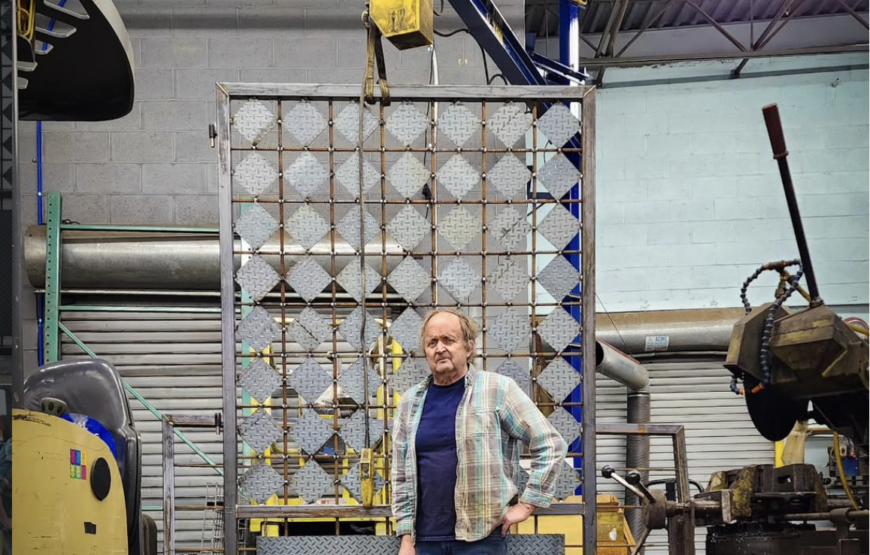
In a corner of the old supermarket at Lackawanna Station, a steel anvil rests on a balloon. It looks like it should pop. It never does. Charlie Spademan, the Montclair artist who made it, has spent more than 30 years in town pulling off that kind of trick with metal, wood and resin. The one he hasn’t solved is how an artist makes a living here.
“I don’t know how anybody survives here,” he said. For people “on my level of being creative, it’s really a very much a subsistence. I don’t know how I’ve done it.”
Montclair has called itself an arts town since landscape painter George Inness settled here in the 1880s and other artists followed. Around the time Inness died in 1894, The New York Times reported that Montclair had more prominent artists and wealthy collectors than anywhere else in New Jersey. The Montclair Art Museum opened in 1914. Today a typical home here is worth about $1.2 million, according to Zillow’s Home Value Index through June. Farnoosh and Mike brought one question to Spademan’s studio: when artists help make a town this desirable, what does it take for them to stay?
From the East Village to Grove Street: How a Montclair Artist Got Here
Spademan came to Montclair the way a lot of New Yorkers did: for space he could afford. He had studied sculpture and metal forging at the Cleveland Institute of Art and landed in the East Village in the fall of 1977.
“I was remarkably lucky to end up in the small group of people, musicians and artists and filmmakers that inhabited the East Village at the time,” he said. “There were interesting friends and you could afford to live there. It was easy… in a way that I find unimaginable now.”
What finally pushed him out was “crack moving into my apartment building.” He wanted to start a family, his wife at the time had friends in Montclair, and in 1993 they bought a house on Grove Street for about $170,000. He said it recently sold for just short of $1 million.
“It was perfect,” he said, “and it was affordable.”
Before he made art, he made tools. At a high-end Manhattan framing shop, he solved problems for craftsmen who gilded frames by hand. He saw so much expensive art that it started to look like wallpaper. Then a David Hockney came through, a swimming pool made of paper, and the whole shop stopped to look.
“It’s funny how what would seem to be very mundane life experiences can teach you very profound things,” he said.
Framing also produced his best story: a job for Disney installing an enormous work on paper by pop artist James Rosenquist, made of panels roughly five feet wide and eight feet high. He designed a system to hang plexiglass in front of them. “And we flew down one night to go and install this thing,” he said. “While everybody else was asleep, installed it, it worked beautifully. And then went and was served breakfast by Goofy.”
His Montclair career turned on a door. He was hand-forging gates and railings for local homes when the Montclair Arts Council held a competition for the entrance of Bangz salon. He won, and developer Bob Silver noticed the ornate metalwork, which led to years of commissions.
For a long time, Spademan wasn’t sure those gates counted as art. Mike compared it to a friend who built dry-laid stone walls, stacked without mortar: technical work that ends up being art anyway.
“Because they were utilitarian and sometimes would follow somebody else’s general design, it wasn’t what I chose to make. It’s what I could make,” Spademan said. “But then I realized my creativity in problem solving has gone into every single one of those. And I just decided to embrace it. That’s what I do. I’m a creative person and I’m an artist.”
Lately, that problem solving has taken the shape of trees.
The Olmsted Oak Bench and the Trees He Saved From the Chipper
Spademan’s best-known recent work is a bench made from a fallen landmark. When a storm brought down the Olmsted Oak in Anderson Park in August 2024, park neighbors Bob and Rhonda Silver commissioned him to turn part of it into a curved seat. It went back into the park in May 2025 and won a 2025 award from the township’s Historic Preservation Commission. Another slab became the ordering counter at Farm House Fried Chicken in Upper Montclair.
Silver also owns the lot at Hillside Avenue and Orange Road where Spademan curates Hillside Sculpture Park. “As a supporter of the arts, nobody has done more than Bob has, I think, in providing spaces for artists to show work,” Spademan said.
Spademan rescued the next tree on his own dime. When a large red oak came down at Hillside School, across the street from the sculpture park, he said he tried to claim the wood properly first. He called the Board of Education, which sent him to the district’s Buildings and Grounds office, where he left messages. Nobody called back.
“I watched for them taking it away and then I went and paid the guy to drop here instead of taking them to wherever they were going,” he said. The trunk sections, which he estimates at 3,000 to 4,000 pounds apiece, now sit in the yard behind his workshop. “They felt unwanted, and I felt they oughta be preserved.”
He plans to forklift a few inside and use them as tables by the bar at Lackawanna. “It’ll take years for them to dry unless, you know, I force them,” he said, meaning a kiln far larger than the kind used for firewood. “But people can enjoy them in the meantime.” Eventually he wants to make tabletops from the rest, sell them and send a portion of the money back to the schools, possibly through the Montclair Fund for Educational Excellence, the nonprofit that funds grants and programs in the district. “I think it’d be a nice way to remember the tree.”
None of this work came out of a township budget. There used to be one.
What Happened to Montclair Public Art Funding
As Spademan remembers it, the Montclair Arts Council received about half a million dollars from the township and produced four or five significant public works, two of them at the Bay Street train station, along with murals around town. The council disbanded around 2010, during a budget crisis.
“They felt like the return on investment was good. They felt like they drove a lot of business into Montclair,” he said. “The town felt like there were opportunities for artists. And at the moment I don’t feel like there are any.”
Then he went further.
“I feel like Montclair used to be progressive. I feel like it still markets itself as being progressive. I feel like it’s anything but,” he said. “I feel like Montclair presents itself as being a town that really supports the arts, but understandably because the town doesn’t have any money… there’s no line item that goes into the arts in Montclair at all.”
The closest thing the township has is the Arts Advisory Committee, a volunteer group founded in 2015 that advises the council. Spademan was invited to join and sat in on early meetings before stepping back. The committee reviews proposals for public art, and he wants to bring some of his own. “It’s not in my best interest to be part of this because I want to present artwork to the town,” he said.
Even finished, proven work has trouble getting in. During the pandemic, he helped build “Point of Action,” a holiday installation by architect Nina Cooke John that had already stood in Manhattan’s Flatiron Plaza. Bringing it to Crane Park was “a real uphill battle,” he said. Asked why, he answered in three words: “Money. Just liability.”
Summit, by contrast, puts art on its streets. Spademan’s sculpture “Surface Tension” stood there for two years. “They have public artwork all over the town,” he said. “And it doesn’t need to be expensive to do, because a lot of artists like myself are interested in just showing work and you don’t need a big budget to do it.”
That is the part of his argument Montclair can act on.
What Montclair Could Do for Its Artists
Two private developers have filled part of that gap, and Spademan works inside one of their buildings. When he lost his shop in Belleville, he asked Lackawanna developer Dave Placek, whose family he had worked for, whether he could set up in the parking lot and build a sculpture for the redevelopment in public. Placek invited him inside instead. Spademan is now Lackawanna’s artist in residence, meaning he gets studio space on site rent-free. In return, he does much of the physical work of keeping the place running.
“I’m not an employee. I feel like I am, but it’s been very good for both of us,” he said.
His studio includes a refrigerated semi-trailer he bought to move his equipment from Belleville. It sits on the old supermarket loading dock, across from the post office, with a mini-split (a ductless heating and cooling unit), a Barcalounger and a desk from Facebook Marketplace. “This is the space that nobody in Montclair knows about,” he said. “I could live here easily.”
Space alone doesn’t sell art, though. Spademan thinks the gallery system runs backward, with artists groveling for galleries that depend on them, and that local openings draw “friends showing up for their friends, and they aren’t really people who are there to buy.” He’s blunt about his own part in it. “I think I’m a very good artist. I’m a very bad businessman.”
His answer for Lackawanna is four or five independent gallery spaces that rotate constantly and stay affordable “for people who are looking for art for their wall.” Two are already open alongside his.
For public art, he thinks the fix is patrons: residents with money who want to leave a mark on the town, the way Andrew Carnegie once paid for libraries, on a much smaller scale. “I think that for the town to be populated with more artwork is going to take a group of benefactors essentially, patrons, to do it,” he said. “And I personally am interested in working at that level.”
He already knows where he would start. He has a design for the Church Street Circle, and he won’t describe it. “I don’t want to say exactly. I have a very specific thing.”
In the meantime, there’s a giant anvil in his workshop, a fiberglass prototype he imagines hanging high enough for people to walk underneath. He said it isn’t meant for Church Street. Then he reconsidered: “Although you know what, it’d be kinda cool there.”
Where to See Charlie Spademan’s Work, and How to Weigh In
If you want artists like Spademan to stay in Montclair, start by seeing what he’s already given the town. The Olmsted Oak Bench is in Anderson Park near the northeast entrance at 274 Bellevue Ave. Hillside Sculpture Park is open outdoors at Hillside Avenue and Orange Road. His anvil-and-balloon sculptures are inside Lackawanna Station, 1 Lackawanna Plaza, with the Hillside oak in the yard out back. The ordering counter at Farm House Fried Chicken in Upper Montclair is cut from the Olmsted Oak.
Show up. The Arts Advisory Committee meets the second Monday of every month at 7 p.m. in the second-floor conference room of the Municipal Building, 205 Claremont Ave., and meetings are open to the public. The next one falls on Dec. 14.
Buy from him or commission him. Spademan sells his work directly and takes commissions. Find him on Instagram at @charliespademan, and hear the full conversation on The Montclair Pod.
Photo: Instagram/@charliespademan