Christian McBride has spent forty years being the person other musicians call. Sting called him. Paul McCartney called him. Somewhere in between all of that, a jazz radio station handed his future wife a children’s workshop assignment that would eventually become the reason more than 27,000 people turned out for last year’s Downtown Jamboree at Lackawanna Station, in a town McBride himself sums up in six words. “Montclair feels like Greenwich Village West,” he told The Montclair Pod.
McBride, an eleven-time Grammy winner and the artistic director of the Montclair Jazz Festival, sat down with The Montclair Pod ahead of this year’s 17th annual Downtown Jamboree, and told most of this story himself.
A School Full of Prodigies
McBride grew up in Philadelphia in a house full of bass players. His father and his uncle both played bass, and watching them was what pulled him into music in the first place. His earliest paying gigs came alongside organist Joey DeFrancesco, a classmate at the Philadelphia High School for Creative and Performing Arts, known as CAPA, who died in 2022. “He was the king,” McBride told The Montclair Pod. “It was wonderful to watch someone single-handedly revive the popularity of jazz organ.”
At 15, McBride was already gigging with baritone saxophonist Joe Sudler’s big band, a working group with a 250-song book covering jazz, Top 40 and Broadway across graduation parties, bar mitzvahs, weddings and gigs at Penn’s Landing. “That was very, very important for me,” he said, “to get that sort of professional experience.”
CAPA’s roster that year was stacked well beyond McBride and DeFrancesco. Guitarist Kurt Rosenwinkel was there. So were the future members of Boyz II Men, and two kids named Ahmir Thompson and Tariq Trotter who were still years from becoming Questlove and Black Thought of the Roots. According to JazzTimes’ oral history of that CAPA class, McBride and Thompson actually met over a James Brown bassline in the school’s music room, each quizzing the other on what he knew about James Brown before becoming close friends; DeFrancesco, for his part, described jamming with McBride over the phone with a mentor from the time they met, the summer before school even started.
None of it happened by accident. Trumpeter Wynton Marsalis came through Philadelphia for a series of master classes around 1987, heard McBride play, and invited him to sit in with his group. Through Marsalis, McBride met saxophonist Branford Marsalis and trumpeter Terence Blanchard, along with saxophonist Bobby Watson, whom he’d already crossed paths with in Philly. “By the time I came up here to go to school, I knew a bunch of people already,” McBride told The Montclair Pod. “I just tried to ride the wave.”
The Young Lion Who Wouldn’t Stay in His Lane
Once he landed in New York, McBride’s generation of young jazz musicians got branded the “young lions,” a label, he told The Montclair Pod, that stuck harder than it deserved to. “None of us said that we wouldn’t play other styles of music,” he said. When he’d bring up James Brown or Earth, Wind & Fire, or his friend Roy Hargrove would talk about hip-hop, people acted surprised. Critic Stanley Crouch’s outspoken praise for a specific circle of players, McBride included, only hardened the label further. “I deeply respect Stanley,” McBride said, “but I had to make the but part loud and clear. You’re gonna get shade from whoever. You can’t not do stuff because you’re afraid you’re gonna get shade.”
That refusal to stay in one lane is a big part of why McCartney and Sting both wanted him behind them, pulling him into the pop and rock world even as he kept building his reputation in straight-ahead jazz.
The Thrill of a Lifetime
Nothing McBride has done seems to have meant more to him personally than SuperBass, the trio Ray Brown formed in 1996 with McBride and fellow Brown protégé John Clayton. “That was like the thrill of a lifetime,” McBride told The Montclair Pod, “getting a stand next to your bass hero and feeling that pulse up close.” The relationship outlasted Brown himself: when Brown died in 2002, his widow insisted McBride take one of his three basses, and McBride still plays it today, an instrument Brown had played for the final thirty years of his life, as McBride has since told NPR.
That same crossover instinct produced two of McBride’s most beloved records: the groove-heavy Philadelphia Experiment with Questlove and pianist Uri Caine in 2001, and Live at Tonic, a three-disc set recorded at the since-closed downtown Manhattan club known for pairing a lounge up front with a live room in back. “It’s hard to believe that it’s already been 20 years,” McBride told The Montclair Pod. “We made that record in 2005.”
“I’m Going to the Middle of Nowhere”
McBride knew Montclair before he lived here, and he wasn’t impressed. In his late teens, he played the now-closed jazz club Trumpets a couple of times: once backing saxophonist Benny Golson, once behind vocalist Jackie Jones. “At the time I was just like, Montclair, I’m going to the middle of nowhere,” he told The Montclair Pod. “But that’s when I was like 19. I didn’t know.”
He found out. McBride met jazz vocalist Melissa Walker in 2003; they married two years later and moved to Montclair almost immediately. Asked how long they’d actually been here, McBride didn’t miss a beat: “20, 21 years now.”
These days, when he isn’t on the road, home mostly means staying home. When he does go out, it’s a short, specific list of spots around town: Trend Coffee & Tea House for the open mic, a cigar lounge next door, a couple of regular haunts he simply calls “my spots.” One of those outings got away from him: a barista at Trend who recognized him from his radio show put his name on an open-mic list without asking. He called Melissa beforehand to warn her they might need to skip town. He didn’t kill, he said, but he didn’t bomb either.
It’s also, half-jokingly, why he was asked on the show whether Montclair could support a real jazz club again, the kind of room the town lost when Trumpets closed for good in 2019. McBride didn’t say no. “Stay tuned, we’ll see what happens,” he said. “We had the exact same thoughts that you just had.”
A Blanket in Nishuane Park
None of McBride’s touring history is why most Montclair residents actually know his name, though. That’s the festival, and it started completely by accident.
“We started our summer program in 2009 and had maybe 25 students who needed to play after the two-week program was over,” McBride told The Montclair Pod. “We set up in Nishuane Park. We didn’t even have a stage. We just put a huge blanket down and had a drum kit and a keyboard and had our students jam.” Only the parents showed up that first year. The second year drew the same small crowd, plus maybe ten more people.
It wasn’t until 2011 that Walker and McBride invited an actual headliner: pianist Monty Alexander, who played on the camp’s borrowed keyboard and, when they tried to pay him, told them to keep the money and get a piano instead. Joe Lovano and Kenny Barron came the year after that. A real piano showed up. “It kept getting bigger and bigger every year,” McBride said. “We don’t actually have a hard start to the Montclair Jazz Festival, because it was totally organic and sort of accidental.”
The organization behind it, Jazz House Kids, is entirely Melissa Walker’s creation, grown out of a jazz masterclass she taught through WBGO at a Newark elementary school a year before she and McBride even met. Teaching five-year-olds jazz meant finding an angle: build a house, one instrument at a time. It’s since expanded well past Essex County, running Jazz House Manhattan out of Trinity Church Wall Street and an exchange program with Tomorrow’s Warriors, the London jazz education organization that produced saxophonist Nubya Garcia and multi-instrumentalist Shabaka Hutchings. “We are officially international,” McBride said.
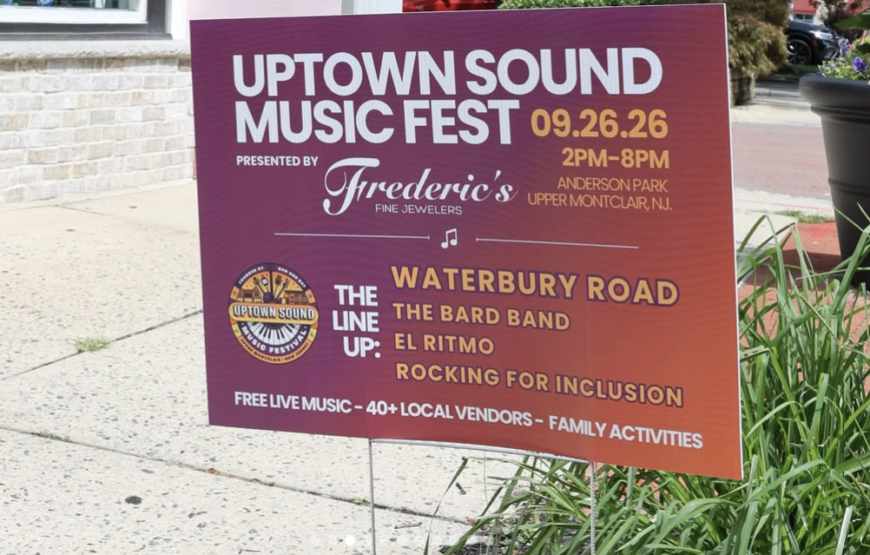
This year’s Downtown Jamboree, on August 15 at Lackawanna Plaza, is the festival’s biggest yet in scope: the Smithsonian Institution selected it as a collaborating festival for “Of the People,” part of the nation’s 250th anniversary celebration, and the day includes a tribute to the centennials of Miles Davis and John Coltrane. One of the pianists on this year’s Soundcheck Series bill, Orrin Evans, actually crossed paths with the CAPA crowd decades ago from a rival Philadelphia arts school, where, according to that same JazzTimes oral history, he found McBride and his classmates thoroughly intimidating. This August, they’ll all be playing the same festival. For the full lineup, Soundcheck Series schedule and Jam Pass details, see The Montclair Pod’s complete guide to the 2026 Montclair Jazz Festival, and for everything else on the calendar this summer, the Pod’s guide to the town’s annual festivals.
McBride’s own Big Band, featuring singer Bilal, closes out the night. Don’t expect him to turn up anywhere else on the bill. “I got enough to do,” he said. “I’m playing with the big band. I don’t need to sit in with anybody else.”
On AI, Live Music, and What Jazz Still Means
Near the end of the conversation, McBride was asked whether AI, or anything else, could ever really replace what he does. He didn’t hesitate. “Human beings doing something meaningful will never go out of style,” he told The Montclair Pod. “No matter how big AI gets, every generation has something that brings impending doom. The human condition will always be the base level way we’re able to get through life.”
Pressed on whether that meant live performance specifically was becoming more important as streaming has reshaped the music business, McBride agreed without qualification. “You nailed it,” he said. “That’s correct. Live experience, that’s going to mean more and more as time progresses.”
That’s not a new problem for him, or for jazz musicians generally, he added. Asked whether it’s sustainable for musicians to make a living without much income from records anymore, McBride’s answer doubled as a shrug. “That’s the way it’s always been, especially for jazz musicians,” he said. “We’ll continue to go out there and hustle. That’s what we do.”
Christian McBride: Quick Biographical Facts
- Full name: Christian McBride
- Born: May 31, 1972, in Philadelphia, Pennsylvania
- Instruments: Double bass, bass guitar
- Education: Philadelphia High School for Creative and Performing Arts (CAPA); studied at the Juilliard School on a partial scholarship before leaving after one year to tour with Roy Hargrove
- Spouse: Melissa Walker, jazz vocalist and founder of Jazz House Kids; married in 2005
- Home: Montclair, New Jersey, since 2005
- Grammy Awards: Eleven wins as of the 2026 ceremony
- Recording credits: More than 400 albums as a sideman, in addition to his own catalog as a leader
Discography Highlights
A partial list of McBride’s albums as a leader or co-leader, spanning three decades (see his full discography for the complete catalog):
- Gettin’ to It (1995), his debut as a leader, on Verve
- SuperBass (1997) and SuperBass 2 (2001), the trio recordings with Ray Brown and John Clayton
- Live at Tonic (2006), the three-disc live set recorded at the New York club
- The Good Feeling (2011), his debut Christian McBride Big Band album and first Grammy win in that format
- Out Here (2013) and People Music (2013), introducing his trio and the Inside Straight quintet
- Live at the Village Vanguard (2015), featuring his Grammy-winning solo on “Cherokee”
- Bringin’ It (2017), his second Big Band Grammy win
- Christian McBride’s New Jawn (2018), a piano-less quartet project
- RoundAgain (2020), reuniting him with Joshua Redman, Brad Mehldau and Brian Blade more than two decades after their work together in the 1990s
- For Jimmy, Wes and Oliver (2020), his third Big Band Grammy win
- Trilogy, Trilogy 2 and Trilogy 3 (2013 through 2025), the ongoing trio project with Chick Corea and Brian Blade
- Without Further Ado, Vol. 1 (2025), winner of Best Large Jazz Ensemble Album at the 2026 Grammys, featuring guest turns from Sting and Andy Summers, Samara Joy, Jeffrey Osborne, Dianne Reeves, José James, Cécile McLorin Salvant and Antoinette Henry
Notable Collaborations
Beyond his own recordings, McBride has built a sideman résumé few bassists can match, including studio and stage work with Freddie Hubbard, Joe Henderson, McCoy Tyner, Herbie Hancock, Pat Metheny, Diana Krall, Roy Haynes, Chick Corea, John McLaughlin, Wynton Marsalis, Hank Jones, Sting, Paul McCartney, Carly Simon, Bruce Hornsby, Kathleen Battle and James Brown. Early in his career he toured with saxophonist Bobby Watson’s group Horizon and trumpeter Freddie Hubbard’s band, and was a member of the Joshua Redman Quartet alongside pianist Brad Mehldau and drummer Brian Blade, a lineup that reunited more than two decades later for 2020’s RoundAgain.
Professional Roles and Associations
- Artistic director, Montclair Jazz Festival
- Co-founder and artistic director, Jazz House Kids
- Artistic director, Newport Jazz Festival (2016 to 2025)
- Artistic director, the New Jersey Performing Arts Center and its TD James Moody Jazz Festival
- Artistic director, the National Jazz Museum in Harlem
- Instructor, Jazz Aspen Snowmass Academy, since 2000
- Host, Jazz Night in America (NPR/WBGO)
- Host, The Lowdown: Conversations with Christian (SiriusXM)
Image Credit: The Montclair Pod