Most people driving down South Mountain Avenue don’t expect to find one of the country’s great small art museums tucked into a neighborhood of Victorian houses. But the Montclair Art Museum has been drawing serious collectors, curators and art students to town for more than a century, home to a collection that outsiders often assume belongs in a bigger city. For Montclair, it’s a reminder that the town’s cultural weight has never depended on its size.
Here’s what to know before a visit: the museum’s history and permanent collection, what’s currently on view, hours and admission, and the classes, café and community events that make it more than a place to look at paintings.
The 112-Year History Behind Montclair’s Art Museum
The museum opened its doors on January 15, 1914, making it the first public art museum in New Jersey and one of the first in the country built around American and Native American art. Two Montclair residents made it happen: William T. Evans, a dry-goods merchant who donated 54 paintings and two sculptures before his death in 1918, and Florence Rand Lang, whose family fortune came from the Rand Drill Company and who gave hundreds of thousands of dollars over three decades and left an additional bequest in her will.
Evans’ gift included work by Childe Hassam, Daniel Chester French and George Inness, artists still central to the collection today. He was building two collections at once, donating dozens of paintings to what is now the Smithsonian American Art Museum around the same time, making Montclair one of only a few institutions to benefit directly from his collecting
Lang’s first gift, $50,000, helped fund construction of the museum. She kept giving for the next thirty years, and her mother’s collection of Native American art, donated along the way, grew into thousands of works and remains one of the museum’s defining strengths today.
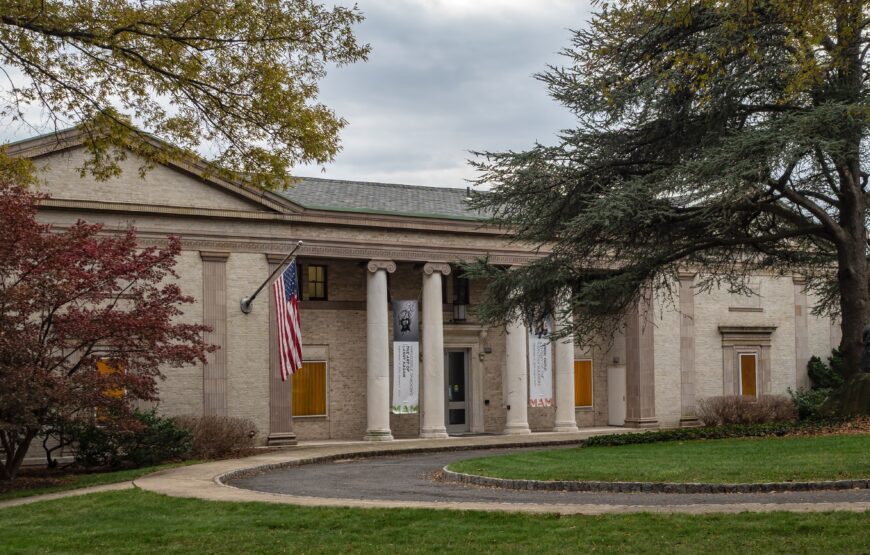
The building came from the same era of civic ambition. Trustee Michel Le Brun hired American architect Albert Randolph Ross, who had already designed several Carnegie libraries and a Colorado courthouse, to build a neoclassical structure at 3 South Mountain Avenue, its symmetrical, column-fronted look borrowed from ancient Greek and Roman architecture. In the 1940s, local horticulturist Howard Van Vleck, the same figure behind Van Vleck House and Gardens across town, turned the museum’s grounds into an arboretum, a curated landscape of trees and plantings meant to be studied as much as admired. The building itself later expanded from roughly 20,000 to 42,000 square feet to hold a collection that has grown past 14,000 objects, and it earned a spot on the National Register of Historic Places in 1986.
No painter matters more to that history than George Inness, who lived in Montclair through the 1880s. He actually began as a renter in 1878, bought a house in 1885, and lived in the town until his death in 1894. His 1857 painting “Delaware Water Gap” anchors a permanent gallery that has barely changed in emphasis in more than a century.
That founding-era story is only half of it. In 1922, the museum invited Montclair residents to vote on their favorite among 25 works being considered for acquisition, an unusually democratic move for a museum of that era. Six decades later, three Montclair figures, artist Ben F. Jones, artist Janet Taylor Pickett and writer Valerie Wilson Wesley, founded the museum’s African American Cultural Committee to sustain and highlight the legacy of artists of the African diaspora, meaning Black artists and their descendants across the U.S. and abroad.
The museum kept growing physically too. When it turned 100 in 2014, it marked the milestone with “Yellow,” a light installation by artist Spencer Finch that filled the facade’s windows with a soft glow, a small gesture meant to counter the formality of Ross’s architecture with something that looked like someone was home. Two years later, the museum opened the Vance Wall Art Education Center, funded by a five million dollar gift from Carol and Terry Wall and the Vance Wall Foundation, adding studio and classroom space that helped grow the programming the museum runs today.
That permanence sits alongside a lineup that never stops turning over.
What’s on View at the Montclair Art Museum Right Now
Exhibits at MAM rotate every few months, so any list here has a shelf life. What does not change is the scale of the permanent collection behind them: more than 14,000 works spanning three centuries of American art alongside Native American painting, beadwork, basketry and ceramics.
This year’s rotation includes “Shifting Terrain: Perspectives on Land in North America,” which opened in late April, and “Victoria Sambunaris: Transforming the American Landscape,” a large-format landscape photography show that opened in late June and runs into 2027. A standing installation of Inness works, “Visionary Landscapes,” has been up since last spring. For the current lineup, check MAM’s exhibitions page.
Montclair Art Museum Hours and Admission Prices
Public gallery hours run Friday and Saturday from 10 a.m. to 6 p.m. and Sunday from 11 a.m. to 5 p.m. The museum is closed to walk-in visitors Monday through Thursday, though private tours can be booked those days between 10 a.m. and 4 p.m. Plan to arrive at least an hour before closing, since that is the last window for entry, and galleries clear out 15 minutes before the doors lock for the night.
Adult tickets run $17. Seniors and students pay $12, as do visitors with disabilities. Children under 12 and members get in free. Through August 30, MAM is charging reduced admission of $8 while it installs its fall exhibitions. Free and discounted admission is also available through several programs: Blue Star Museums for active military families, Museums for All for anyone receiving SNAP benefits, and a free ticket for anyone currently unemployed, no paperwork beyond an ID required. Tickets are timed, meaning you book a specific entry window rather than showing up whenever. Booking online ahead is faster than showing up cold.
Parking is free in the museum’s onsite lot, with overflow street parking on South Mountain Avenue when the lot fills.
But a good museum trip does not have to end at the exit.
What Else There Is to Do at the Montclair Art Museum
Yard School of Art gives the museum a second identity beyond its galleries. Founded in 1924 and folded into the museum in 1999, it still runs classes for kids, teens, adults and seniors year-round, from drawing and painting to Friday-night sessions at the potter’s wheel. In the summer, that expands into SummerART, four two-week camp sessions taught by professional teaching artists rather than seasonal counselors alone. Campers get guided gallery tours tied to whatever is currently on view and close out each session with an exhibition of their own work, one families can walk through in person.
The school reaches well past the standard class schedule, too. MAM’s Access Program offers classes built for neurodiverse students and students with disabilities ages 16 and up, including a drawing and painting class capped at 10 students and a ceramics class capped at six, both designed around smaller groups and a slower pace. The museum is an approved provider through the New Jersey Division of Developmental Disabilities and offers assisted listening devices, captioning and ASL interpretation on request.
Families with young kids get their own dedicated space too, a third-floor Learning Lab built around whatever exhibition is currently up, plus a self-guided scavenger hunt available at the admission desk during regular gallery hours. Every Sunday, a MAM art educator leads a guided art-making session in the same spirit, pulling directly from the art on the walls that week rather than running a generic craft project.
On Friday and Saturday mornings, the Cornerstone Café opens on the lower level, serving coffee and pastries next to a small library of art books, a good excuse to make an afternoon of it rather than rushing through. From October through June, the museum turns one weeknight into something livelier with Free First Thursday Nights, a recurring evening with a full bar, live music and tours.
The museum also hosts community events throughout the year, including a MedievalFest each August, and for residents who cannot make it to South Mountain Avenue, MAM sends the art to them. Between the classes, the café, the tours and the rotating festivals, the Montclair Art Museum works harder as a community hub than its gallery hours alone would suggest.
The museum only opens to the public Friday through Sunday, so plan around that before anything else. Book tickets online ahead of a Saturday, and go before August 30 for the reduced admission window.
Image credit: Montclair Art Museum