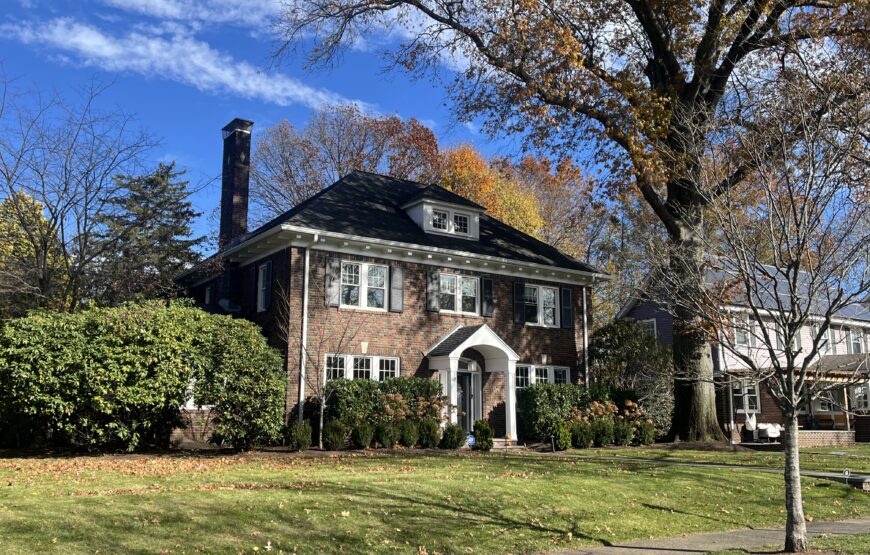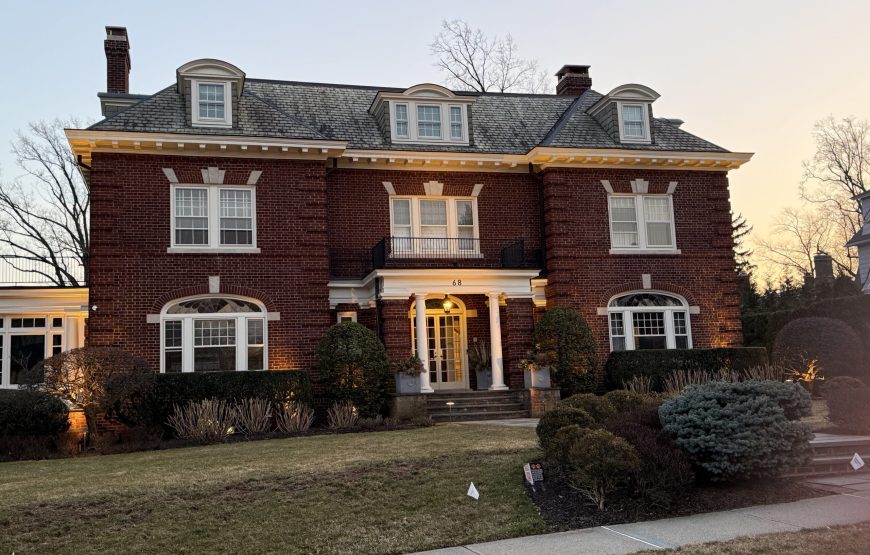
An $8.1 million sale that raised eyebrows, the “Three million is the new four million” phenomenon, and what a Fordham real estate professor thinks is really driving prices in Montclair, NJ
If you’ve felt whiplash watching Montclair home prices lately, you’re not imagining it. A recent Realtor.com survey placed Montclair second amongst the country’s hottest housing markets, and locals have their own anecdotal evidence: a “nice but not insane” house that just sold for $8.1 million, bidding wars that routinely push final sale prices hundreds of thousands of dollars over asking, and a recent trend that finds three million dollar home quietly appreciating to four million.
So is Montclair in a bubble? We put the question to Dr. Joshua Harris, Academic Director of the Fordham Real Estate Institute. While Harris hasn’t served as a real estate agent Montclair’s market, he knows the town personally: Harris taught at Montclair State University, and he served as a reviewer for the school’s real estate program nearly a decade ago. He also had a close friend who lived here, and is very familiar with the area. Harris has also spent his career studying housing markets nationally. His answer might surprise you — and it says as much about New York City’s job market and school anxieties as it does about Montclair itself.
The short answer: no bubble, just no supply
Harris’s read is unambiguous. “I can’t find a single shred of evidence to suggest certainly Montclair or Northern New Jersey has any bubble-ish standards,” he told The Montclair Pod. His reasoning comes down to inventory, not hype.
Montclair, he pointed out, currently has less housing inventory on the market than in 2019 — the pre-pandemic benchmark many people think of as “normal.” Compare that to the run-up to the 2008 crash, when the U.S. was adding as many as 2.5 million new housing units a year, more than double the roughly 1.1 million units needed to meet steady demand. That massive oversupply, paired with reckless lending, is what tanked prices in 2008. Today’s market has almost the opposite problem.
“We are pre-’08, for everybody who was thinking, could ’08 happen again,” Harris said. Back then, the problem was oversupply. Today, nationally and especially in transit-connected suburbs like Montclair, it’s the opposite: there simply isn’t enough housing to go around.
Why Montclair specifically? Blame — and thank — New York City
Harris’s central point is that housing is intensely local, and Montclair’s “local” market isn’t really Montclair. It’s the entire New York metro region.
“A house that is going for a screaming bargain in Peoria, Illinois is really of no value to you” if your job is in Manhattan, he said. But a home in Montclair, Scarsdale, New Rochelle or the Jersey Shore is in your competitive set if you can commute. Because New York City’s job market — including finance, a sector Harris says has grown substantially — remains strong, demand for anything within commuting distance stays high. Montclair, with its multiple NJ Transit stations, sits near the top of that list.
That demand shows up in bidding wars where list prices function less as a ceiling and more as a marketing tool. “That is an absolute strategy the realtors are doing,” Harris said of homes that sell for hundreds of thousands of dollars over ask. “The listing price is meaningless by intention.”
The parents are footing the bill
Ask a Montclair real estate agent about the multi-generational money moving through recent deals, and you’ll likely hear the same thing Harris confirmed: a growing number of these purchases are family affairs, with parents helping fund — or fully funding — their adult children’s down payments.
“If you’re not independently wealthy, it’s very hard to enter as a quote-unquote first-time home buyer,” Harris said, even for dual-income households clearing $200,000 combined, a number that “used to be a big number” and now can feel like lower-middle-class income in a market like Montclair. He described watching open houses in towns like Montclair and Westchester and being able to spot, almost instantly, “who’s actually financially going to be behind that transaction” — often a parent standing quietly beside a young, house-hunting couple.
The national numbers back up what Harris is seeing anecdotally. More than 20% of first-time buyers nationwide used gifts or loans from family for their down payment in 2025, according to the National Association of Realtors. A separate 2026 LendingTree survey found that 40% of all homeowners got financial help buying their current home, up from 35% in 2023 — and that figure jumps to 56% among millennials and 78% among Gen Z buyers.
What about those famously high property taxes?
Montclair residents pay some of the steepest property taxes in the country — an average around $22,000 a year. Harris doesn’t dismiss the sticker shock, but he frames it as a trade-off many buyers are implicitly making against another cost: private school tuition in Manhattan and Brooklyn, which he says can run into six figures per child when you add up tuition and other education and enrichment-related costs.
“If you don’t trust the public school system… a higher property tax is actually more affordable” compared to the alternative of city income tax plus private school fees, he said. Provocatively, Harris suggested that eroding confidence in New York City’s public schools is itself a hidden driver of demand — and prices — in towns like Montclair.
The trade-off has a psychological cost, though. Harris described dual-income households pulling in $500,000 a year who still feel like they’re living paycheck to paycheck after property taxes, mortgage payments and retirement contributions. “That’s the lived reality of more and more people,” he said.
Could a downturn hit Montclair? Yes — eventually
Harris was careful to separate “no bubble” from “prices never fall.” Recessions and market corrections are inevitable, he said; the only unknown is timing and trigger. “There will be another recession, there will be another stock market crash. I just can’t tell you when,” he said, pointing to unpredictable “black swan” events as the likely cause — an AI-driven shakeout, a geopolitical shock, something no one is currently pricing in.
If that happens, Harris expects the Montclair market to cool, partly because home equity is hard to tap and partly because parents subsidizing down payments may pull back. But he pushed back on the idea of a crash on the scale of 2008, absent something as extreme as a mass exodus of New York City jobs. Today’s real estate lending is far more conservative than it was before the last crisis, he noted, which insulates the market even in a downturn.
He also raised a longer-term trend worth watching: as remote work persists, some buyers are increasingly asking whether a two-hour train commute is worth a $2 million-plus price tag when a comparable home in Florida, Ohio or upstate New York costs a fraction of that. “Is it worthwhile to buy…at that point?” he asked, describing conversations with his own Fordham students who increasingly see New York-area homeownership as out of reach — not because they failed, but because the math no longer works. A growing number, he added, are moving back in with their parents after graduation, a choice he says that’s lost its old stigma.
Harris’s prescription for Montclair: build more
Ask Harris what would actually cool the market and improve affordability, and his answer isn’t about interest rates or federal policy — it’s local zoning. He pointed to New Rochelle, New York, which approved roughly 11,000 new apartments around its Metro-North station, as a model for transit-oriented density that towns like Montclair could replicate.
“Allow new apartments to get built, allow new condos to get built, allow us to densify these great cities,” Harris said. “This is one of those few things where you actually don’t have to wait for Congress and the president to agree on something.” More housing near train stations, he argued, spreads infrastructure costs across more residents — which is ultimately what brings tax burdens down, not up.
Quick facts: Montclair real estate, at a glance
Biggest wildcard: A national economic shock (Harris calls it a “black swan event”) rather than anything specific to Montclair
Recent notable sale: $8.1 million for a home described locally as “nice but not insane”
Bidding wars: Homes are routinely selling for several hundreds of thousands of dollars over asking price
Average property tax bill: roughly $22,000/year
Inventory: Lower today than in 2019, pre-pandemic
Bubble risk: Low, according to Fordham real estate economist Dr. Joshua Harris — the market lacks the oversupply and lending excess that caused the 2008 crash