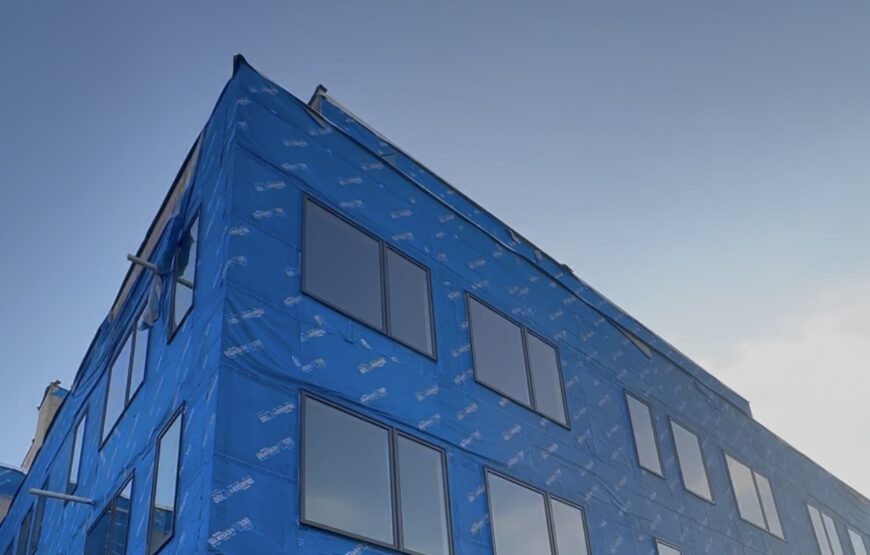
The blue construction wrap has hung over 59-65 Church Street for so long that most people who walk past it downtown do not remember what the block looked like before it went up. Now the building has a new owner, a new tax agreement and, for the first time in years, an actual deadline.
The Montclair Township Council voted 5-1 on August 11 to approve a Montclair Church Street tax break, transferring the site’s existing 30-year PILOT agreement to Dobco Group, according to Montclair Local’s coverage of the meeting. The Wayne-based developer took over the stalled project after a $24.6 million foreclosure sale closed last September, and the vote clears the way for construction to resume on a building that has sat behind that fence since planning approval back in 2020.
What the Council Actually Approved
PILOT stands for payment in lieu of taxes. Instead of paying standard property taxes, a developer pays the town a set annual amount, usually as an incentive to make a project financially viable. Most of that money goes to the township. A small share goes to the county. The school district gets none of it, which means the PILOT structure shifts some of the tax burden onto everyone else’s property bill.
The 59-65 Church Street project already had a 30-year PILOT in place from its original approval. The council’s vote did not create a new tax break. It transferred the existing one to Dobco after the previous developer, Lakewood-based Accurate Builders and Developers, lost the site in foreclosure. Second Ward Councilor Eileen Birmingham, who chairs the council’s finance committee, told planning director Janice Talley during the meeting that the developer has a legal right to that transfer regardless of how the council feels about it. Talley agreed, Montclair Local reported.
That legal reality didn’t stop one councilor from objecting to the deal on principle.
Why One Councilor Voted No
First Ward Councilor Erik D’Amato cast the lone no vote.
“This building should have never had a PILOT. This is a textbook example of the granting of PILOTs when there was no need. It’s a commercial spot. It should have just been a building, ad valorem taxes. It’s punishing the regular homeowner to do this,” D’Amato said, according to the Montclair Local.
D’Amato’s point is that this was never a marginal project that needed a financial push to happen. The plan calls for five stories, 74 apartments and about 3,936 square feet of retail on a well-located 0.84-acre downtown lot, the kind of project developers compete for, not one that needs a tax incentive to pencil out.
That argument gets sharper once you look at what else is baked into this deal.
The Affordable Housing Math
Buried in the ordinance is a detail that says more about how Montclair regulates new construction than the PILOT fight does. Of the 74 planned apartments, eight will be affordable, about 10 percent. That number comes from the site’s original 2002 redevelopment plan.
Montclair’s own affordable housing ordinance, passed in 2018, requires 20 percent affordable units on new construction townwide. So which rule wins? The older redevelopment plan overrides the newer ordinance, planning staff told the council, since redevelopment areas are governed by their own approved plans rather than by townwide zoning updates that come later. The practical result: a building rising in 2026 gets held to a standard the town abandoned eight years ago, half the affordable housing percentage any other new construction downtown would be required to hit.
That gap barely came up during the council discussion, but it may outlast the PILOT fight entirely. PILOT terms get renegotiated. A 2002 redevelopment plan setting affordability rules for a 2026 building does not fix itself.
When Will the Building Actually Get Finished
The council did extract real concessions in exchange for the transfer. The revised agreement tightens the definition of annual gross revenue, the figure used to calculate PILOT payments, so that if Dobco later wins approval to expand the retail space, the township captures that additional revenue too. Any future transfer of the agreement now requires a formal application to the mayor and council along with a fee equal to two percent of the annual PILOT payment. Talley told the council that safeguard was missing back in 2022, when the agreement was assigned to the previous developer’s entity without the council ever formally signing off.
As for the building itself, council members have told Dobco they want the facade finished by October 31. Dobco’s own estimate puts the full project’s completion around spring 2027. A public hearing on the ordinance still has to happen before it becomes law.