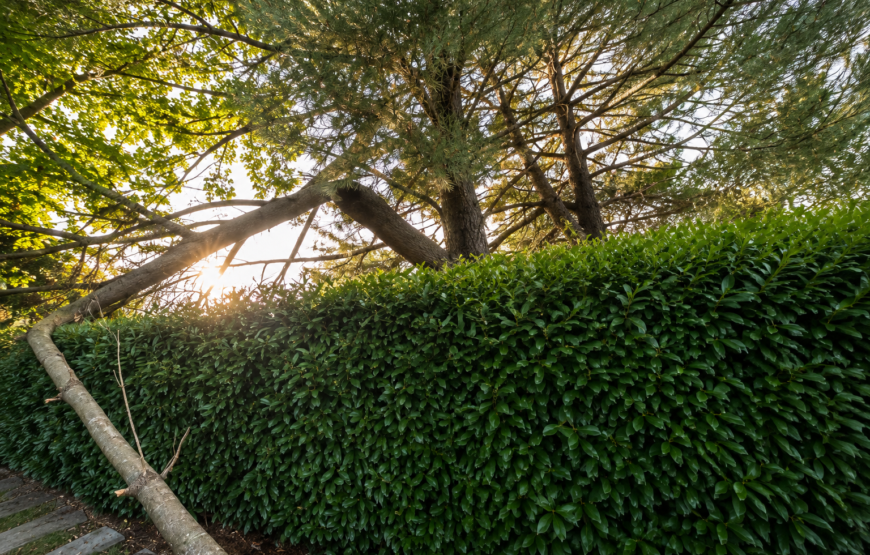
A few weeks ago, during one of this summer’s rolling storms, a big branch tore off a pine tree in Mike’s neighbor’s yard and landed in his. The branch never fully separated. It stayed attached to the tree it fell from, which meant it was technically in both yards at once. That detail turned a routine cleanup into a real question, and it’s one almost every Montclair homeowner eventually asks: who is responsible when a tree falls in New Jersey, and who is supposed to pay for it?
In a town full of century-old trees leaning over closely spaced lot lines, this happens somewhere in Montclair almost every storm season.
So, Who’s Responsible When a Tree Falls in New Jersey?
The rule comes down to where the damage lands, not where the tree grew. Whoever’s property gets hit files on their own homeowner’s policy. It doesn’t matter whose yard the tree was rooted in.
The one exception is negligence, meaning the tree’s owner knew it was dead, rotting, leaning or otherwise hazardous and did nothing about it. If you are able to prove that, only then, the tree’s owner can be held liable. Absent that, the law treats a healthy tree that comes down in a storm as an act of God: nobody’s fault, each side handles its own damage.
That’s the general rule. New Jersey courts have actually tested it.
The Case That Actually Settled This: Burke v. Briggs
In 1990, a white oak on a Clifton property suddenly toppled onto the neighboring yard, crushing a garage and causing $7,900 in damage. The neighbor’s insurance company sued, arguing the tree’s owner was automatically liable simply because it was his tree standing on his land.
New Jersey’s Appellate Division, the state’s mid-level appeals court, disagreed. The court ruled that ownership alone doesn’t create liability, regardless of whether a lawyer calls the claim a nuisance, a trespass or negligence. Each of those is just a different legal label for the same underlying question: did the property owner act unreasonably. The only thing a court actually weighs is whether the tree’s owner knew, or should have known, the tree was dangerous and failed to do anything about it. A tree that falls for no apparent reason, with no evidence the owner had any warning sign, doesn’t create liability on its own.
That standard, set nearly four decades ago over a different oak tree in a different Passaic County town, is still what governs a pine limb landing in a Montclair backyard today — New Jersey courts have continued to cite Burke v. Briggs as the controlling standard in tree-liability cases decided as recently as 2024.
Should You File an Insurance Claim When a Tree Falls?
Filing feels like the obvious move. It’s not automatically the smart one.
A homeowners insurance claim, even a small one, typically raises a policyholder’s rate by roughly 10 to 30 percent at renewal, though estimates vary by source and claim type — figures range from about 7 percent for a single minor claim up toward 30 percent or more for larger or repeat claims. That increase can stay on a homeowner’s claims record for five to seven years, tracked through the CLUE (Comprehensive Loss Underwriting Exchange) database that insurers use to check loss history before writing a policy. New Jersey’s storm protections are narrower than most residents assume, too. The state does let insurers apply a hurricane deductible, a higher out-of-pocket cost that kicks in specifically for hurricane damage, but only when the National Weather Service formally designates a storm a hurricane with sustained winds of 74 miles per hour measured somewhere in New Jersey. A routine summer squall doesn’t come close to that threshold, which means none of those hurricane protections apply.
For a cleanup that runs a few hundred dollars, paying out of pocket and keeping the claims record clean is usually the cheaper move over time. For real structural damage, a cracked roof, a caved fence, a garage like the one in Burke v. Briggs, that math changes.
Before the next storm rolls through, take the fight out of the driveway. Walk the property line with a neighbor now, while nothing is broken, and talk through which trees look like a problem waiting to happen. Photograph anything that already looks dead, leaning or split. The rule is where it lands, but the smartest approach is to never let it get that far.