Yotam Ottolenghi brought a friend’s confession to Montclair on October 6: She can host a dinner party without flinching, but weeknights wear her down.
“I’m stressed about what I feed my kids every night because I’m worried that I’m not doing well enough,” she told him. Asked why, she listed her worries: “I don’t know if it’s a balanced diet and I don’t know that it’s the best I can give them and I don’t know if there’s enough protein.”
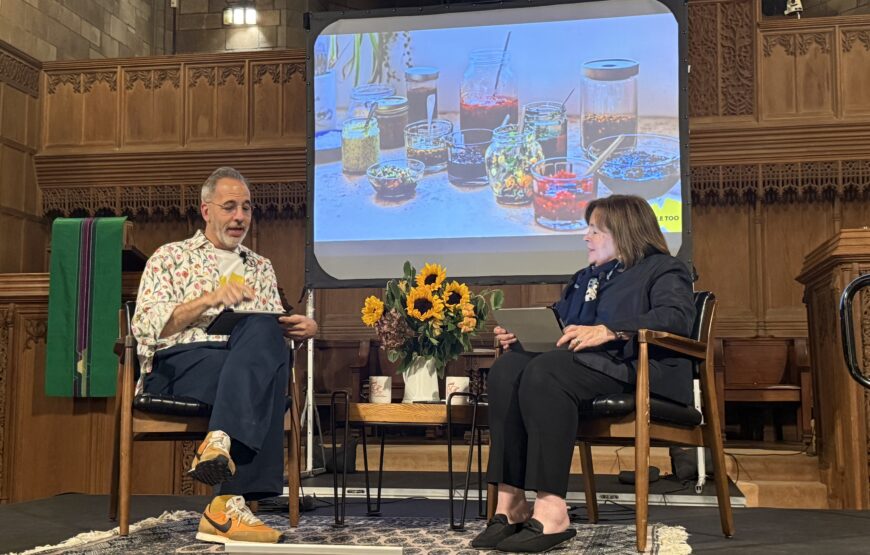
The London chef told the story to a sold-out room at First Congregational Church. Ottolenghi, whose cookbooks put vegetables first and have reshaped home kitchens worldwide, came to celebrate “Simple Too,” the follow-up to “Ottolenghi Simple.” Watchung Booksellers hosted the evening, and Ina Garten, host of “Barefoot Contessa,” interviewed him. His message to the room was a permission slip, not a recipe.
Why does home cooking feel so stressful right now?
Ottolenghi said his readers have changed since “Ottolenghi Simple” came out in 2018, and not for the better. “The world has just changed so dramatically between 2018 and 2026,” he said. “We are more anxious, we’re more nervous as people.” The biggest shift, he said, is that “we spend less time with other people and we’re addicted to our screens.”
His reply to his friend: “You’ve been brainwashed. And we all have. I’m the same. You’ve kind of outsourced your decision making to the screen.”
He blamed the short videos that make cooking look effortless. People “spend like days and weeks preparing this five second video on TikTok,” he said, so the bacon sandwich on screen looks easy. “We all feel like we’re not doing right by ourselves.”
His fix lowers the bar on purpose. “Any cooking is good enough cooking,” he said. “It’s much better than opening a package or going out or getting a pizza, because it’s about being present.” He is not a purist, he said; he sells takeout and still wants people to buy it.
The book, he said, was built to prove it.
What is Ottolenghi’s “Simple Too” cookbook?
“Simple Too” is the follow-up to the 2018 bestseller, written with co-author Verena Lochmuller, and it began with Ottolenghi’s sister. She told him the food was great, but she was “just a busy working mom” with no time for it. He said he wanted to prove her wrong: “You can have that complexity, you can have those flavors, you can have those contrasts, and you can still cook in a way that is doable.”
“Simple” means different things to different cooks, so the recipes sort into categories: 30 minutes, one pot and make ahead. Some people hate shopping and want to cook from the pantry. Others want to batch cook, meaning make big portions once and eat from them all week.
A new chapter, “Fundamentals,” collects 15 flavor builders meant to live in the fridge, including spring onion oil, confit tomatoes (tomatoes slow-cooked in olive oil) and chili crisp, a crunchy chili-oil condiment.
The lemon returns, too. The British cover of the first book carried one big lemon. The new cover has two, “like two old friends slightly leaning on each other.”
The stress was the diagnosis. The recipes were the treatment.
Which “Simple Too” recipes can you make ahead?
Ottolenghi’s case for leftovers runs against a decades-old ethos of cooking everything fresh. Serving everything the moment it’s done, he said, is “the restaurant mentality.” “Batch cooking is not considered very sexy, but batch cooking is really the future.”
One tray of tomatoes, olive oil, herbs and two heads of garlic roasts down to a sauce. Squeeze the soft, sweet garlic out, whisk it in, and the sauce gets body. “I just add like six fillets of fish and put it in the oven,” he said. “When it comes out, I put tahini [a sesame paste], and that’s your dinner.”
His Moroccan pastilla, a sweet and savory chicken pie usually sealed in layers of pastry, is one of the book’s most complicated recipes. He cooks chicken thighs low and slow, shreds them and tops the pan with phyllo, a paper-thin pastry dough, scrunched with butter and flaked almonds. “Everything happened in one tray within an hour and a bit, but with very little intervention,” he said.
Then there is the chicken that doubles as dressing. Thighs roast with lemon slices, and the pan juices toss with romaine under a quick buttermilk ranch. “You don’t lose anything,” he said. “You’ve got the juices and you don’t throw them away.”
Garten wanted to know how a philosophy student ended up in a professional kitchen.
How did Yotam Ottolenghi go from philosophy to the kitchen?
Ottolenghi’s master’s thesis examined the status of the photographic image in aesthetic and analytical philosophy. When he finished, he said, “I was having a conversation with about three other people that understood the language.” Kitchens were the opposite. “Everybody understands food. So it’s a wonderful medium if you want to have some ripples.”
His parents, both academics, were not thrilled. “It’s a typical immigrant story, isn’t it?” he said. They made peace at his 40th birthday party. “My dad stood up and said, I don’t think I’ve got any more advice to give you, because the last time I gave you advice it was the wrong advice,” Ottolenghi said. “That was kind of his way.”
His turning point came when the Guardian asked for simple recipes in 2015. He bristled. “I thought this is an oxymoron. Ottolenghi does simple,” he said. “I remember really hating the challenge and then loving the challenge… It’s amazing what a challenge does to you.” He “kind of almost got addicted to it,” he said, and a whole book followed.
That is the lesson he hoped the room would take home.
Where to buy “Simple Too” after Yotam Ottolenghi’s Montclair event
Tickets for the Oct. 6 evening sold out. The book is the next-best way to take the night home, and Watchung Booksellers, the event’s host, is at 54 Fairfield St. The store is open 10 a.m. to 7 p.m. weekdays and 10 a.m. to 5 p.m. weekends.
Start with the one-tray tomato sauce this weekend, then invite someone over. Garten made the case for that second step: “The simpler your cooking is, the more likely you’re gonna pick up the phone and say, Come for dinner. And anybody that gets an invitation to dinner shows up.”
Any cooking is good enough cooking, as Ottolenghi put it.