“Think of the Uber driver who brings you your Uber Eats in the evening,” Anne Mernin said. “Someone who’s packing your groceries in a local market. A bus driver. Someone putting gas in your tank. Someone taking care of your children in a preschool. These are all people that we see every day, that we interact with every day, and we don’t realize that they’re food insecure.”
Mernin has run Toni’s Kitchen as executive director for more than 15 years. This week she sat down with Farnoosh and Mike to talk about what federal cuts to SNAP, the Supplemental Nutrition Assistance Program that puts grocery money on an EBT card each month for low-income families, seniors and people with disabilities, are doing to food access in Montclair, Essex County and across New Jersey. The Congressional Budget Office projects 47,000 New Jersey residents will lose SNAP benefits in a given month under the new rules. Mernin put that in local terms: Montclair has about 40,000 residents. The number of people expected to lose benefits is larger than Montclair and Glen Ridge combined.
She is not pessimistic about what this community can do about it. But she is clear about what’s coming.
What Changed, and Why It Matters for New Jersey
In July 2025, President Trump signed the One Big Beautiful Bill Act into law. The legislation, passed through the budget reconciliation process rather than the Farm Bill process that has traditionally been used to set SNAP and agricultural policy, made several changes. It expanded work requirements to everyone between 18 and 64 who is able-bodied and without dependents under 14, raising the previous age ceiling of 54 by a decade. It removed prior exemptions for veterans, people experiencing homelessness and former foster youth up to age 24. And it changed how future SNAP benefits can grow, limiting the federal government’s ability to increase benefit levels beyond standard inflation adjustments. “It doesn’t allow for inflation,” Mernin said. “Whatever is in there this year at this year’s dollars, that’s the cap going forward.” She paused. “We’re really sort of trying, I think, to kill SNAP with a hundred cuts. But we’re not fixing the things that give rise to the need for SNAP.”
The three-year rule is what she considers the most consequential detail for the people she serves. Once someone loses SNAP benefits under the new requirements, they have a 30-day window to successfully navigate the reinstatement process. “You have to remember there’s a wide variety of education levels, of the ability to navigate some of these complex rules,” she said. “And then you’ve got these new populations that are subject to the work rules. So like people who are unhoused, right? Well, okay, that’s a challenge on so many levels, just to get a shower, to get yourself together to apply for a job.
What Toni’s Kitchen Actually Does
Most Montclair residents know the name. Fewer know how much the organization has changed. Toni’s Kitchen was founded in 1982 as a project of St. Luke’s Episcopal Church, named after its first cook, Antoinette “Toni” Green, and it started as a soup kitchen. Mernin, who came from a management consulting career in New York City, got involved about 15 years ago “very much by happenstance,” she said.
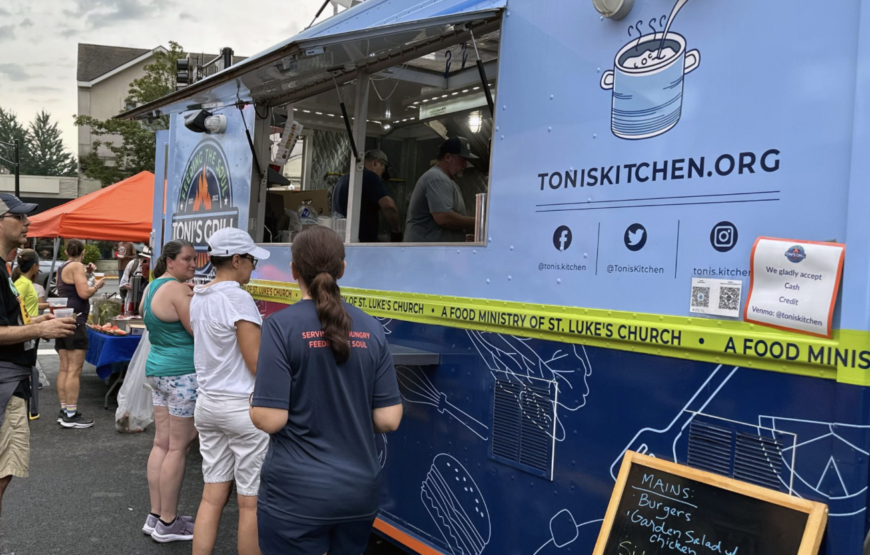
A soup kitchen, she explained, serves a specific population: people who are unhoused or in precarious housing, often with histories of trauma or mental health challenges, for whom a shared meal is also a point of entry into services. That model has its place. But it isn’t the right solution for everyone who is food insecure. So the organization eventually built something different. The Choice Pantry now runs Wednesday through Saturday, structured like a farmer’s market where guests choose their own groceries, with roughly 25 community partner organizations on site offering services from nutrition counseling to mobile dental care to legal help. Nine neighborhood mobile markets operate at schools, libraries and faith communities across Montclair, Bloomfield and West Orange. The organization delivers meals to seniors and people with serious medical needs, runs a food truck, and school pantries.
“Our goal is to look at who is it that we’re serving, who is food insecure, what is the best way to connect with that population, and then what is the best food for that population,” Mernin said, “because populations need different types of food.”
Sourcing that food is its own operation. Toni’s Kitchen relies partly on gleaning, the practice of collecting surplus food that would otherwise go to waste, from retail partners including Trader Joe’s and Whole Foods. Mike asked how it works practically. Mernin explained: staff pick up soon-to-spoil produce, like mislabeled milk and bread near the end of its shelf life, seven days a week, combining it with purchases, food drive donations and supplies from the community food bank before allocating it across programs.
What Food Insecurity Actually Looks Like in Montclair
Food insecurity is not the same as hunger. Hunger is missing a meal. Food insecurity is not having reliable access to healthy food appropriate to your household at all times. In a suburb, the distinction matters because the problem is invisible in ways it isn’t elsewhere. “If you drive into Irvington, you will see that evictions are rampant just by driving down the street,” Mernin said. “You will see people’s furniture and all their belongings on the street every day. But you won’t see that in all communities. So we just don’t see it’s happening. It’s more theoretical than real.”
The majority of households receiving SNAP who are not retired are working, she said. They earn wages that cover some of what they need, and SNAP covers the gap. “This is not like a bunch of people who don’t feel like working.” Mike put it more sharply: people like him and Farnoosh experience inflation as an annoyance, a dinner costing more than it should. “For people who are living on the margins,” he said, “inflation means the difference between feeding yourself and not. And when you lose a benefit like this, I can’t even imagine.”
Toni’s Kitchen has responded to disruptions before. When the federal government shut down in November 2025 and temporarily suspended SNAP funding nationwide, the organization stood up a Government Shutdown Market within days and, with support from the Bravitas Group and the Silver Family Foundation, launched a matching-gift campaign up to $118,000. That response took weeks to build. What’s happening now is different in kind: it is written into law, it is already rolling out, and there is no court order that will reverse it.
What the State Can and Can’t Do
“The governor knows Toni’s well,” Mernin said of Governor Sherrill. “She has volunteered here and her staff have been here.” Sherrill has proposed over $100 million in FY2027 budget support for SNAP administration and is pushing back on federal cost-shifting provisions that would require New Jersey to cover up to 15% of actual benefit costs if the state’s payment error rate, a federal measure of incorrectly issued benefits, exceeds 6%.
But Mernin was precise about the limits. Starting in October, counties absorb an additional 25% of SNAP administrative costs previously covered by the federal government, layering new expenses onto already stretched budgets. And the competition for state dollars is real, including with Medicaid and education budgets. “There will be an impact on taxpayers,” she said. “And you have to remember that SNAP is an economic engine.” Every SNAP dollar spent at a local grocery store generates between $1.50 and $1.80 in local economic activity. Pull those dollars away from ShopRite, from Acme, from corner stores not part of national chains, and the absence is felt there too. “We know that the state cannot fill the void if this rolls out the way it’s expected,” she said. “And this is in law now. It’s not a maybe.”
What Mernin Thinks Montclair Can Actually Do
Mernin grew up here. She went to Grove Street School, now the Dorren School, graduated from Montclair High, left for college and came back to raise her three children. She knows the town’s class lines, even when they’re invisible to most people who live here. A childhood friend who lived on Walnut Street, when that street still marked a divide between the town’s socioeconomic halves, asked her once: when your mom washes your clothes, does she always use detergent? “I realized that her mom could not always afford laundry detergent,” Mernin said. “I so appreciated, as I grew up, that I had the experience of being in different kinds of homes.”
That kind of economic range within the same neighborhood is harder to find in Montclair now. The single-room occupancy buildings and rooming houses that once provided low-cost accommodation along Claremont and South Park are largely gone. The town has become more expensive and, in some ways, more uniform. But the civic instinct is still here, and Mernin is genuinely optimistic about what it can produce. “With the resources, values and needs. They all coexist here,” she said. “If we can’t do it here, I just don’t know who can… I think it’s on us to develop solutions that model how communities can come together and address these issues while the noise at the federal level works itself out.”
She is specific about what action looks like. Running to ShopRite: pick up an extra bag. In a book group or on a block: ask people to bring a healthy breakfast item. None of that is dramatic. She pushed back on the instinct to treat it as small. “It’s food for a family. It’s food for a senior who’s trying to figure out, do I buy food or do I turn my heat on? Do I buy food or do I get my medication? These feel like small things, but they really aren’t.”
The bigger ask is awareness. Think, she said, about the person putting gas in your car. Do they make enough to live in New Jersey? “It’s kind of mind-blowing when you look at it that way.” She described food insecurity as different from other large systemic problems in one way that matters: it is solvable at the community level, even when the federal picture is bleak. “I think food is a little different,” she said. “When any of the other pillars of stability in our communities begins to wobble, it always shows up in food. But the bright side is that food is something we can solve. We as a community can just decide we are not going to tolerate food insecurity in our community, and we’re going to take action against that. And it can have a very meaningful, tangible impact on families and seniors.”
Toni’s Kitchen is at 73 S. Fullerton Ave., Montclair. The Choice Pantry runs Wednesday through Saturday, 10:30 a.m. to noon. To donate, volunteer or find current programming: toniskitchen.org, hello@toniskitchen.org or (973) 932-0768.