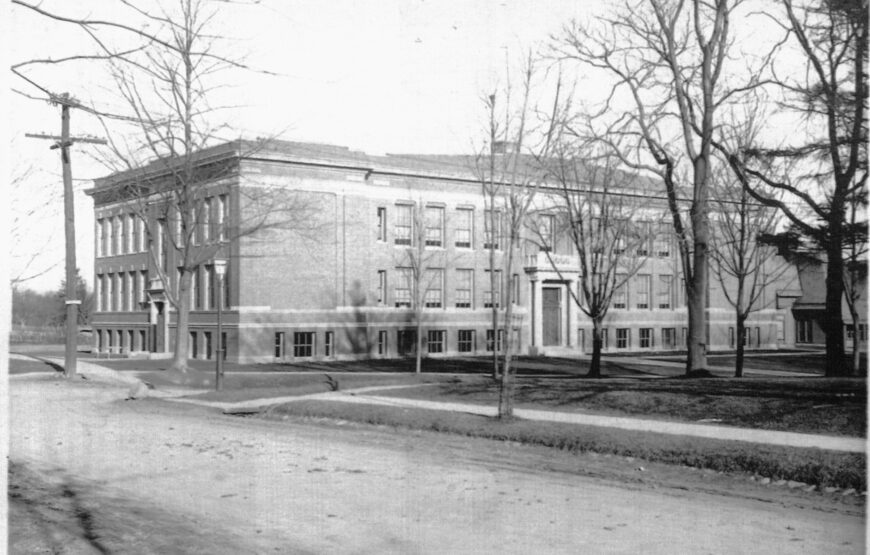
Photo: Nishuane School, 1906
Source: Montclair Public Library Photo Foundation
Montclair proudly defines itself through a district-wide magnet school system rooted in choice, diversity, and integration by design. In the wake of the district’s financial crisis, residents are starting to ask: Can we still afford our magnet system? To understand why we even have a magnet system, we need to step back in time to learn about how our present system is deeply tied to the town’s history of community activism, segregation, and racism.
By reflecting on the past, we can use those lessons to help guide the future of our magnet district. Superintendent Ruth B. Turner shared her thoughts, saying, “The magnet system was one of the things that attracted me to Montclair. I don’t question its relevance, but we are going to have to reimagine a lot of things.”
Through firsthand accounts and historical milestones, this timeline explores how policy, protest, and perseverance shaped one of the state’s most closely watched school districts.
Montclair’s magnet school system didn’t just happen.
It was built through activism, resistance, court battles, busing, bold ideas, and decades of community work.
This timeline shows how we got here and why the questions facing our schools today matter so much.
Late 1800s
After the Civil War, there was a significant migration of Black families to Montclair, many from Northern Virginia, to work in the domestic sector for wealthy families. These families largely lived in the South End and in Frog Hollow, the area now home to Tierney’s and the Montclair Bikery.
As the district built schools, residents were assigned to the specific neighborhoods where they lived and became largely segregated as a result, even though there were no explicit statutes mandating segregation at that time in Montclair.
Early 1900s
This pattern continued into the early 20th century. Montclair had some integration, including a large working class Italian population in parts of town and some schools south of Watchung Avenue were began to have mixed races.
At the same time, Black residents of Montclair were becoming more economically mobile. The town was known for having Black doctors, lawyers, and business owners. Still, schools in the southern section were typically underfunded compared to those in affluent Upper Montclair.
1933
In 1933, the Montclair Board of Education implemented a gerrymandered redistricting plan that transferred all Black students from the racially mixed Nishuane School to the predominantly Black Glenfield School. At that time, Glenfield did not offer the same college preparatory curriculum as other schools in the district and instead emphasized vocational training. Former student, Elizbaeth Yarbourough, shared that school officials “sometimes still treated us [African Americans] as though we are stupid, recommending nearly all black children for trade school.”
Frank Pickell, Montclair’s superintendent, brazenly acknowledged the intent to segregate Black students at a Board of Education Meeting in September 1933, stating, “Negroes should be satisfied with arrangements for separating Negro school children…in the South Negroes had to take the crumbs and were glad to get them.”
In response to discriminatory practices, Black families in Montclair organized a boycott of segregated schools, led by local parent Mary Allen, who refused to send her children to the schools they were assigned. This early act of resistance, predating the modern Civil Rights Movement, was part of a broader tradition of Black organizing in the town. The Montclair NAACP, founded in 1913, played a central role in protests and advocacy for desegregation, a legacy that continues today.
The state ultimately backed the Montclair Board of Education, allowing many elementary and middle schools to remain effectively segregated.
1948
For close to 20 years, the Montclair district stayed unfortunately the same and segregated. In 1948, the district employed only one Black teacher.
1954
In 1954, Brown v. Board of Education ruled that racial segregation in public schools was unconstitutional. Montclair responded by asserting that segregation in the district was based on residential boundaries and individual choice, not race.
According to later research, Montclair High School did not hire its first Black teacher until 1956.
Early 1960s
By the early 1960s, Glenfield was 90% Black and suffered from chronic underinvestment. The superintendent proposed closing the school and dispersing students across the three junior high schools to integrate them.
Some white parents from other Montclair schools ended up suing the Board of Education, but ultimately they lost in a 7 to 0 decision in the New Jersey Supreme Court. The ruling stated that ignoring race may work when the government is separating people, but it does not work when the goal is to bring people together.
After the decision, junior high schools were integrated, though many elementary schools remained segregated.
1966 and 1967
In 1966, Black families filed Rice v. Montclair Board of Education, arguing that de facto segregation denied students resources and caused psychological harm.
In 1967, the court ruled that all Montclair schools must be integrated. The district began experimenting with different approaches to desegregate the various schools.
Late 1960s
At Montclair High School, racism may have been seeping into the school’s football team. Black football players were reportedly being denied access to college recruitment letters by coach Clary Anderson. In an interview, former athlete, Lonnie Brandon, recounted the football team’s student manager who “asked me if I had seen this letter from Southern Illinois University. I said, ‘No, what letter?’ He said, ‘Oh, Clary has it.’ So I go to Clary. He tells me, ‘Yeah, you got a letter, but you can’t get into that school, so you really don’t need a letter.’”
The writer notes that Clary Anderson made similar decisions for many other gifted African American student-athletes.
At the time, Montclair High School had 2,500 students, about 30% Black, but only four African American teachers. One of them, Jeanne Heningburg, intervened, demanding that all withheld letters be released, according to Brandon.
Clary Anderson later became a prominent figure in Montclair athletics, with the ice skating rink named in his honor. Lonnie Brandon went on to graduate from Wagner College and serve as director of Montclair’s Parks, Recreation, and Cultural Affairs Department from 1973 to 2004.
1972
Mandatory busing began in 1972. An estimated 1,500 students left the public school system, either enrolling in private schools or moving out of the district. Reasons for the mass exodus varied, including racism and logistical challenges. Busing plans changed frequently, splitting friend groups and causing widespread dissatisfaction across the town.
A group of frustrated Black and white parents were so upset by mandatory bussing that they bypassed the Board of Education and appealed the decision directly to the state. This effort is documented in Our Schools, Our Town: A Short History of the Montclair Magnet School System, produced by Masiel Rodriguez-Vars.
Longtime Montclair resident and teacher Dan Gill argued that early desegregation efforts were designed to fail. He described forced busing as a poorly constructed solution—intentionally ineffective—meant to prove that integration “couldn’t work.” Gill compared it to early, impractical seat belt mandates that frustrated the public rather than encouraging real change.
1975
In 1975, the district formed a task force to develop a sustainable integration plan, with Dan Gill and Dr. Carol Layne Williss as two of its central members.
Gill explained: “We developed a plan at Glenfield that functioned as a gifted and talented program, with a strong emphasis on visual and performing arts. It was organized around a house system, six schools within a school, each with four teachers, an in-class support teacher, and about 120 students.
Students entered in sixth grade and stayed with the same group through eighth grade, which provided stability during a time when so much is changing. Each house had its own schedule, and teachers shared planning time so they could collaborate, talk about students, and build intentional support plans.
The program offered students meaningful opportunities in the arts and the consistency of having the same teachers throughout adolescence. “To build support, we took the plan directly to the community, meeting in people’s living rooms, using carousel slide projectors, and showing families exactly what we were proposing,” Gill said.
1977
In September 1977, the magnet school system officially launched with two schools. Nishuane became a more experimental gifted and talented school, while Bradford stayed more traditional with a “back to basics” model.
By the late 1970s and early 1980s, both schools had roughly equal numbers of Black and white students.
1979
Federal funding began to decline. In 1979, the district received $2.2 million in federal aid, equivalent to about $8.7 million today. To put into context, in 2024, the district received $2.9 million, roughly the same nominal amount as 1979. This is about a 75% decrease in funding over 45 years.
1980s
The magnet model expanded districtwide. Watchung focused on science and technology, Edgemont on Montessori, Glenfield on visual and performing arts, and Hillside on gifted and talented education often with students coming from Nishuane.
Diane Tyree Anglin, the President of the Montclair NAACP explained, “The magnet school happened to make certain schools look sexy… So it really became about what your child’s interests were.”
By the 1980s, neighborhood specific schools were effectively phased out of the Montclair school district.
1990s
To help offset declining federal and state support, the Montclair Fund for Educational Excellence (MFEE) was founded in 1991. Current Executive Director, Masiel Rodriguez-Vars shared that when the magnet system was established in the late 1960s and 1970s, significant public funding supported curriculum design, staffing, and specialized resources across schools. As those dollars dried up, sustaining the strength of the magnet system became increasingly difficult. MFEE was created to fill that gap by raising outside funds to help preserve and support Montclair’s district-wide magnet school model.
Throughout the 1990s, the achievement gaps persisted. At Montclair High School, honors classes were overwhelmingly white, while remedial classes were overwhelmingly Black. Joann McCullough, who spent 25 years at the helm of IMANI said: “The gap was pretty glaring… the majority of students that anchored the bottom rung were African American males. The scores of African American students were so much lower than their white counterparts, and we needed to figure out why.”
2007
In 2007, despite a state mandate requiring school desegregation, the Supreme Court ruled that race could no longer be the primary factor in student assignments. So what was Montclair to do? The district hired consultants to help chart a path forward, bringing in researchers from the Kirwan Institute at Ohio State University. They developed a complex plan for student placement – so intricate, in fact, that it took multiple attempts for us to to fully understand and three years to develop and execute.
2010
In 2010, Montclair divided all neighborhoods into three socio-economic zones based on five factors: the number of students receiving free or reduced-price lunch, parental education levels, median household income, household poverty rates, and race. Every school in the district is required to have a roughly equal distribution of students from each zone.
This means that when families select an elementary or middle school, placement decisions aren’t made solely based on preference, administrators must ensure an even distribution across the zones. However, students with siblings already at a school are typically allowed to attend the same school if they choose.
November 2025
Montclair Local writer Asad Jung reported that achievement gaps persist to this day. Montclair schools have sobering data regarding the current achievement gap due to factors like ethnicity, income levels, and school capabilities.
Jung shared “only 44% of Black students were graduation ready in math, as compared to 80% of white students. Black and Hispanic students also scored lower across subjects and grades in NJSLA assessments. For example, only 45% of Hispanic students met or exceeded expectations in Grade 9 for ELA, as compared to 78% of Asian students.”
Jung elaborates, “This disparity isn’t just about race, it’s also rooted in income levels, with “only 38% of economically disadvantaged students were graduation ready in Math, as compared to 74% of non economically disadvantaged students.”
January 2026
Over the decades, Montclair’s magnet school system has grown increasingly complex. While it remains a model of choice, diversity, and integration, the district continues to face ongoing challenges in balancing equity, resources, and student placement. Superintendent Ruth B. Turner said, “We are going to have to look at what students are succeeding in our school systems, who is not, and make sure that every student has the resources that they need to be successful. The data is very clear that we’re not doing a great job of meeting their needs, and that is something that we as a system have to pay attention to and address.”
As students return from winter break, many are finding fewer teachers and support staff in their schools. The district has eliminated more than 100 positions, including operational aides and curriculum support staff, and has also cut the restorative justice program.
the future of the magnet system
As we look to the future, one critical question remains: how should we measure student success? Many argue that success cannot be defined solely by what happens in the classroom or between 9 a.m. and 3 p.m.—it also includes enrichment opportunities.
Dan Gill, reflecting on the early days of the magnet system, emphasizes that true equity required extending the school day for students who needed additional support, as well as offering special classes and experiences. He recounts, “When we integrated, we got a federal grant to keep the schools open for three more hours with buses so the kids could stay. We had a really robust enrichment program where students could explore various activities. This was valuable because it extended integration beyond the regular school day and gave opportunities to children who might not otherwise have had them.”
Gill continues, “Integrated schools provide the best education – for kids of color, for white kids, for poor kids, for rich kids. The data is clear. The question is, how do we make sure that we are not only integrating our school buildings, but our classrooms, and that the resources are there to leverage the integration? It’s not just about putting the bodies in the buildings. It’s about how you use that, how you train your teachers, and how you give them the support to do differentiated instruction. The data shows that integration has a direct impact on academic outcomes for all students, and it also helps build the kids we all want in this world—kids who have critical thinking skills, who are empathetic and compassionate.”
As resources shrink and costs rise, Montclair faces a familiar dilemma. Can the magnet system still deliver on its promise of equity, and can the district afford the infrastructure that makes it possible?
Tune into the Montclair Pod every Thursday for the latest updates on the Montclair school district.