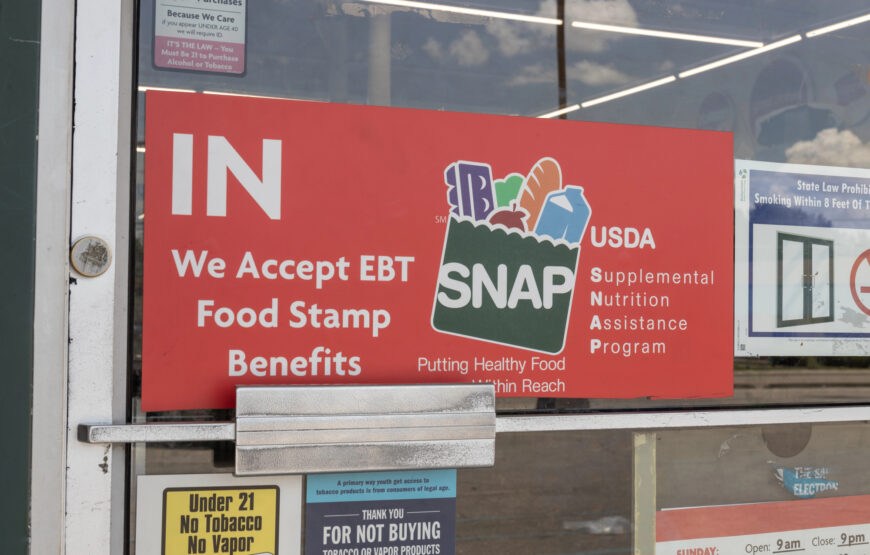
In June, Anne Mernin sat down with the Pod to explain what SNAP cuts in New Jersey would mean for Montclair. The executive director of Toni’s Kitchen didn’t predict one dramatic cutoff. She predicted a slow build.
“It’s just gonna roll out over time,” she said. “It’s gonna get bigger over time.”
Five months later, it has. And in Essex County, it’s building faster than it is across New Jersey as a whole.
In July, 102,749 Essex County residents received SNAP, the federal benefit that loads grocery money onto a card each month and was once called food stamps. That’s 12.4% fewer than a year earlier, according to state data. Statewide, enrollment fell 7%, to 737,447 people.
Essex is losing SNAP recipients almost twice as fast as the state. Toni’s Kitchen, which serves Montclair, Bloomfield and West Orange, sits in the middle of that drop.
How Many People Have Lost SNAP in New Jersey?
In June, Mernin drew a distinction.
“It’s not so much the elimination of SNAP as just making SNAP much more difficult to access and a little bit more bureaucratic, I would say,” she said.
The biggest hurdle is a work rule. Under the One Big Beautiful Bill Act, which Congress passed in July 2025, adults 18 to 64 without a child under 14 at home must log 80 hours a month of work, volunteering or job training. Fall short, and benefits stop after three months in any three-year window.
Most of New Jersey had been exempt. A federal waiver, granted to areas with high unemployment or too few jobs, covered every county but Morris until Feb. 1. Now it covers only Camden City and Cape May County.
The first cutoffs came in May. By mid-June, more than 26,000 New Jersey residents had lost benefits for not meeting the work rule or not filing a medical exemption. Essex County led the state, with more than 6,800.
Not every drop is a work-rule case, and the state’s monthly reports don’t track why people leave the program. But the total is stark: between June 2025 and June 2026, New Jersey lost 71,300 SNAP recipients, and the count kept falling in July.
And the rule now reaches the people Mernin worried about most.
Who the SNAP Work Requirements Are Catching
The 2025 law ended exemptions for veterans, people experiencing homelessness and young adults who grew up in foster care, who had been exempt until 24.
“I have no words for that,” Mernin said of the veterans now subject to the rule. “These are people who have really given of themselves and oftentimes come back with very significant emotional scars.”
She also pushed back on how “work requirements” sounds to people who have never needed help.
Toni’s Kitchen puts a number on it: 82% of New Jersey SNAP households include someone who works, according to the organization. Its list of those workers reads like a weekday on Bloomfield Avenue: delivery workers, home health aides, bus drivers, preschool staff, retail workers and gas station attendants.
The rolls are shrinking. The cost of running what’s left is shifting to the states.
Who Pays for the SNAP Cuts in New Jersey
The cost shift Mernin flagged for October arrived on schedule. On Oct. 1, the federal share of SNAP administrative costs, the money that staffs offices and processes applications, fell from 50% to 25%. In New Jersey, counties run SNAP.
“So if you’re at the county level, you’re seeing a lot more administrative burden because of the new requirements,” Mernin said in June. “And then you’re also going to pick up additional costs.”
For now, Trenton is covering most of that bill. The budget Gov. Mikie Sherrill signed June 30 includes $71 million for the new administrative costs, with $61 million going directly to counties and the rest covering the state’s own share. The administration calls this a transition year, with the state taking on the cost for the counties.
The larger bill is still ahead. Starting Oct. 1, 2027, states will pay part of the benefits themselves, with the share tied to each state’s payment error rate, a federal measure of how often benefits go out in the wrong amount. In letters to New Jersey’s congressional delegation, state officials put the cost at $98 million to $293 million a year, depending on the error rate used.
“States are really in a difficult spot here,” Mernin said. “And you have to remember that these are dollars that will compete with public safety dollars.”
Whether that date holds is up to Congress, which is fighting over it in the farm bill, the law that sets federal food and agriculture policy every few years. Senate Agriculture Committee Chairman John Boozman, R-Ark., has offered a one-year delay, and Democrats say states need at least two years to prepare their budgets. Republicans argue the cost share gives states a reason to bring their error rates below 6%. Boozman’s bill would also make states with higher error rates pay a bigger share, a trade-off the Food Research & Action Center, an anti-hunger group, opposes.
“This is in law now,” Mernin said. “So it’s really whether it’s undone at the federal level.”
Until it is, the gap lands closer to home.
How to Help With Food Insecurity in Montclair
Toni’s Kitchen provided more than 2 million meals in 2025, according to its website. It counts 24,413 household visits to its Choice Pantry, where guests pick their own groceries market-style, and 20,350 to its neighborhood mobile markets, pop-up versions of the pantry at schools, libraries and houses of worship. Sixty-one percent of its meals now reach people off-site, and the organization is raising money for a refrigerated van to keep that food fresh on the road.
Food insecurity, not having reliable access to healthy food, is easy to miss in Montclair. The rules are set in Washington and the bills land in Trenton, but the shortfall shows up on South Fullerton Avenue.
The simplest place to start is Toni’s Kitchen. Donate at toniskitchen.org, where gifts go to buying food and supplies, or sign up to volunteer. Bring groceries to 73 S. Fullerton Ave., entering through the Union Street parking lot, Monday through Friday from 9 a.m. to 1 p.m., Saturday from 9:30 a.m. to noon or Sunday from 3 to 5 p.m., and call 973-932-0768 to confirm holiday hours. The Choice Pantry, where guests shop for groceries, is open Wednesday through Saturday from 10:30 a.m. to noon. Human Needs Food Pantry, at 9 Label St., also accepts food donations.
For more places to give, the Pod keeps a list at montclairpod.com/giveback. If we’re missing an organization, email hello@montclairpod.com. If you need food yourself, start with our guide to food and housing resources.
Congress has until Dec. 11 to fund the government, and advocates want a SNAP delay attached. The pantry on South Fullerton Avenue isn’t waiting for the vote.
Image credit: Deposit Photos