A newly formed nonprofit has 41 days to raise $176,000. The clock is ticking.
Montclair Public Schools is in the middle of a severe budget crisis, and athletics is one of the casualties. As part of a $257,000 cut to sports, clubs, and extracurricular programs for the 2026-27 school year, the district is eliminating freshman sports entirely and slashing the athletic department budget by $176,000 — cuts that affect coaching positions, away game travel, and security staffing at home events across virtually every sport at Montclair High School.
A newly formed parent-led nonprofit, the Montclair Athletics Blue and White Club, is trying to stop it. The club has until June 1st to raise $176,000 to reinstate the athletic department budget to its current baseline. If they don’t hit the number in full, none of the cuts get reversed.
Kevin Price, the club’s president, wants people to understand that the stakes go beyond freshman sports — the headline that has gotten the most attention.
“Clubs and freshman sports is a great talking point and it’s easy to spit out very quickly, but it’s not really the whole picture,” Price said, “in the sense that there are sports at the high school that don’t run freshman specific teams in any given year. Some years they may and some years they may not, but that doesn’t mean that their budget isn’t getting cut or hasn’t already been cut.”
According to Price, the $176,000 gap breaks down across the entire program: 13 coaches who won’t be retained, 80 away games teams won’t be able to attend due to umpire fee cuts, transportation funding covering the equivalent of 12 different sports teams, and reduced security staffing at home football and basketball games. It’s a number that touches virtually every program at Montclair High School.
The club is also working toward a broader $350,000 overall fundraising goal to begin building reserves for future years, invest in facilities like the aging weight room in the Fuzzy Furlong Fieldhouse, and fund mental health programming and college recruitment support for student athletes.
A New Kind of Organization
Price describes the club’s origins as coming together “through the prodding of the current athletic director, Matt Belford.” The structural gap Belford identified, Price explained, was that Montclair’s individual sport booster clubs operate “in their little silo” — fundraising and organizing for their own sport, “very disparate and aren’t interconnected.” There had never been an organization looking at the bigger picture.
“One president doesn’t even necessarily know another president of the booster club,” Price said. “They raise for their particular sport and that’s primarily what they do.”
The club, now a registered 501(c)(3) nonprofit, brings together a nine-member board that includes Price as president and Laura Quiros as vice president. Quiros, a licensed clinical social worker and longtime Montclair parent whose daughter played soccer at the high school, frames the organization’s mission partly in terms of equity.
“The superintendent is really clear that it’s all for one and one for all, like she’s living in the space of equity,” Quiros said. “And I think that creates pause for people. [And] I know that’s a little philosophical and maybe hard for people to relate to, but yeah, it’s about — it is about equity in this moment.” Quiros said she knows firsthand that booster clubs vary widely in their capacity to fundraise — “there’s a lot of disparity between all of these booster clubs based on demographics, who plays, how many girls are on a team.” A coordinated umbrella organization is meant, in part, to address that imbalance.
A Student’s Perspective
For students, the stakes are about a lot more than playing time.
Dylan Kaelin-Panico is a graduating senior at Montclair High School who played both football and lacrosse, and who will be heading to NJIT next year to play Division 1 lacrosse. He traces a direct line from his freshman year experience to where he is today.
“My coaches were there for me and they are a huge reason of who I am today, just from the start,” Kaelin-Panico said. “They honestly laid a pretty good foundation for me to become a division one athlete.”
But he’s quick to point out that athletic achievement is almost beside the point.
“I think it’s one of the most important things for just freshmen in general, because just like the transition from middle school to high school, I mean, that’s one of the biggest transitions you make,” he said.
Quiros, drawing on her background as a social worker, is blunt about what’s lost when those entry points disappear.
“Psychologically speaking, it’s isolation, right? You have kids that are not naturally extroverted, that are not going to go up and meet somebody, right? You don’t have these freshmen teams that build, literally build community where you have older upperclassmen driving freshmen to practice.” She continued: “I’m a social worker, right? So the first thing that comes to my mind is, okay, trauma — increased trauma, increased isolation, increased lack of belonging, increased exclusion. You know what that does for the high school in general?” And on the broader stakes: “I can’t even imagine what it would be like without freshman sports because then we’re going back to increased isolation. There’s a psychological component here around loss that I don’t think people understand.”
The Hard Math
Price explained that the district-level cut to clubs and athletics totals $257,000 — a figure that includes non-athletic clubs like chess and the book club alongside sports programs. The athletic department portion alone is $176,000, which is what the Blue and White Club is targeting in its first campaign. (For a full breakdown of the approved budget, see our Montclair Schools Approve $158.9M Budget coverage.)
What makes the fundraising target particularly important is that it can’t be partially met. Quiros and Price were unequivocal on this point when asked what happens if the goal isn’t reached. “We don’t manifest that,” Quiros said — meaning the question of falling short simply isn’t entertained.
Price also notes that this is almost certainly not a one-year problem. Montclair’s structural budget deficit isn’t going away quickly, and any surplus the Blue and White Club raises beyond the $176,000 immediate goal will be held in reserve.
“If 12 months from now we find out that there’s another district cut to athletics and the gap is $75,000,” Price said, “we may already have the $75,000 sitting in the bank and we don’t have to make the community weary while we go try and go to that well one more [time].”
Bringing Back Mountie Pride
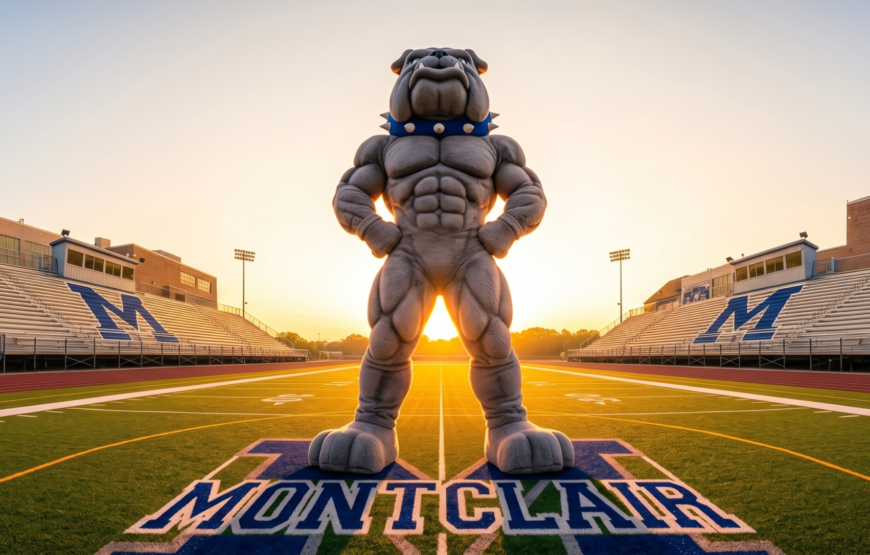
The fundraising goal is urgent, but Price and Quiros are clear that what they’re really after is something harder to quantify. “Montclair is a huge sports town,” Quiros said. “It has legends that live here, have lived here. We have phenomenal teams. We have phenomenal coaches. And there hasn’t been a lot of Mountie pride in general… So the reason for this club was to build Mountie pride, to build community in a town that seemed to have lost it a little bit.”
Price puts numbers to the feeling. “There were hundreds and hundreds and hundreds of people at some of those events that had no real connection to any player on the field,” he said of Montclair high school games in earlier years. “Just over time, it seems like it’s faded for whatever reason. I don’t know that it was anything particular, but I just feel like over the last two decades, certainly it’s not the same as it used to be.”
What that used to look like is captured vividly in an oral history Brenda Smith Williams recorded for the Montclair History Center. Smith Williams grew up in Montclair in the 1950s and 60s, and her memories of Thanksgiving football games read like a different world: “There was standing room only, hot chocolate, hot dogs. And we always had to have the yellow mums with the blue ribbon, everybody. And it was a sight to be seen it, and everybody in town was out there… and that’s the way it felt. It was hardly anybody who didn’t support that winning team because we used to win and it was beautiful to see all of the, all of the yellow, you had to have a mum with the blue and white streamers. And it was so jovial.”
She remembered the pep rallies too: “We had [a] pep rall[y] before the football games at Montclair High School… all of the football players would have something to say. They would introduce us to them. So we knew the football players and we were just behind them. It was just such a spirit thing, not only for the high school but for the whole town. Everybody in town.”
That’s what the Blue and White Club is working to get back.
How to Help
The Montclair Athletics Blue and White Club is accepting donations through GiveButter and also via Zelle at the handle mabwc-mountie-pride-2026. All donations are tax-deductible and corporate matching gifts are welcome.
The June 1 deadline is firm.
Those interested in joining the fundraising committee don’t need prior nonprofit experience — just a network and a willingness to help. Email mabwc26@gmail.com or follow the campaign on Instagram at @montclairathleticsbluewhite.