A lifelong Montclair resident recalls the football games, the pep rallies, the raccoon coats, and the spirit that defined her youth in the 1950s and 60s.
Based on an oral history recorded by the Montclair History Center, with additional reporting by The Montclair Pod.
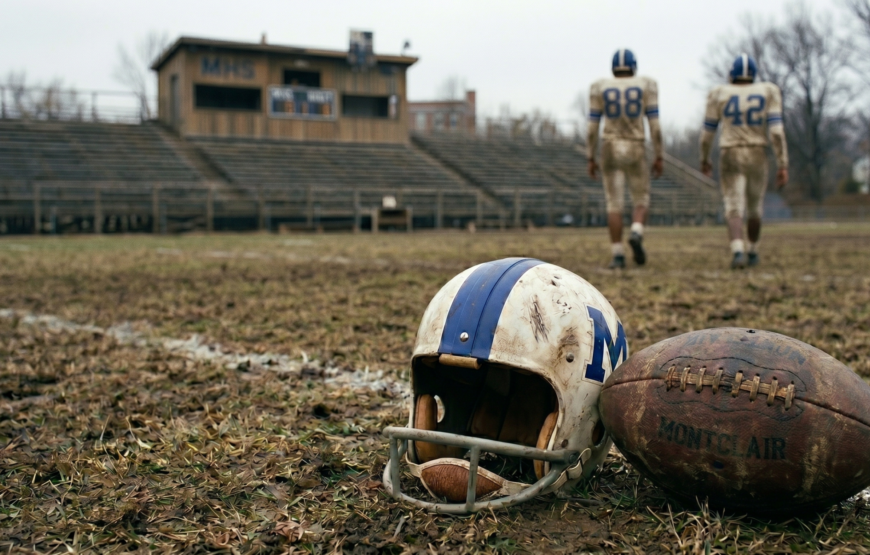
Brenda Smith Williams has been watching Montclair play football since her father first took her to a game as a little girl. Her family roots in this town run back to the late 1800s, when her paternal grandfather arrived here as a baby. Her father was born in Montclair in 1921. She was born here in 1944. Her daughter graduated from Montclair High School too. Five generations.
When she sat down with Montclair History Center interviewer Jane Eliasof in November 2018, she didn’t take long to get to the subject closest to her heart.
“The very best part [of growing up in Montclair] was football,” she said. “We were a football town.”
Coach Anderson, Aubrey Lewis and the Haines Brothers
Growing up in the South End near Nishuane School, Smith Williams came of age during what many consider the golden era of Montclair High School athletics. She remembers the names that mattered then: Coach Clary Anderson, Aubrey Lewis, the Haines brothers.
Clarence “Clary” Anderson coached football at Montclair High School for nearly three decades, winning 209 games and more than a dozen state titles, including a stretch from 1946 to 1957 when Montclair won 102 games and lost just 4. He resigned in 1968 to take over the program at Montclair State. (His legacy is complicated; as we explored in our conversation with Lonnie Brandon, who played under him in the 1960s, Anderson’s relationships with his Black players were allegedly not always equitable.)
Aubrey Lewis was a different kind of Montclair legend. Born in Glen Ridge, Lewis grew up in Montclair and graduated from Montclair High School in 1954. A three-sport star, he led the way to two state football championships, scoring 49 touchdowns and running for over 4,500 rushing yards, and was named the Offensive Player of the Century by the Star-Ledger alongside Paul Robeson. He chose Notre Dame from a list of 200 schools that offered him scholarships. He was selected by the Chicago Bears in the tenth round of the 1958 NFL draft, but an ankle injury prevented him from playing professionally. He later became one of the first two African Americans to complete training at the FBI Academy in Quantico, and went on to a long career as a senior executive at F.W. Woolworth. He died in 2001; the Aubrey Lewis Sports Complex at Woodman Field is named in his honor. Read more about Lewis at the Notre Dame official athletics site and NJSports.com.
The Haines brothers Smith Williams mentions were Richard and Robert Haines, twin running backs known as the “Twin Comets.” They led Montclair’s undefeated 1956 team as part of that school-best 37-game unbeaten streak. Richard was a high school All-American and the program’s all-time leading scorer at the time; Robert was celebrated as a bruising blocker and tackler. Both were three-sport athletes in football, basketball, and baseball. Read more about them in this New York Times article from 1958.
For Smith Williams and her peers, these were not abstract figures from a record book. They were people you knew, players you cheered for, names you learned about in gym class. The oral history transcript notes that students even learned the fundamentals of football in physical education. That’s how embedded the game was in daily school life.
The Pep Rallies and the Amphitheater
Before home games, the school held pep rallies in the amphitheater, the same outdoor space where for generations, Montclair High School students have walked across the bridge at graduation. Smith Williams remembers those rallies vividly.
“We had a pep rally before the football games at Montclair High School… all of the football players would have something to say. They would introduce us to them. So we knew the football players and we were just behind them. It was just such a spirit thing, not only for the high school but for the whole town. Everybody in town.”
That last phrase – everybody in town – comes up again and again in how she describes it. Not just the students. Not just the parents. The whole town.
Thanksgiving, Raccoon Coats, and the Yellow Mums
The biggest games of the year were the Thanksgiving matchups, and Smith Williams’s memories of those afternoons are vivid.
“On Thanksgiving, you know, those old raccoon coats, you saw a lot of people with raccoon coats,” she recalled. “There was standing room only, hot chocolate, hot dogs. And we always had to have the yellow mums with the blue ribbon, everybody. And it was a sight to be seen it, and everybody in town was out there… and that’s the way it felt. It was hardly anybody who didn’t support that winning team because we used to win and it was beautiful to see all of the, all of the yellow, you had to have a mum with the blue and white streamers. And it was so jovial.”
The yellow chrysanthemums with blue and white ribbons she describes were more than a fashion accessory. The tradition of wearing chrysanthemum corsages in school colors to football games dates back to at least 1911, according to a Stanford University report. By that year, Berkeley and Stanford students were already competing over whose chrysanthemum corsages were more conspicuous at their annual Big Game. The flower’s natural autumn bloom made it the ideal football season accessory, and wearing one in your school’s colors was a visible, public declaration of loyalty. At Montclair, where the team was racking up state championships under Coach Anderson, the sea of yellow mums in the stands wasn’t just decoration, it was way for members of the community to project their support.
The raccoon coats she remembers seeing at those games have their own piece of American cultural history. As Messy Nessy Chic has documented, the style originated in the 1920s when Ivy League undergrads began wearing heavy, full-length fur coats to football games as a status symbol and a badge of Jazz Age collegiate enthusiasm. In 1928, George Olsen released a song called “Doin’ the Raccoon” to capture the craze, and The Saturday Evening Post featured a cover illustration of college men in the coats that cemented the look as a symbol of the era. By 1935, according to Messy Nessy Chic, the leading men’s fashion magazine Men’s Wear was reporting that the coat was back in fashion, with the best style worn by “undergraduates and alumni alike.” The trend had faded during the Depression, only to briefly re-emerge after the war in the 1950s, right around the time a young Brenda Smith Williams was watching Montclair football games with her father.
After the Game: Rudd’s Dairy and the Mountie-Gras
The ritual didn’t end when the final whistle blew. After the games, Smith Williams and her friends from the South End would head to Rudd’s Dairy (formerly Rudd’s Dairyland) for hamburgers, French fries, and the jukebox at the booths. The white kids, she notes, generally went to Bond’s in Upper Montclair, though sometimes the groups mixed. It was, she says without apparent bitterness, just the way things were.
At the end of the football season, there was the Mountie-Gras (Montclair’s take on Mardi Gras), a dance held in the Montclair High School gym to celebrate the team. “Since the football team was so successful in those years,” the oral history notes.
Football wasn’t the only sport that drew crowds. “Track meets in the spring were also popular,” she recalled. “There was a LOT of spirit at Montclair High School.”
A Town That Knew How to Show Up
Smith Williams’s recollections are notable for their specificity: the yellow mums with the blue and white streamers, the hot chocolate from the little building at Edgemont Pond, the amphitheater full of football players introducing themselves before a game.
“I loved football,” she said. “I didn’t understand all of the nuances of it, but it was a spirit thing… Everybody in town was out, at least that is the way it felt.”
Montclair’s athletic programs are currently at the center of a community debate over school budget cuts. Parents have formed the Montclair Athletics Blue and White Club to raise $176,000 by June 1st to restore the athletic department budget for the 2026-27 school year. Read more about the effort here.
Brenda Smith Williams’s oral history is catalogued as part of the Montclair History Center’s collection. You can explore their holdings at montclairhistory.org.