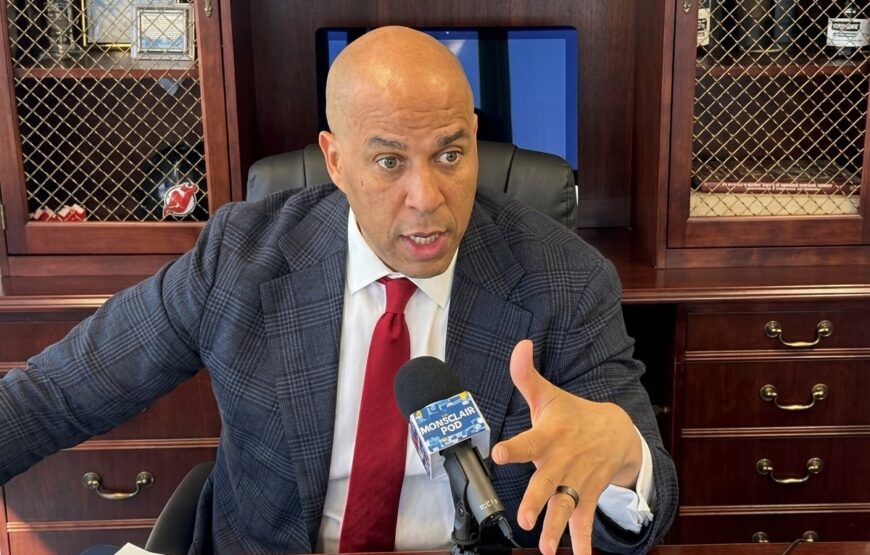
As Montclair enters 2026, the township is navigating a complex financial landscape, rising costs, school budget pressures, and major redevelopment projects. Farnoosh and Mike sit down with Township Manager Stephen Marks to explain how municipal finances operate, what PILOT revenue means for Montclair, and the latest updates on the Lackawanna Plaza development.
🎧 The full conversation is available on this week’s episode of The Montclair Pod. Below is a summary of the interview.
Key Highlights
- Top Budget Priority: Marks emphasized keeping municipal taxes stable as the highest priority.
- Municipal vs. County vs. Schools: Marks clarified that the township manager oversees only municipal operations; school board and county budgets are independently managed.
- Cash Balance & Fiscal Policy: Montclair maintains roughly $15 million in cash reserves, with about $8 million used annually as revenue to ensure consistent fiscal planning.
- PILOT Revenue & Development: Montclair has 11 developments with tax abatements or PILOT agreements, generating about $9 million in anticipated revenue. Lackawanna Plaza redevelopment includes 30% affordable housing, stormwater and traffic improvements, and historic preservation commitments. PILOT rates are slightly lower than conventional taxes but intended to support major investments.
- Municipal Building Plans: The $50 million figure for a new municipal complex stems from construction cost estimates. Discussions are linked to PSE&G’s interest in replacing a nearby electrical substation and potential relocation of the police department and court.
- Revenue Strategies: The township is exploring cost reductions and revenue generation, including parking fees and potential road closure fees for film productions.
- Proposed 2026 Municipal Tax Increase: Marks aims to keep the municipal tax increase at 2% or less, below inflation and Social Security cost of living adjustments, mindful of taxpayer burden.
Budget Priorities and Who Controls What in Montclair
As Montclair enters another challenging budget cycle, Marks said his top priority remains unchanged. “Top priorities would be the same as I mentioned the last time I was on. Number one, keeping taxes stable.” He also addressed a common misconception about his authority, explaining that “the township manager is the manager of the municipal government only,” noting that many residents assume he is “in charge of everything.” Marks stressed that Montclair Public Schools and the Board of Education operate independently with an elected school board, adding, “I have absolutely nothing to do with Montclair Public Schools or the Montclair Board of Education.”
Marks also clarified that the township does not control county finances. “The municipal budget was about $107 million. It takes everything I have to manage the municipal budget of $107 million. The county budget is probably $700 or $800 million.” He underscored that county officials are separately elected and responsible for that budget, adding, “I am not in charge of the county budget.” Breaking down property taxes, he noted that “less than 25 cents out of every property tax dollar that is paid in Montclair goes to the municipality… more than 50 cents out of every tax dollar goes to the schools,” reinforcing that each level of government has its own governing structure.
One Community, Separate Responsibilities
Farnoosh highlighted a concern shared by many residents: that the town and schools do not always feel united as one community. Marks acknowledged that perception, saying, “It is one community, and it is one taxpayer base. So I get it,” but stressed that responsibilities are clearly separated. “The superintendent and the board of education is in charge of the schools and the mayor and council and myself are in charge of the municipal finances.” While Montclair has “one tax collector that collects all of the taxes for the county, for the library, for the school board, and for the municipality,” he noted that this setup is standard across the state. “There are 565 towns in New Jersey and 611 school boards. This happens everywhere else in New Jersey. It’s not unique.”
When Farnoosh mentioned Hackensack’s decision to step in financially for its school district, Marks described it as temporary and risky. He said the city is “basically putting forward its entire cash reserve or fund balance, its surplus,” calling it “a gift from the city to the board of education,” not a loan. He added that state oversight bodies have not signed off on the plan and that it may not even be finalized. Using a household analogy, he explained that a municipality’s cash balance is like “what is left over in your bank account or your checking account when you’re done paying bills for the month.” Spending it all, he said, leaves a town “very little wiggle room” and essentially “starving your finances for cash.”
Montclair’s Cash Balance and Fiscal Policy
Mike asked about Montclair’s cash balance, Marks pointed to guidance from the Government Finance Officers Association, which recommends municipalities maintain about two months of operating expenses in reserve, or roughly 16.66%. In Montclair’s case, that equates to about $15 million. He clarified that this is not a static rainy day fund. “it’s not $15 million at any one point in time. There’s money going in, there’s money going out.” Instead, the township strategically anticipates using a portion of that surplus each year as revenue, a common practice among municipalities.
In the 2025 budget, Montclair planned to use $8 million from its cash balance, and Marks signaled a similar approach moving forward. “just for as a good sound fiscal policy, the rating agencies and even the State Department of Community Affairs recommends having consistency so there’s no large fluctuations. So we used $8 million last year and I would recommend in this year’s budget that we again will use $8 million.” The goal, he suggested, is stability and predictability, both for taxpayers and for the town’s long term financial health.
Farnoosh revisited a previous conversation about the possibility of a state monitor stepping in to oversee the school district, noting that the township has said it does not have additional funds to support the schools. She asked whether Marks’ thinking had evolved as residents continue debating what a state monitor could mean for the district and whether raising taxes might be preferable.
Marks’ response was brief and definitive. “I have nothing more to add.”
PILOT Revenue, Lackawanna Plaza, and What It Really Means
Turning to Payment in Lieu of Taxes (PILOT) revenue and redevelopment, Farnoosh asked about the financial impact of projects like Lackawanna Plaza and what those agreements could mean for the township. Marks explained that Montclair currently has 11 developments operating under tax abatements or payments in lieu of taxes. In last year’s budget, the township anticipated about $9 million in revenue from those agreements. He emphasized that this is not unexpected or extra money, but already built into the budget. “So it’s not just found money that we weren’t anticipating. It’s an anticipated revenue source.” Because that revenue is already accounted for, redirecting it elsewhere would require replacing it dollar for dollar.
Regarding Lackawanna Plaza, Marks said the Mayor and Council are considering a redevelopment agreement that includes a request for a PILOT. The adopted redevelopment plan allows for up to 300 units, with 30% set aside for affordable housing, including low income, moderate income, and workforce housing. He described that level of affordability as larger than what many towns typically require. In addition, the redeveloper would be responsible for millions of dollars in offsite improvements, including stormwater upgrades, traffic infrastructure, and historic preservation of the site’s waiting room. Marks said the total project cost is estimated at about $440 million and that a construction cost estimator reviewed the financial assumptions. “The finances for the redevelopment project barely pencil out in terms of being cash positive.”
Addressing concerns that PILOT agreements give developers an overly favorable deal, Marks noted that while they do provide predictability, the difference is not dramatic. The redeveloper is seeking a 30 year term. Under the proposed structure, payments would begin at 10% of gross revenue and gradually rise to about 13.5%. By comparison, conventional property taxes would be roughly 15% of gross revenues. “So it’s a little bit more favorable than conventional taxes, but it’s not a lot more favorable.”
The $50 Million Municipal Building Question
Farnoosh asked about the widely discussed $50 million price tag for a potential new municipal building and how such a project could possibly be financed. Marks said the number was more of a headline than a formal proposal. He explained that the figure came from a rough calculation. The current municipal building at 205 Claremont is about 35,000 square feet, the police headquarters is roughly 16,500 square feet, and the municipal court is between 8,000 and 9,000 square feet. Combined, that totals about 50,000 square feet. With construction costs today estimated at about $1,000 per square foot, that is how the $50 million number was derived.
The project is being driven in part by infrastructure needs. The police building, originally built around 1893, has structural issues, and PSE&G has approached the township about replacing a nearby electrical substation that dates back to 1925. Because modern energy demands far exceed those of a century ago, the utility is seeking a nearby site and has expressed interest in acquiring either the police building or its parking lot. However, relocating the substation would require the township to first identify a new location for the police department and municipal court. Marks confirms the Facilities and Infrastructure Committee is holding community meetings to review possible sites and that no location has been selected as of yet.
Raising Revenue While Keeping Taxes in Check
As the conversation turned to broader revenue strategies, Marks said the township is approaching the budget from both sides. “You could do two things, right? In terms of the budget, you could either cut costs or you could raise revenue,” he said, adding that Montclair is doing both. With employee health benefits rising by nearly $4 million, he noted, “There’s no magic money that anybody found.” To help close that gap, the township is examining revenue sources that impact both residents and visitors. Parking fees in commercial areas are one possibility, particularly given Montclair’s draw as a regional destination. He also pointed to potential road closure fees for film productions, since while the township charges film permit fees, closures can create significant inconvenience for residents without generating additional compensation.
Looking ahead, Marks said the municipal budget will be introduced on March 17, with a goal of keeping the municipal tax increase at 2% or less. “Given the fact that healthcare costs are up by 36%, a 2 % increase is reasonable,” he said, noting that it would fall below recent cost of living adjustments such as Social Security’s 2.8% increase. At the same time, he acknowledged that even small percentage increases carry weight in a town where the average residential tax bill exceeds $22,000. “ % is still a lot of money,” he said, emphasizing that the township is trying to remain mindful that not every taxpayer can absorb annual increases of 3, 4, or 5%.