Montclair has long defined itself by its district-wide magnet school system—a model built on choice, diversity, and integration by design. For nearly fifty years, this system has been more than just an educational framework; it has been a central pillar of our town’s identity. It’s the reason many of us moved here and the reason many of us stay.
But as we step into 2026, that pillar is under unprecedented strain. Facing a $20 million budget deficit and a $10 million annual transportation bill, the community is grappling with a difficult, almost existential question: Can we still afford the system that defines us?
On this week’s episode, Farnoosh and I take a deep dive into the history, the price tag, and the future of our schools.
The Deep Dive: A 50-Year Experiment at a Crossroads
The heart of this episode is a historical and financial autopsy of the magnet system. To understand where we are, we have to look back at the 1930s, when the Board of Education implemented a “gerrymandered” redistricting plan designed to funnel Black students into the Glenfield school.
In her research paper, “Challenging Containment: The Struggle for Integrated Schools in Montclair, New Jersey,” author Patricia Hampson Eget provides a window into the systemic forces at play during this era. She notes that while the official rhetoric often leaned on “administrative efficiency,” the reality was a concerted effort to maintain racial boundaries:
“The Board of Education’s strategy was not merely about school placement; it was a broader effort of containment—restricting the mobility and educational opportunities of Black families to ensure that white neighborhoods remained unaffected by the growing calls for integration.”
Activism in Montclair began long before the Civil Rights movement of the 1960s. In the 1920s, the town was starkly divided. Black residents were forced to sit in the balconies of the Wellmont and Claridge theaters, sparking marches and organized protests.
This discrimination extended directly into the schools. During the 1920s, graduation ceremonies were strictly segregated by protocol: Black students were forced to wait outside until every white student had processed into the room, effectively walking “after” their white peers in a public display of second-class citizenship.
The situation escalated in 1933 when the Board of Education implemented a “gerrymandered” redistricting plan. This plan was explicitly designed to funnel Black students into the Glenfield school.
The legal battle for integration was fought in two distinct waves. The first occurred in the early 1960s, focusing on the middle schools—specifically the conditions at Glenfield. This led to a 1964 State Supreme Court ruling that found the Board’s desegregation efforts were insufficient.
The second wave arrived in the late 1960s with the Rice v. Board of Education case. This lawsuit specifically targeted the elementary schools, challenging the model that maintained racial imbalances at the earliest levels of education. Together, these cases forced the district to find a new path forward.
Following the court mandates, the 1970s became a period of intense trial and error. In 1972, the district initially turned to “forced busing” to achieve desegregation, a move that mirrored national trends but caused significant community friction and more than 1,500 students left the district during the period.
The realization that mandatory busing wasn’t a long-term solution led to the 1977-1978 breakthrough. Instead of a mandate from on high, a task force of parents and teachers reimagined the district. As Gill recalls on the pod: “We were mostly children of the sixties, so that’s what we did. We dreamt and we said this is what we wanted… and because we designed it, we wanted it to work.” By 1978, the first two magnet schools were established, shifting the strategy from forced assignment to voluntary choice.
The strategy was to make schools attractive to families through specialized themes, ensuring every building was a destination regardless of its neighborhood. Diane Tyree Anglin, President of the Montclair NAACP, explains the marketing genius behind the move:
“[In my opinion] the magnet schools happened… to make certain schools look sexy because what would make you go from living all the way on Alexander Avenue down to Maple Avenue and choose that school? You made Glenfield the ‘Gifted and Talented’ school. You made Mount Hebron ‘Science and Tech.’ Suddenly, the geography didn’t matter as much as the curriculum.”
This “sexy” branding wasn’t just about labels; it was a carefully crafted pitch to a skeptical town. Dan Gill notes that the system was effectively “sold” to parents as a way to fulfill a dream rather than a requirement. “I think that parents and teachers and administrators, this would be wonderful to say, you know, this is what we were told: Just dream,” Gill says. “What is it that you think a school should look like? And we got most of it. And the thing about that is… because we designed it, we wanted it to work.”
While the system successfully integrated the buildings, the financial foundation has eroded. Since 1979, federal funding for magnet schools has seen a roughly 75% decrease when adjusted for inflation. Today, the district spends roughly $10 million a year just on the buses required to make the system work.
New Superintendent Ruth B. Turner isn’t shying away from the hard numbers. “The magnet system was one of the things that attracted me to Montclair. I don’t question that it’s relevant,” Turner told us last fall. “But we are going to have to reimagine a lot of things.”
The Second-Tier Segregation: Tracking and Gaps
Beyond the finances, we address the “second-tier” of segregation: the classroom. For example, recent data reveals that while 80% of white students were graduation-ready in Math, only 44% of Black students met that benchmark.
The pod explores the controversial role of “leveling” or tracking—a struggle also highlighted in Lee Manchester’s “Lonnie Brandon & the North Hall 27,” which recounts the institutional hurdles faced by Black students in the 60s and 70s. “Are we producing kids who are good at school or are we producing kids who are learners?” asks Dan Gill.
Despite these challenges, the social value remains high. Even Congresswoman Mikie Sherrill, a Montclair parent, touts the “mix”: “I like how the kids all seem to know everybody, not just by their own little neighborhood… they all kind of mix and mingle. I like that,” she told us in a recent interview.
For filmmaker Masiel Rodriguez-Vars, whose documentary “Our Schools, Our Town: A Short History of the Montclair Magnet School System” provides a visual history of this struggle, the stakes are high. We spoke to Vars who say the data shows that integration doesn’t just reflect our values, it produces better students. “Integration builds the kids that we all want to have in this world,” she said, “that have critical thinking skills, who are empathetic, who are compassionate, and yes, all of that does matter.”
A Call for Clarity: The Superintendent’s Path Forward
Superintendent Turner is urging the community to move past the initial shock of the deficit and engage in the process of setting priorities. In her recent address to staff and families, she emphasized that “focus does not mean asking people to do more with less. It means clarity of priorities, alignment of effort, and protecting staff from unnecessary distraction so energy is directed where it matters most for students.”
To that end, the district is seeking direct feedback from parents and residents to guide the development of the 2026-27 budget. You can weigh in on which investments should be protected and where trade-offs can be made via the Superintendent’s Budget Survey, which is open now through January 30th.
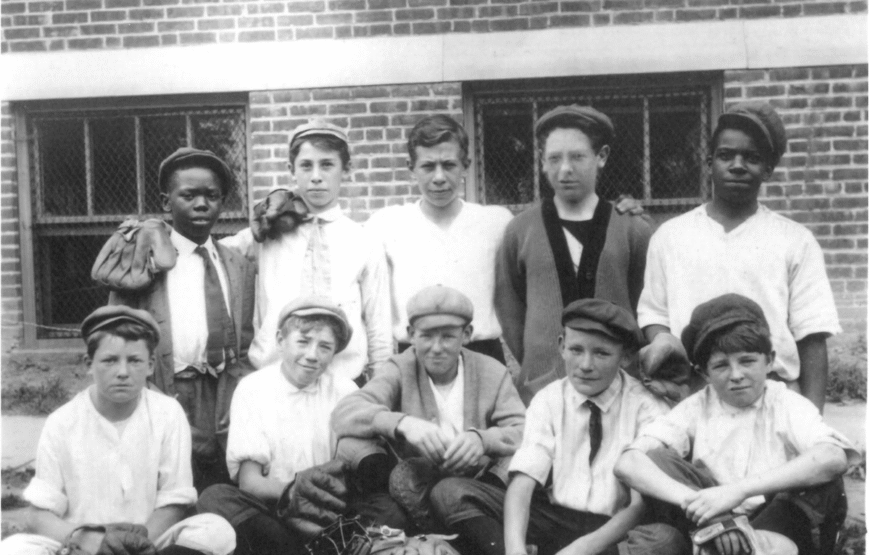
Image Credit: Maple Avenue School (Later Glenfield) Summer Baseball Team, 1910, The Montclair History Center