Craig Schattner knew almost nothing about Montclair’s $19.6 million school deficit until the yard signs appeared.
He and his wife had moved to town in 2024. By the following November, lawns across Montclair were filling with competing messages — bright orange signs urging voters to say yes, yes to two school funding questions, blue ones calling for no, no.
Schattner started asking people what, exactly, everyone was fighting about.
The answers were not especially clarifying.
One neighbor told him the schools simply needed the money. Another saw the referendum as a bailout for years of poor financial oversight. Some residents were worried about the quality of the schools. Others were worried about whether they could afford to stay in town.
The more Schattner asked, the less the story resembled a straightforward argument over taxes.
“It was very clear to me that this was a complicated issue that went a little bit deeper than just our school system,” he said. “It really said something to me about Montclair, good or bad.”
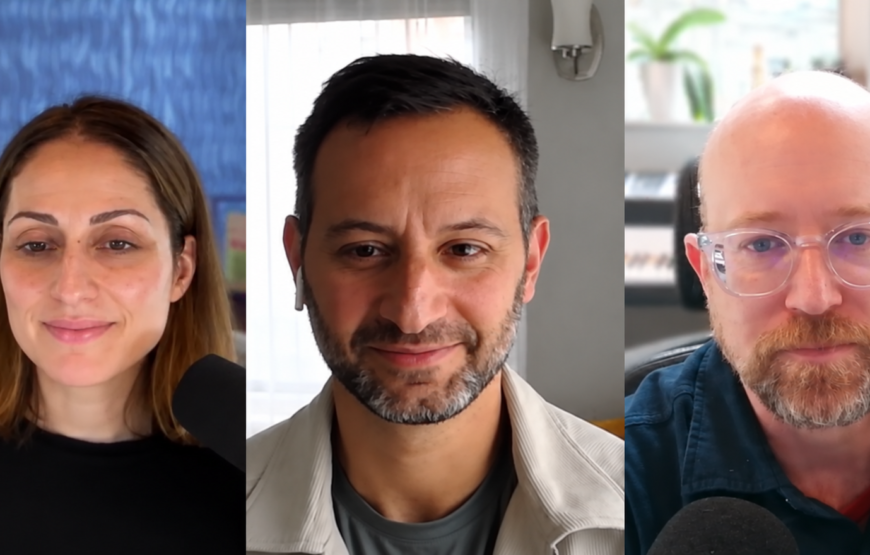
That confusion — and the divisions underneath it — became Referendum, Schattner’s 30-minute documentary about the school funding crisis and the vote that followed. The film screens publicly for the first time Oct. 21 at Just Jake’s. Farnoosh Torabi and Mike Schreiber appear in it, and Schattner recently joined The Montclair Pod to talk about what he found.
A Town Arguing With Itself
On paper, the referendum presented voters with two choices. Question 1 asked taxpayers to approve a one-time $12.6 million increase to address past debt. Question 2 sought a permanent $5 million annual increase.
In practice, Schattner found, the debate was about considerably more than two numbers on a ballot.
“Yes, yes” voters tended to argue that the schools needed immediate financial support. “No, no” voters often saw the referendum as an attempt to shift the consequences of bad management onto taxpayers. But even within those camps, motivations varied. Some residents felt financially squeezed. Others believed the district had failed to deliver the schools they thought they were paying for.
For Schattner, a relative newcomer, the dispute became a way of looking at the town itself.
Montclair, he said, is a progressive community near New York that “really holds itself to high standards.”
“I think we weren’t meeting those standards as a community through this,” he said, “and I think it was a good way to reflect on what our values are together as a community.”
That became the governing idea of the film. Schattner was less interested in identifying a single culprit than in documenting what happened when a town accustomed to seeing itself one way was forced to confront a messier reality.
Looking Past the Blame
There were plenty of opportunities to make a different kind of film.
The district’s financial collapse produced months of questions about who knew what, when they knew it and who should be held responsible. Christina Hunt, the district’s business administrator, resigned in July 2025. Schattner said The Montclair Pod’s reporting helped draw him deeper into the story, but the search for individual accountability sometimes struck him as almost cinematic in its own right.
The hunt for Hunt, he joked, “felt like a caper.”
That was not the movie he wanted to make.
“My take on it was more about this is a community in crisis and how do we get ourselves out of this?” he said. “How do we stop playing the blame game? How do we help each other out, understand our neighbors?”
What interested him most was the way residents could look at the same set of facts and arrive at entirely different conclusions.
“I think a lot of people who voted either way just were seeing their own issue,” he said. “They weren’t seeing it from the other side.”
His own assessment of the district’s financial problems is less dramatic than some theories that circulated during the crisis.
“I do think I agree with a lot of the people that said that this is run-of-the-mill, not idiocy … just bad management, bad decision making, not communicating clearly,” he said.
He also points to the district’s structural deficit — the recurring gap created when expenses rise faster than the amount school districts are permitted to raise through property taxes each year.
“The structural deficit that everybody talks about, that’s a real thing,” Schattner said, “and people just didn’t want to make hard decisions.”
Whether Referendum ever gets a second chapter may depend on what comes out of the forensic audit. In August, the Board of Education hired EisnerAmper to conduct an outside examination of the district’s finances at a cost of up to $250,000.
“If there is some wild news coming out of this forensic audit, then maybe,” Schattner said.
For now, though, his story ends where he always intended it to: with the vote.
The Ending Kept Moving
Schattner initially expected that ending to arrive Dec. 9.
Then, one week before the scheduled referendum, a judge ruled that the ballot questions were too “convoluted,” halting the vote and forcing the district to start again.
The delay changed the production schedule, but it also gave Schattner more time. Much of the film’s interviewing took place during the winter, as the town waited for a new election date.
“In my head, that was always gonna be the end date, was the vote,” he said.
That date eventually became March 10.
The result was about as divided as the months leading up to it. Voters approved Question 1 by 300 votes, 5,390 to 5,090. Question 2 failed by just 13: 5,240 opposed, 5,227 in favor. Turnout was 30.1 percent, according to the certified results.
Schattner spent Election Day filming at polling locations, including Nishuane and Hillside.
He did not cast a ballot himself.
“You guys are gonna hate this. I was thinking of taking the fifth, but I didn’t vote,” he told the hosts. “I was filming that day. That was my excuse.”
He said he had been leaning toward no, no. But months of interviewing people on both sides had made certainty harder to come by.
“I see the value in everything. I really do,” he said. “If you were gung ho for either one of those, maybe you should just pause and think about what the other side was thinking.”
The consequences of the vote are no longer theoretical. Property tax bills reflecting Question 1 have begun arriving, with the increase amounting to roughly $1,100 for the average homeowner.
“We’re all seeing property tax bills come through, and we’re all feeling it now,” Schattner said.
A Festival Rejection, Then a Bar on Park Street
Schattner had hoped Referendum might premiere as part of the Montclair Film Festival, which runs Oct. 16 through 25. The film was not selected.
He had thought its subject matter might give him an advantage.
“At the end of the day, that was probably just a cheat code, and it didn’t work,” he said.
He said he holds no grudge. “They had a lot of great submissions this year.”
So the film is getting a different kind of local premiere.
Referendum screens Oct. 21 at 6 p.m. at Just Jake’s, 30 Park St. For Schattner, the event is less about a traditional film debut than about returning the story to the people who lived through it.
“That’s gonna be our first time to just share it with the community,” he said.
He hopes there will be more screenings after that — perhaps at The Bellevue, or even through local PTAs.