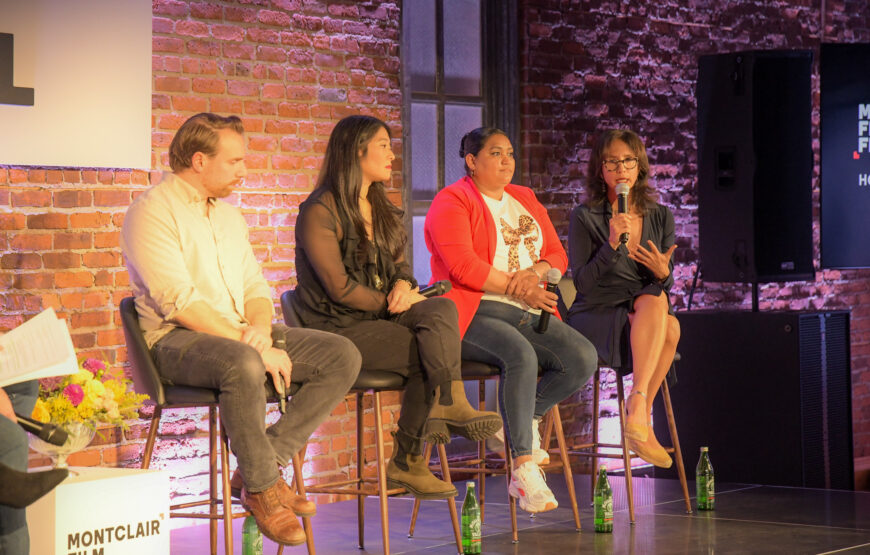
Photo: Masiel Rodriguez-Vars speaks on a panel at the 2025 Montclair Film Festival
Source: Montclair Film
Montclair’s public school district is in flux, grappling with budget pressures, busing challenges, and ongoing debates about the magnet system, equity, and inclusion. For a town with high property taxes and a strong public school reputation, persistent disparities across schools and student experiences have raised hard questions about how the system works and who it serves.
This week on the Montclair Pod, we spoke with Masiel Rodriguez-Vars, executive director of the Montclair Fund for Educational Excellence (MFEE), about MFEE’s role in this moment. For over 30 years, MFEE has been a local education foundation for Montclair Public Schools, raising private funds to support students, teachers, and families, pilot new initiatives, and help address systemic gaps in the district as public funding continues to tighten.
Rodriquez-Vars also released a documentary, Our Schools, Our Town: A Short History of the Montclair Magnet School System, which guides viewers through the full history of Montclair’s magnet schools that is essential viewing for any Montclair local.
We included excerpts from our interview with Rodriguez-Vars in the latest Pod episode, which offers a full deep dive into Montclair’s magnet system, tracing its history from the late 1800s to today. Listen to the episode below.
Magnet system equity
The Montclair magnet system was created to offer extraordinary, well rounded learning experiences, but sustaining that vision required new forms of support as public funding is declining. As Rodriquez-Vars explains, “when the magnet school system was founded in the late 60s and 70s, there was significant funding to support those schools,” allowing districts to invest deeply in curriculum, staff, and innovation. When those dollars began to dry up, she notes that it “was really going to strain our ability to keep that system strong,” prompting the founding of MFEE to bring in outside resources. Rather than simply filling gaps, Rodriquez-Vars emphasizes a strategic role, asking, “how do we use these dollars strategically to complement what the district investments are,” so that what already exists in the magnet system can truly “come alive” for students.
This moment calls for renewed commitment to educational equity and MFEE has long seen that work as central to both its mission and Montclair’s history. As Rodriquez-Vars notes, “we are passionate about continuing to support educational equity for all,” and she underscores that doing so “is going to take local investment.” With a limited budget, MFEE focuses on targeted efforts that keep the system strong, especially around equity, recognizing that “you actually have to work really hard to sustain that.” Rodriquez-Vars points to initiatives like Learning Circles on Race, launched to help the community understand “what inequity means, how that is created, how that is sustained,” and the subsequent equity grants that asked schools to take action. By concentrating on students who face the greatest barriers, including multilingual learners, she explains that “when you can build supports for the students who have the most barriers, you learn a lot about how you can start to build systems that are more equitable” for everyone.
MONTCLAIR SCHOOL BUSING
Transportation has long been a major point in discussions about Montclair’s schools, especially during times of budget strain. Rodriquez-Vars recalls the 2008 financial crisis, explaining that “we were looking at really having to tighten our budget and make some decisions around cutting teachers and cutting programs.” Transportation costs became part of that conversation, and she remembers that some PTA leaders suggested, “we could cut our transportation budget, let’s go back to neighborhood schools,” not realizing that the magnet system had been created under a desegregation order as a tool for integration. She adds, “making decisions about our school system that don’t understand the history behind it and where we came from, that’s really problematic because that can’t inform where you’re going to go.”
Reflecting on the origins of the magnet system, Rodriquez-Vars emphasizes its success in achieving racial integration: “in terms of the broadest goal of integrating, racially integrating the schools, it’s certainly the magnet system without a doubt accomplish[ed] that goal.” She points to the community-driven nature of the system, noting, “what’s really brilliant about this magnet school system is that they put in the time and the work of listening to as many stakeholders as possible to figure out what is it that you want? What do you want out of your schools? And they built from there.” Rodriquez-Vars highlights the lasting power of such systems: “systems that are built on that kind of input do have lasting power. You’re not forcing people, people are choosing. And when you just figure out what their choices are based on, that was what really might allowed us to see the integration.” She concludes by acknowledging ongoing challenges, stressing that “we still have a pretty significant opportunity gap,” particularly for Black, Brown, and economically disadvantaged students, and that the work to improve academic equity continues.
achievement gap
Addressing the achievement gap in Montclair has been a longstanding challenge. Rodriquez-Vars reflects on efforts from 2015, noting that “one of the biggest outcomes were the recommendations that came out of that committee was to have an assistant superintendent in charge of equity,” a role intended to consistently use data to drive interventions. She explains the impact of losing that position, saying, “when you don’t have folks with this as their expertise who have the resources and the authority to really drive curriculum change and district wide change, I think then we’re not going to see the kind of impact that we need to see.”
Rodriquez-Vars emphasizes that out-of-school programs play a role but cannot carry the full weight of addressing gaps. She says, “when you think about what it takes for a student to really succeed at school, that home connection is vital,” and adds that students also need “supports during the school day… that’s the bulk of their learning time. It’s six hours. We had to really think about how we are making the most of those six hours for all of our kids, but especially the kids who have some gaps.” She underscores the importance of staffing, explaining, “you’ve got to have the people in the buildings who can execute that, and that’s what I think is particularly tragic right now with their fiscal challenges… we are losing some really key people who help bridge those gaps.”
Education equity
Rodriquez-Vars stresses that educational equity must remain the central goal, even amid fiscal pressures. She cautions, “I would really caution us to think about… what the impact would be of going back to neighborhood schools,” noting that “if the goal is educational equity for all, integration is a key component for making that happen.” She explains that integrated schools provide the foundation for success because “when you have a school of folks with parents who have the resources… and they are empowered to advocate, those are the ingredients for a strong educational community.”
On balancing integration with other resources, Rodriquez-Vars is clear: “the main goal is excellent education for all kids, all 6,000 kids. That’s the goal. And so the how is what we’re gonna wrestle with. Integrated schools are gonna get you the best education for kids of color, for white kids, for poor kids, for rich kids. The data is clear.” She emphasizes that integration is not just about physical placement: “it’s not just about putting the bodies in the buildings, it’s about how you use that and how you train your teachers and how you’re giving them the support to do differentiated instruction… the integration has a direct impact on academic outcomes for all students.”
Beyond academics, Rodriquez-Vars highlights the broader benefits of equity-driven integration: “it also builds the kids that we all want to have in this world, right? That have critical thinking skills, who are empathetic, who are compassionate, and yes, all of that does matter. It is absolutely critical to success for an individual and success for the collective.” She frames MFEE’s core question as, “how do we support a high quality integrated public school experience?” pointing out that in a community with abundant resources—financial, intellectual, and civic—Montclair has the tools to make it work: “we just have to figure out, but also just the resources of… brilliant minds, incredibly engaged community, incredible nonprofits… we can’t do it here, where can you do it?”
Education equity
Rodriquez-Vars points out that even with Montclair’s long-standing integration, challenges remain at the high school level. She notes that while the high school has been integrated, students can still experience segregation within groups, and gaps that start earlier in elementary school can carry through. Drawing on her experience as a parent and filmmaker, she created Our Schools, Our Town: A Short History of the Montclair Magnet School System through MFEE, and followed high school students for a companion project called Inside Montclair High. Through that work, she saw firsthand how students navigate the system, learning to advocate for themselves and take advantage of opportunities.
Reflecting on one student’s first year, she recalls, “he authentically… said I made it, I made it through this year and like I didn’t think I could,” highlighting how the school challenges students but also fosters resilience. Rodriquez-Vars emphasizes that the high school, like the broader K–12 system, offers growth and learning across a range of experiences: “there’s incredible growth that happens in those four years at that school. And really, if you stretch it out, K to 12, this really is a community and the school system like no other.”
Support Montclair Students Today. Your gift to MFEE helps bridge the gap and provide every local child with the resources, programs, and opportunities they need to thrive.