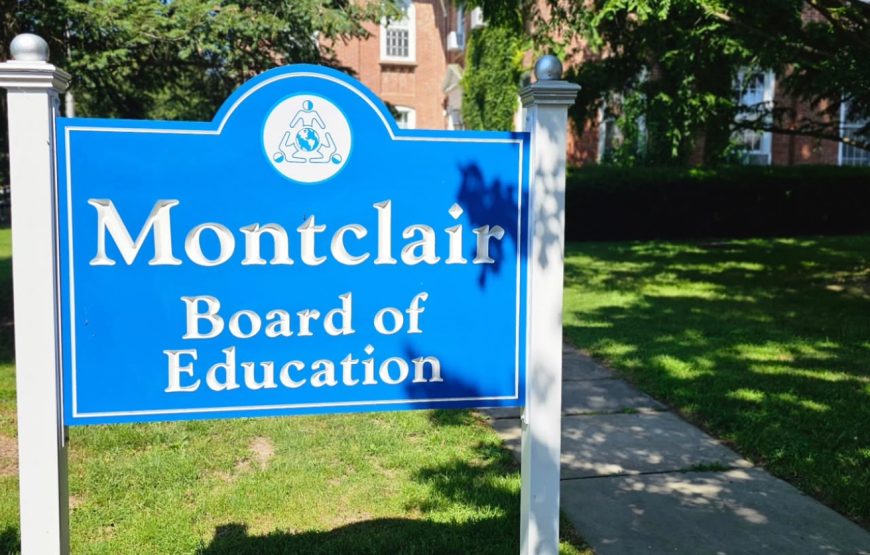
Montclair Board of Education candidate Chrissy Thomas has entered the race as a write-in. It’s a late twist in an already fluid election for three seats on the Nov. 4 ballot. Local reporting has tracked both her announcement and the broader turbulence facing the district, from an eight-figure budget shortfall to a Dec. 9 referendum that could pair tax hikes with a forensic audit—or trigger a state loan and fiscal monitor.
Adding to the shake-up, current board member and finance chair Brian Fleischer has withdrawn from re-election; his name may still appear on printed ballots, but he says he’s not pursuing another term.
Like other candidates (read here and here), Thomas responded to our questionnaire by email. In the exchange below, she outlines why she’s asking voters to write in her name physically, how she’d pursue fiscal responsibility and transparency, and where she stands on preserving the magnet system while addressing persistent achievement gaps. These are core questions as families, educators, and taxpayers brace for consequential decisions.
What experiences, skills, and perspectives make you uniquely qualified to serve on Montclair’s Board of Education?
I am uniquely qualified to serve due to my personal and professional experiences, skills, and perspectives. I have spent over 50 years as a Montclair resident. I attended Edgemont School, Glenfield, Mount Hebron, and graduated in 1987 from MHS. My daughter is currently a 9th grader at MHS after attending Edgemont and Buzz. I’ve experienced what has made our schools a shining light in the tri-state area as well as a dysfunctional trainwreck. I’ve seen what’s worked and what hasn’t.
Additionally, my professional experiences make me particularly suited to serve on the board. I am a lawyer with an MBA and a Master’s in public policy. I am a professional negotiator who understands contracts and law; I know how to analyze a balance sheet and spot irregularities; and I understand how state government works, which will be particularly important should a state monitor be assigned.
I have always been someone who fights for justice, for transparency, and for truth. I’ve never been one to follow the herd, to go along to get along, or to stay silent when I see something amiss. I promise to speak up, not shut up—because that’s who I am. At this singular moment, my personality might be even more important than my deep connections to the Montclair schools and my professional experience.
Montclair Public Schools are facing significant budget challenges, including $18 million in debt and concerns about financial management. As a Board member, how would you work with the superintendent and the community to promote fiscal responsibility, transparency, and clear priorities in spending?
First we need to know how we got here. There has been a lot of blame shifting from those who have seen this disastrous situation unfold under their watch and no explanation as to why we should trust them again. We need some form of a forensic audit, otherwise we are doomed to repeat the past.
As for moving forward, you can’t have “a little” transparency. You have to tell people the truth within the limits of the law, even if the truth is not what people want to hear. Simultaneously, we need a shared vision for what we want. The last thing we need right now is for decisions to be made without community input. I will ask the public for their help in making creative decisions about what to do, just like we did when we faced the challenges of segregation.
I would work with our insurance companies to see if there is a way to make a forensic audit happen for free as part of ongoing litigation. I will scour the budget with my fellow board members and the superintendent while also making it a priority to reach out to all the stakeholders in the community. These stakeholders include all taxpayers, parents, teachers, those who work in the central office, nurses, security staff, etc. I would encourage working with the unions to cut costs, because insurance and benefits are going up faster than taxes. Once we know exactly where we are, we can work with the stakeholders to find out what is necessary and what is not. Moving forward, we will make spending more transparent and deliberate, not just reactive.
Part of my job is also going to include saying “no.” We see where saying “yes” got us. I am fully prepared to say “no” and to understand that people are going to be upset. This situation is extremely upsetting and many people are going to be hurt due to past mismanagement. I can handle saying “no.” In fact, I’m good at it. The well-being of our children and the affordability of our town is at stake.
Montclair is known for its diversity, but achievement gaps persist across the district. What specific policies or initiatives would you support to ensure that all students—regardless of race, income, or learning ability—have equal opportunities to succeed?
I am unique because I had the privilege of experiencing the best of the Montclair Public Schools. I entered the school system in the mid-1970s. I highly recommend every resident watch the MFEE film Our Schools, Our Town on YouTube about how the Magnet System was born of parents “crafting” the schools they wanted their children to attend. Things were very different for my siblings, who are about 10 years older than me, and lived through segregation. Now, for my daughter, who is MHS class of 2029, it is different as well. Many of her friends do not understand why we have busing or magnet schools, as opposed to just neighborhood schools. I’m living through the pendulum swinging.
History is repeating itself without taking to heart the important lessons of Montclair’s past. We had ambitious desegregation and we continue to talk about diversity, yet we have the stubborn durability of an achievement gap. Our population has earned national attention for its innovative approaches, yet systemic disparities by race and class widen rather than disappear. Why? Factors outside the classroom—housing, income, access to enrichment, and differential treatment within schools—have continued to drive unequal outcomes.
Efforts to address those realities—de-tracking, expanded equity offices, data-driven interventions, and repeated public battles over policy and governance—signal serious commitment. However, these efforts also underscore how politically and socially fraught corrections require long-term, coordinated action across schools, families, and municipal systems. In short, Montclair’s history since 1974 shows that diversity alone is not a remedy. Without sustained, systemic investment in equitable resources, culturally responsive instruction, and targeted early-grade supports, the promise of integration will remain unrealized for the district’s most vulnerable students.
We have to do better by tapping into the genius of the community once again. I am living proof that our “community-built” magnet system is at the root of our ability to ensure all students have equal opportunities. There is much to be built upon this magnet system.
Unfortunately, at this moment we first have to get back to basics: balancing the budget; figuring out needs vs. wants; not settling for mediocrity. With the current budget shortfall we are at risk of losing the magnet system. To me, it is irresponsible to talk about all the wonderful programs we can launch or continue (like our restorative justice program) when these are sure to be cut. Our focus right now needs to be on financial stability, and this focus will, sadly, continue for all four years of service because of the crater we have fallen into.
I am not rich, and I want to stay in Montclair, but it is really difficult. As a single mom and longtime active resident, I want to add that our diversity is dependent on people being able to afford to live here. Without strong fiscal leadership, it will become harder and harder to live and/or stay in our wonderful town.
What frustrates you most about our schools?
The lack of communication and common sense that plagues our district really upsets me. Hearing that we have a library at a school with no librarian, and a librarian at a school with no library, is the kind of waste that really rankles me. We try to teach foreign languages to students in K–5 with one hour of instruction per week. We often prioritize spending in nonsensical ways that don’t account for the largest number of students. For example, the HVAC installation is still not complete and the MHS auditorium still has not been renovated, with hundreds of seats unusable. It makes no sense.
What do you love most about our schools?
Having spent so many years in the schools as a student and as a parent, there is so much to love! I love how we support our athletes and our artists. I love how each school has its own unique character that creates its own unique sense of pride. I love the dedication, creativity, empathy, and generosity of so many of our teachers, nurses, security guards, and principals. I love that educators have for decades sought out jobs at our schools and then stayed in the district for decades.
I love the promise and the idea of the magnet school system. Thanks to the solid education I received through the Montclair public schools, I was able to attend Wesleyan University, the University of Pennsylvania, Georgetown, and the University of Virginia. I earned an MBA, a Master’s degree in Public Policy, and a Law Degree. I am truly grateful that I got to attend a magnet school, and I wanted that same experience for my daughter.
How would you recommend strengthening trust…?
When emails do not get answered, when OPRA requests go unfilled, when meetings get canceled over and over again, trust disintegrates. These problems have accelerated over the past few years as have our budget problems. The superintendent is already changing how the district communicates. Ms. Turner is on the right track with open public meetings and direct communication. With everything going on, she has returned all or virtually all emails that have come into her inbox.
Now the board must follow her lead and become responsive to the community. My candidacy was a last-minute decision because I was alarmed to see that there are only two candidates who are not or have not served on the BoE during the years of extreme mismanagement. While those who have served on the BoE deserve recognition, current board members running for another term haven’t shown us they won’t end up repeating the same mistakes.
We need a new style of leadership at the board that welcomes questions, criticism, and ideas. We need someone who actually enjoys working with the many stakeholders. Yes, sometimes these discussions cause friction or disagreement. That’s okay. As a professional negotiator, I welcome different points of view and am excited to work with all these community members.
What frustrates you most about our schools?*
The lack of common sense.
What do you love most about our schools?*
The promise of a well-run magnet system.
The relationship between the Board, district leadership, and the community has been strained in recent years. How would you recommend strengthening trust and collaboration among families, teachers, administrators, and the Board of Education?
When emails do not get answered, when OPRA requests go unfilled, when meetings get canceled over and over again, trust disintegrates. These problems have accelerated over the past few years as have our budget problems. The superintendent is already changing how the district communicates. Ms. Turner is on the right track with open public meetings and direct communication. With everything going on, she has returned all or virtually all emails that have come into her inbox.
Now the board must follow her lead and become responsive to the community. My candidacy was a last-minute decision because I was alarmed to see that there are only two candidates who are not or have not served on the BoE during the years of extreme mismanagement. While those who have served on the BoE deserve recognition, current board members running for another term haven’t shown us they won’t end up repeating the same mistakes.
We need a new style of leadership at the board that welcomes questions, criticism, and ideas. We need someone who actually enjoys working with the many stakeholders. Yes, sometimes these discussions cause friction or disagreement. That’s okay. As a professional negotiator, I welcome different points of view and am excited to work with all these community members.