J-L Cauvin spends his weekdays in Bronx housing court, representing families who are on the verge of losing their homes. Some nights, he flips that switch entirely: red hat, exaggerated squint, the voice that has made him one of the internet’s most recognizable Trump impersonators, racking up hundreds of thousands of views on a single clip. Last winter, in between both of those jobs, the Bloomfield comedian and attorney found time for a third. He ran for Congress in the special election to fill Governor Mikie Sherrill’s old House seat, called after Sherrill left the House to become governor.
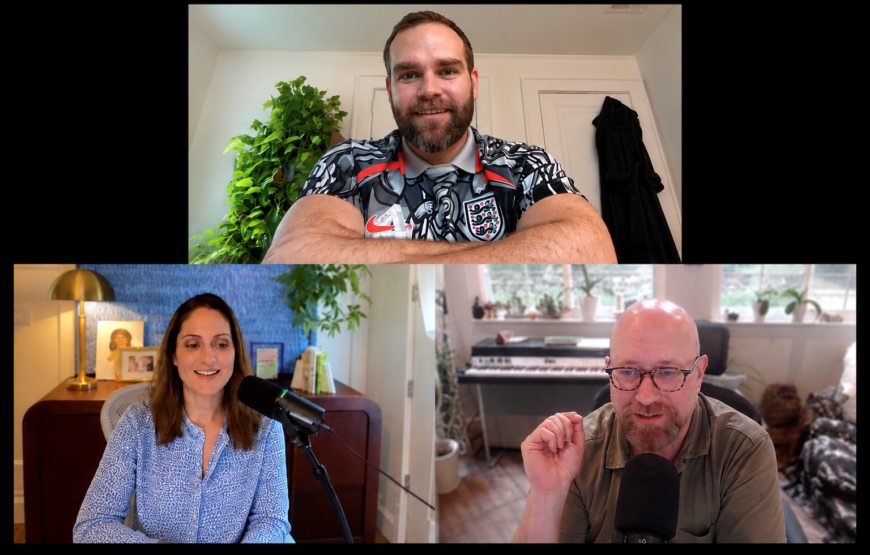
None of it happened by accident. Cauvin has spent more than two decades treating comedy and the law as competing, occasionally overlapping, full time jobs. Congress was just the latest thing he decided to squeeze in. He sat down with Mike to discuss his long-shot campaign, his theory on the only thing that can make Trump feel like a winner, and the book that pulled him into eviction law in the first place.
What’s Behind J-L Cauvin’s Trump Impression?
Cauvin started doing Trump in 2014, before Trump had even entered politics. “I remember the origin story, it was 2014, before he even ran,” Cauvin said. “I started doing it, and it was bad, but at the time it didn’t seem so bad. I’ve just kept developing it along with him ever since.”
None of it is scripted, and the character keeps changing as its subject does. Where other Trump impressionists lean on a signature bit, Cauvin has let his drift somewhere flatter and more worn down. “I try not to lean into too many crutches,” he said. “Mine has sort of just kept evolving, and now he’s in the sleepy phase. He should still have the anger, but he doesn’t have the energy anymore.” Mike offered his own read on why that shift feels true: there’s nothing left for the real Trump to win, so there’s nothing left to perform.
That idea, a man with nothing left to chase, is the theory Cauvin has built the whole impression around. “The way I’ve explained him to people is that winning is not a win,” he said. “If he won the Powerball for a billion dollars, the average person would just say, ‘I can’t believe I just won a billion dollars, that’s amazing’. I guarantee you, Donald Trump would say, ‘I just won the Powerball for three billion dollars. Nobody’s ever won three billion dollars before.’ And it’s like why did you have to make that up?”
He kept building the case. “I think there’s a real serial killer kind of attitude, where the way he best feels a win is to know that someone lost,” Cauvin said. “If he won a billion dollars, there’s nothing to inflate there. He won the popular vote as president for a second term. Instead, he has to call it historic, one of the biggest, when it wasn’t a landslide, it was a close election… I don’t think he’s capable of feeling a win outside of the context of someone losing.”
For a stretch during Trump’s first term, Cauvin’s videos and Sarah Cooper’s Trump lip-sync clips were among the most-watched Trump content online, which made what happened next hit harder. When Twitter suspended Trump’s account in January 2021, Cauvin said his own account got caught in the same current. “My videos were averaging hundreds of thousands of views per video, and then it hit a brick wall,” he said. He compared it to an algorithm that couldn’t tell satire from the real thing. “The way a chimpanzee has 97 percent of the DNA of a human, but it’s the 3 percent that makes the difference,” he said. “I think they were treating me like this is another Trump MAGA account, because it literally hit a brick wall.”
The account never fully recovered, but Cauvin is unbothered about where he ranks among the many comedians doing Trump today. “That’s where I try to separate myself,” he said. “It’s the material, it’s the improv, it’s the volume. If somebody were ranking all of them, taking in all factors, I’d have to be number one.
Why J-L Cauvin Never Picked One Career
Cauvin grew up in the Bronx, the son of a Haitian father and an Irish Catholic mother, in a house he describes as loving but demanding. “My mom was kind of the dominant personality in the family,” he said. “Very hard working, but also somewhat unforgiving. The kind of Michael Jordan esque, if I’m gonna work this hard, then I demand that everyone attain the unreasonable level of standard that I have set for myself.” He went to Williams College, then Georgetown Law, and started doing stand-up while he was still in law school, working amateur nights while he studied for the bar.
He passed the bar and took a job as an assistant district attorney in the Bronx, comedy running underneath everything as a second job. There was one point, he said, when he nearly let it become the only one. “I had some money in the bank and I was feeling real good, like, OK, this is the time. This is the time to strike. You gotta always take a little bit of a risk. I think this is the time,” Cauvin said. Three years later, he had zero dollars in the bank. “I guess that was not the time.”
He eventually landed at a large law firm in Manhattan, work that carried him through the pandemic and into 2023, when he was laid off.
What came next is the part most of his comedy fans don’t know about. Cauvin now works as an eviction prevention attorney back in the Bronx, meaning his job is to represent tenants in housing court and try to keep them from being legally removed from their homes. He traces the decision to a single book. “I read a book early last year, in 2025, called ‘There Is No Place for Us,'” he said. The book, by journalist Brian Goldstone, went on to win the 2026 Pulitzer Prize for general nonfiction. “It’s about the working homeless in Atlanta, people with full time jobs or part time jobs who just cannot get by and cannot stay in their homes…This book hit me very hard, and I felt like a calling.” Within a week of finishing it, he saw a job posting. “It literally felt like the Truman Show,” he said.
The work does not come easy. “I have poor sleep,” Cauvin said. “You don’t really know you care, but when you’re waking up in the middle of the night thinking about a case, you’re like, OK, do I care too much?…This job gives me a little bit more fulfillment, which is better late than never. I’m in my late forties, but I think I found something where comedy can give me an outlet, and this job can give me a little more substance in my life.”
That outlet looks different than it used to. Cauvin still tours, though less than before. “It varies, I didn’t have the most packed summer, but I have a decent number of road gigs,” he said. Most of his comedy income now comes from the internet rather than the road, cameos and channel revenue instead of ticket sales, which he calls a mixed blessing.
Why HE RAN for Congress in NJ-11
A year into his job as an eviction prevention attorney, Cauvin decided to run for Congress, in the same 11th District that includes part of Montclair. Thirteen Democrats and one Republican filed for the February 5, 2026 special primary to replace Sherrill. Cauvin drew 293 votes in the 13-person Democratic field. “I really gave it what I could,” he said. Analilia Mejia won the Democratic nomination by fewer than 900 votes over former Rep. Tom Malinowski and went on to beat Republican Joe Hathaway in the April 16 general election.
He never took a leave from his day job to run. “I said, how can I run as a guy who’s an eviction prevention lawyer, who cares deeply about affordability, but says those people can wait because I’m running for Congress?” he said. “So I just simply didn’t sleep much.”
He spent his campaign money on a manager and two mailers his mother now keeps framed, plus lawn signs his girlfriend’s sister in law designed. Whatever was left, he said he gave to other candidates and to charity. He said he would stay involved in Essex County politics, though he is not convinced he would run again.
For now, he is back to splitting his time between eviction court and the internet, one Trump video at a time.