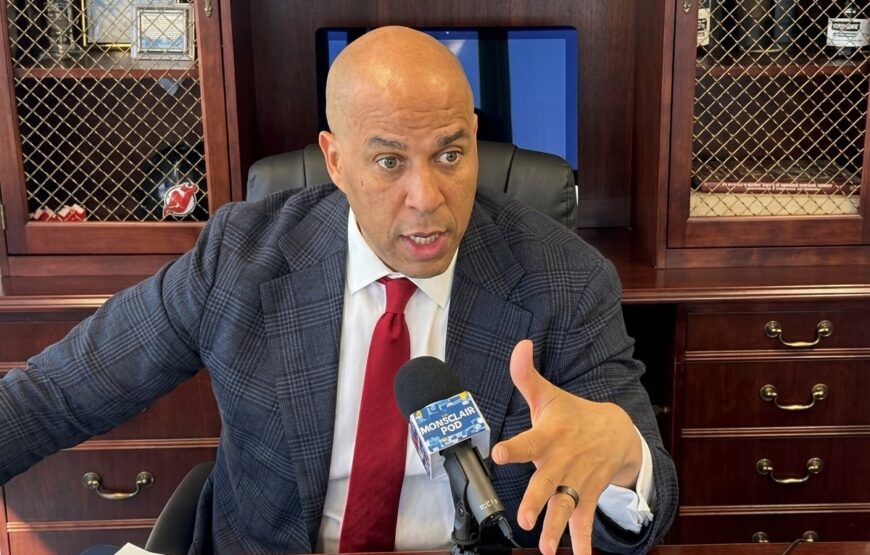
If you’ve been feeling the squeeze — property taxes, groceries, the basic cost of keeping a household running in Essex County — Senator Cory Booker has a proposal he wants you to hear about. It’s a topic we’ve tracked here in Montclair, where the struggle to balance the lifestyle with the economic reality comes up again and again.
In a sit-down interview on The Montclair Pod this week, recorded fresh off a press conference in Bloomfield, Booker laid out the Keep Your Pay Act: legislation he introduced on March 9 that would eliminate federal income taxes on the first $75,000 earned by most American households.
“You talk to the average Montclair resident, they are frustrated that they’re paying more and more taxes and finding it harder and harder to live,” Booker told us. Later in our conversation he put it even more directly: “I want to deliver for you the biggest tax cut in American history for working people.”
That’s a significant claim. Here’s what the bill actually says — and what it doesn’t.
What the Bill Would Do
The centerpiece of the Keep Your Pay Act is straightforward: raise the standard deduction to $75,000 for married couples filing jointly, with proportional relief for single filers and heads of household. According to Booker’s office, the median American family would see their federal income tax burden reduced by roughly 85 percent.
A note on the $75,000 figure: The bill does not make the first $75,000 universally tax-free for every filer. The full deduction applies to joint filers. Single filers and heads of household receive proportional reductions. If you file alone, your relief will be meaningful but smaller than the headline number suggests. Booker’s office has launched a tax calculator on his Senate website where you can run your own numbers.
Beyond the standard deduction, the bill includes two significant expansions of existing tax credits:
Child Tax Credit: The credit would increase to $3,600 per child ages 6 to 17 and $4,320 for children under six, with an additional $2,400 “baby bonus” in the year a child is born. The credit would be made fully refundable, meaning families with lower incomes would no longer be left out.
Earned Income Tax Credit: The EITC would be tripled in value and expanded to include workers ages 19 to 24 and 65 and older without children at home — groups currently excluded from the full benefit.
What Would It Mean for Your Household?
Based on projections provided by Booker’s office and the Senator’s online tax calculator, the estimated relief breaks down as follows:
Single parent, $60,000 income: approximately $6,000 in annual tax relief
Family of four, $150,000 income: more than $10,000 in annual savings
Booker gave us both numbers directly in the interview. “For a family, mom making $60,000 a year, she’s gonna get about $6,000 back. Or that family in Montclair making $150,000 with two young kids, they’re gonna get more than — be able to keep more than $10,000 of their money.”
Keep in mind, these figures come from the Senator’s office and his official tax calculator. They have not been independently verified by a nonpartisan tax analysis organization.
The Historical Argument
During our conversation, Booker offered context for why he believes the current tax code is broken. He noted that the federal income tax was created in 1913 primarily to apply to the wealthiest Americans, and that over the following century, the code accumulated so many carve-outs for corporations and high earners that working families now face higher effective rates than some of the wealthiest taxpayers.
“A century later, you have a tax code where actually working people, middle-class families are paying higher effective tax rates than some of the wealthiest corporations and the wealthiest of the 1%,” he said. “The effective tax rate of the top 1% is actually a lot lower than the effective tax rate of somebody who lives in Montclair.”
How Would It Be Paid For?
Booker has been emphatic that the bill is not designed to increase the deficit. His official press release states the legislation would be fully paid for by “closing unfair tax loopholes used by the ultra-wealthy and big corporations.”
In our interview, Booker went further than the press release and named specific numbers: raising the corporate tax rate to 29% and the highest income tax bracket to 41%. He also cited eliminating carried interest — the provision that allows some Wall Street fund managers to pay lower rates than wage earners — and rolling back other mechanisms that allow wealthy individuals and corporations to reduce their effective tax rates.
“I say we raise the corporate tax rate — not back to where it was, because again, I’m a pro-growth free market guy — but we raise it to 29%,” he told us. “Highest income tax brackets up to 41%. But more than that, we get rid of things like carried interest and some of the capital gains tax deductions that allow income from passive assets not to be taxed at the same rate as those of us who sweat and work for a living.”
These specific rate figures (29% corporate, 41% top bracket) were stated by Senator Booker in our interview but do not appear in his official Senate press release.
He also drew a pointed contrast with Republican tax policy: “What Republicans have done with their tax cuts is they’ve created the biggest deficits we’ve ever seen… they still cut Medicaid, they still cut school lunch, they still cut veterans programs, but ultimately they’re still growing the deficit by a trillion dollars.”
The Political Reality
Can a bill this sweeping pass a divided Congress? Booker acknowledged it won’t be easy, but argued the politics are more favorable than they might appear. Republicans currently hold a 53-45 Senate majority, and Democrats are targeting competitive races in Alaska, Georgia, Maine, Michigan, and Ohio in the 2026 midterms. It’s the kind of structural challenge we explored in depth in our conversation with Governor-Elect Mikie Sherrill, who has also weighed in on the ongoing fiscal crisis in Montclair’s schools.
Booker’s own New Jersey seat is rated as safe by Cook Political Report. But he framed the Keep Your Pay Act as something that could appeal across party lines — and was explicit that it’s designed to build momentum over time, not pass next week.
“What’s often lacking in America right now is the big ideas that could speak to Americans,” he told us. “I don’t care if you’re Republican or Democrat, this idea that we would have the biggest middle-class tax cut in our country’s history… is a very hard thing for Republicans who’ve been arguing for tax cuts for a long time.”
He was clear about what would need to happen legislatively: “If we have the White House, the House, and the Senate, this is something that could fly through.”
Whether the electoral map gets there remains to be seen.
The Human Stakes
Booker closed by returning to a story from his years in Newark — a woman everyone knew as Mama Tasha, who worked three shifts in a row just to keep up with her rent while raising three boys. She has since passed away.
“This bill would have returned thousands of dollars to her and really gone a long way to stopping the stress for these incredible people — single moms that are making their way out of nowhere with very little help.”
For Booker, that’s the argument in its simplest form: not a tax policy debate, but a question of whether the system is built for people like her. The Keep Your Pay Act, for all its ambition and its uncertain path through Congress, is his answer.