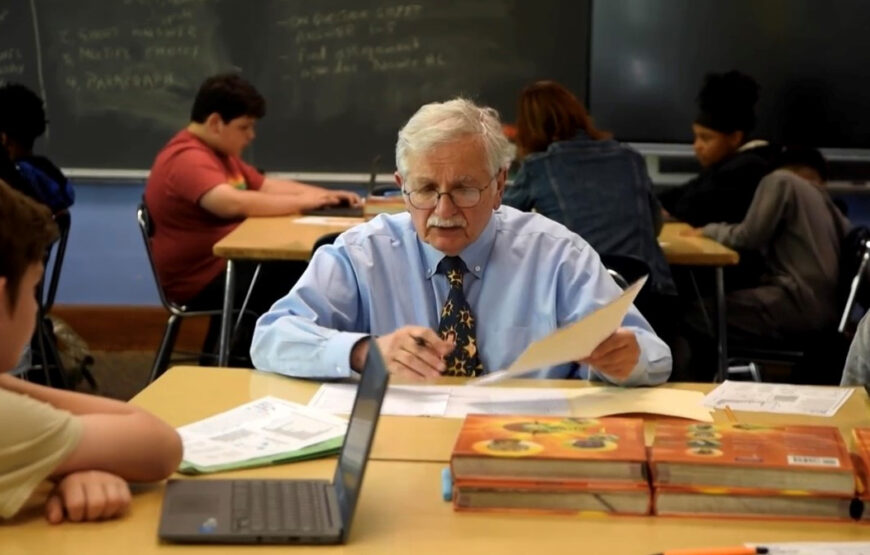
Photo: Dan Gill
Source: Montclair Public Schools
With the ever-changing landscape of Montclair’s schools, Dan Gill, a retired educator who dedicated 53 years to Montclair public schools, shares his insights on the past, present, and future of education. Drawing on decades of experience, Gill discusses bridging achievement gaps, rethinking the school day, and the critical role of enrichment programs that extend learning beyond the classroom. From the impact of testing and the challenges of union rules to the promise of magnet schools, student choice, and even preparing for a future shaped by artificial intelligence, Gill offers a thoughtful vision for schools that nurture curiosity, creativity, and meaningful learning for every student.
Our full conversation with Dan Gill is outlined below, but many of his key insights and sound bites are featured in our latest podcast episode. Tune into the episode below.
early days of the magnet program
Gill traces Montclair’s magnet system back to the 1966 Vice v. Board of Education lawsuit, which challenged inequities in local schools. One of the students named in the suit is the current mayor. The case, based on the Brown v. Board of Education ruling, argued that separate and unequal schools should no longer exist.
When Gill arrived in Montclair in 1970, the board had largely dragged its feet. “When I arrived at Glenfield Middle School in ’77, if two people put on a projector to show a film, there would be a fire, an electrical fire. The basement’s flooded. My new books were Mount Hebron’s old books,” he recalls. The first response—forced busing—was not enough. “This does not work if you don’t change what’s at the end of the bus ride,” Gill explains.
Parents from across the community pushed for real change, demanding schools that were good for all children and reflected Montclair’s diversity. The New Jersey Board of Education offered guidance after local leaders bypassed a resistant, paternalistic school board. Historic examples of neglect, like the refusal to fix Washington Street School’s roof in 1959, underscored the urgency.
Progressive board members and educators, such as Dr. Carol Willis, worked with parents to redesign schools. At Glenfield, a gifted-and-talented program focused on the visual and performing arts was created. A house system grouped students from sixth through eighth grade, providing stability and strong teacher collaboration. Gill recalls going door-to-door in the community, showing parents the new plans on slide projectors.
The approach built trust and participation. On the first day of Glenfield’s new magnet program, one student missed the bus, so Gill personally drove the child home.This dedication helped the community embrace a more integrated, equitable school system.
Diversity in school staff
Gill emphasizes that integration efforts extended beyond students to school staff and administration. “First of all, in administration, there had been no Black administrators until the late sixties,” he notes. The district recognized that meaningful change required leadership that reflected the community as well as teachers in the classrooms.
Over time, recruiting and retaining diverse staff proved challenging. “If you’re a minority person and good in math, science, or writing, there are other opportunities to make more money than being a teacher,” Gill explains. Despite these challenges, the principle remained clear: the staff should mirror the student population.
While progress has been made, Gill acknowledges that staff diversity continues to be an ongoing issue. Ensuring that teachers and administrators represent the community is not only a matter of equity but also vital for creating an inclusive learning environment.
learning beyond the classroom
Gill emphasizes that addressing the achievement gap requires more than just traditional school hours. “Getting kids out of poverty through education is really hard,” he says, noting that children from privileged backgrounds have access to enrichment activities like dance, music, and trips, while less advantaged students often return to empty homes or unstructured environments.
To address this, Montclair secured a federal grant to keep schools open three extra hours after class, providing buses and a robust enrichment program. “If you had an interest in woodworking, you didn’t have to be a shop teacher, but you could start a class,” Gill explains. The program aimed to give students from under-resourced backgrounds opportunities they otherwise wouldn’t have, from hands-on projects to cultural trips across the region. He recalls taking students from the south end of town to neighborhoods they had never seen, broadening their perspective and understanding of the world.
Gill also prioritized heterogeneous classrooms, believing students benefit from learning alongside peers with different abilities and experiences. “Kids get labeled very soon, and teachers should challenge kids of all levels,” he says. Project-based learning, collaborative activities, and diverse classrooms were central to his approach, ensuring that every student could grow academically and socially while breaking down barriers imposed by socioeconomic differences.
REthinking Busing
Gill acknowledges the ongoing debate about whether money spent on busing could be better used to directly enrich students’ lives. The Montclair Pod raises the question of whether funds devoted to transporting children across town might instead provide opportunities for students who lack access to extracurriculars, enrichment programs, or cultural experiences. He points out that diversity sometimes becomes a status symbol for wealthier families rather than a meaningful educational goal.
“It’s a complicated question,” Gill responds. “Is it worth the money to bus kids? If that money could instead be used to enrich the lives of kids who don’t have those opportunities, that would be great. But I’m not sure the board would think that way. They’d probably just see the savings.”
He notes that historically, federal funds helped cover busing costs, but now the district is spending around $10 million a year on busing alone. Gill suggests that if parents advocated for reallocating these resources, it could provide much-needed support for students experiencing the achievement gap. “We could adjust that money to help kids who are suffering from this gap problem, giving them the opportunities that other kids get simply because of wealth,” he says.
The Montclair Pod adds another perspective, noting that modern research highlights practical considerations like sleep. Because of staggered bus schedules, some children are picked up as early as 7:15 a.m., while others leave later, giving some students less rest than their peers—a factor known to impact learning. The discussion underscores the need to balance diversity goals with both logistical realities and the direct support of students who need it most.
Reimagining education for the future
Looking back over decades of experience, Gill emphasizes the need to rethink what school should be. “Are we producing kids who are good at school, or are we producing kids who are learners?” he asks. He argues that current systems often focus too heavily on test scores and traditional measures of academic success rather than fostering curiosity and creativity. Reflecting on the origins of Montclair’s magnet system, he recalls how educators and parents once dreamed boldly about what a school could be and then made it happen.
Mike points out that today, there seems to be less willingness to take risks. He notes a culture where people are “very precious” about certain programs, and debates about education can feel polarized, even in discussions involving unions or emerging challenges like artificial intelligence. The Montclair Pod adds that the changing workforce will demand different skills, highlighting the importance of hands-on learning, technical jobs, and creative programs.
He points out that choice also allows families to make decisions that align with their child’s strengths and needs. The Montclair Pod notes examples where families have opted out of certain schools to find the environment that works best for their children. Gill reminds listeners that the original intent behind Brown v. Board of Education was also about choice – the ability for children to attend better schools—not merely forced integration.
In Gill’s vision, reimagining the school system would prioritize both the individual needs of students and opportunities to dream, explore, and learn in ways that extend beyond traditional classrooms. Choice, creativity, and bold ideas, he argues, remain central to building schools that truly serve all students.
Student Feedback and testing
Gill is critical of the overemphasis on standardized testing, arguing that it often distorts what schools prioritize. “People are just so focused on the numbers. They don’t know what’s behind the numbers,” he says. He points out that tests fail to account for the full spectrum of student needs, such as children with IEPs, dyslexia, or reading levels below grade. “Is it true that a kid who has an IEP and has a third grade reading level and has dyslexia has to take the same test as the other kids? And the answer is yes,” he explains. Gill stresses that schools designed to perform well on tests are not necessarily better places to learn.
Drawing on a historical analogy, he recalls how World War II pilots were trained: young high school graduates were trusted to fly complex planes, showing that ability and learning cannot always be reduced to standardized metrics. “If you have outcomes that are designed toward tests, then you’re gonna have schools designed to do better on tests. They’re not necessarily better places to learn,” he says.
Gill is passionate about breaking assumptions around what school should look like. He believes that parents, teachers, administrators, and students themselves should be involved in shaping education. “Do we ever ask students about their experience? Feedback is so valuable,” he says, highlighting that student perspectives are often overlooked. By incorporating their voices, schools can create learning environments that truly meet the needs and interests of the students they serve.
the rise of charter schools
The Montclair Pod raises the question of how public schools can continually reinvent themselves, noting that charter schools often have the resources to provide enrichment programs and field trips that traditional public schools struggle to fund. Gill acknowledges the appeal of charters but voices caution. “I’ve always liked the fact that you have public schools and public governance,” he says, emphasizing accountability.
He explains the complications when public funds are diverted to charter schools: “If a kid from Montclair decides to go to a charter school in Newark, we have to send them whatever we spend per child. We don’t have any say about how that money is being used. We don’t know how they pay their teachers or how they remediate kids having difficulty.” Gill also highlights concerns about private funding: “I do not want to see corporate money coming in, because nothing’s free—someone always benefits. You don’t want teachers walking around with ads on their backs.”
At the same time, he acknowledges that charter schools have demonstrated the importance of choice and have pushed public schools, especially in urban areas, to improve. “The question is, why can’t our school district create their own charter-like programs that operate outside the traditional framework?”
The discussion then turns to structural limitations, such as union and tenure rules. The Montclair Pod points out how challenging it is to manage underperforming teachers within the system, citing stories of educators who move from school to school despite documented issues. Gill confirms these frustrations, noting that traditional public systems often lack the flexibility to address these problems effectively, unlike charter schools, which can operate with more autonomy.
Hopes for the future
For Gill, the solution lies in reimagining schools. He has long advocated for “remagnetizing” schools, with a focus on both creativity and mental health. Parents, teachers, and even students should have a voice in shaping the school system. When asked to define a magnet school, Gill described it as a place that attracts students based on curiosity or interest, rather than rigid demographic ratios or arbitrary busing requirements. The key is ensuring that all schools are adequately funded, with resources equitably distributed, so that wealthier neighborhoods don’t dominate opportunities.
The Montclair Pod added that while a school might reserve most of its slots for local students, it should still be designed to be so strong that families want to attend. “It’s about giving kids opportunities—language immersion, arts, or specialized programs—that draw them in and engage teachers who are excited to teach,” Gill explained. Programs like schools-within-schools can also work at the high school level, allowing students to explore areas of interest while remaining part of the larger community.
The magnet model, according to Gill, allows for creativity and engagement without imposing a one-size-fits-all approach on every school. By involving parents, teachers, and students in the design process, schools can be transformed into environments that genuinely inspire learning. Even with challenges such as confusing or flawed ballot measures, Gill expressed confidence in the community’s ability to work toward solutions. “With informed people and parents invested in schools, we’ll figure it out,” he said. “A good starting point is rethinking how we structure and fund our schools so they truly meet the needs of every child.”