A listener wrote to The Pod with a question that had been on their mind for a while. They had lived in Montclair for decades but they had never seen this many rabbits.
“Can you guys please investigate why there are so many rabbits in Montclair now? I’ve lived here for almost 27 years and there never used to be this many bunnies! They’re cute but…” the listener wrote.
Farnoosh and Mike read the email and started noticing rabbits everywhere too. So they went down, you guessed it, a rabbit hole.
Is Montclair Actually Overrun With Rabbits?
Montclair residents think so, and they have the sightings to prove it. The Pod posted a video on Instagram asking followers directly: have you noticed more rabbits and bunnies in Montclair? The replies came fast. One commenter wrote that two baby bunnies had set up camp in her potted tomato plant while she was on vacation. Another said her yard now hosts, in her words, the entire cast of “Bambi.”
The Pod also ran an informal poll in the same Instagram post asking whether people’s sense of the local rabbit population had gone up, stayed flat or gone down. It was not a scientific survey, just a gut check. More than 600 people answered. Ninety-five percent said they had noticed more rabbits this year.
The anecdotal count backs it up too. Danielle Neff, who runs the Montclair Moms Dads and Families Facebook group, reported seeing 10 to 12 rabbits on her dog walks at dusk, roughly the same number one Instagram commenter counted living under her shed with two neighboring families. Separately, Montclair Community Farms told the Pod they have noticed an increase as well, and said two of their neighbors have started actively protecting rabbit nests in their gardens.
So we are not hallucinating the rabbits, but the harder question is why.
What’s Actually Driving the Montclair Rabbit Boom
Nobody can say for certain, not even the experts. David Alexander, coordinator at the Essex County Environmental Center, confirmed the uptick is not unique to Montclair. He has seen more rabbits this season in neighboring Roseland too.
Alexander was straightforward about what he does not know. He would not point to one cause. Instead he offered a few possibilities, none confirmed: normal predator-prey cycles, fluctuations in the local hawk and owl population, or something tied to last winter’s weather.
Whatever is triggering the increase, something about Montclair itself is making it easy for rabbits to stick around.
Why Montclair Is Basically Built for Rabbits
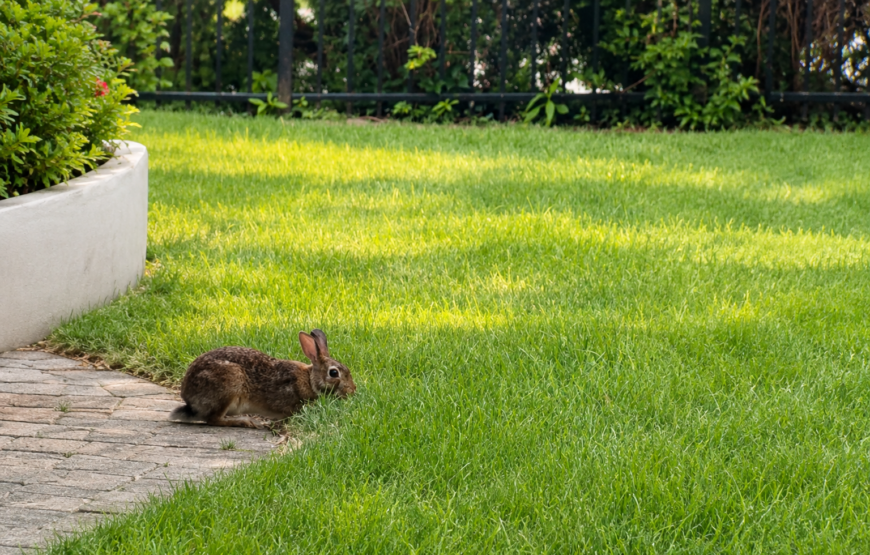
Humane World for Animals says the town’s own landscape all but guarantees rabbits will do well here. Rabbits, most commonly the Eastern cottontail in this part of New Jersey, favor what ecologists call edges, the places where two different habitats meet. Montclair is full of them: yards next to shrubs, parks next to houses, playgrounds next to wooded lots.
Rabbit populations also run in natural boom-and-bust cycles. They reproduce quickly, but most young rabbits do not survive to adulthood, so a small improvement in survival odds can make the population feel much bigger than it actually is.
That biology is only half the equation. The predators that would normally keep rabbit numbers in check are dealing with pressures of their own. Foxes, hawks and owls all rely on rabbits as a major food source, and the Montclair Wildlife Coexistence Coalition points to one specific hazard working against them: secondary poisoning from rodenticides, a common pest poison used in yards and homes. A rat eats the poison, then a hawk, owl or fox eats that rat and gets poisoned too. Fewer healthy predators around, even temporarily, could mean more rabbits survive. That explanation is plausible, not proven, but it is one more suburban pressure tipping the balance.
The Montclair Wildlife Coalition put it plainly: there probably are more rabbits this year, but the increase may be two things happening at once, more rabbits and more people paying attention to them.
Living With Montclair’s Rabbits
For now, there is no single explanation and nobody claiming to have one. What is clear is that Montclair’s yards, parks and gardens back onto exactly the kind of habitat rabbits are built for, and the animals filling it in are the same ones turning up at dusk on dog walks and in potted tomato plants across town.
Protect the nests if any turn up in your yard. Consider protecting your vegetables too. And take the Wildlife Coalition’s read as a reminder rather than a warning: not many towns let you walk outside at dusk and run into wildlife this easily.
Seen your own rabbit boom this year? Tell us on Instagram at @themontclairpod.