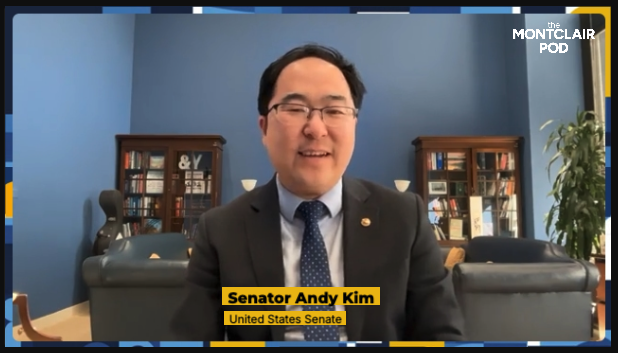
Caring for an aging parent is something many families know is coming, but few are truly prepared for when it arrives. In a conversation on the Montclair Pod, Senator Andrew Kim spoke candidly about navigating his father’s Alzheimer’s diagnosis, the financial strain that followed, and the larger policy gaps facing caregivers across New Jersey and the country.
From the rising costs of long-term care to the limits of insurance and federal programs, Kim connected his personal experience to a growing national challenge. This universal challenge is one that is putting increasing pressure on families caught between supporting their children and their parents. The reality of aging, as Kim put it, is that “you don’t get to choose” how it unfolds. That uncertainty is driving his focus on expanding access to at-home care and rethinking how federal programs like Medicare can better meet the needs of families navigating long-term illness.
For Kim, what began as a personal crisis has become a defining policy priority. “This is something that I’m really making a big part of my life’s work,” he said, pointing to the urgent need for solutions that support families before they reach a breaking point.
🎧 Listen to the full conversation below with Senator Kim for more on adult caregiving, the associated costs, and what needs to change for New Jersey families navigating Alzheimer’s and long-term care.
A Personal Crisis Behind the Policy
Before policy, before politics, the issue of elder care hit home for Kim in a deeply personal way. “It actually started before even the diagnosis,” Kim said, explaining that a serious fall revealed both physical limitations and cognitive changes that had gone unnoticed. What followed was an immediate scramble to figure out next steps. He had to quickly move his father out of his home, while realizing his own house was not a viable option due to stairs and safety concerns. “Just being able to try to figure that all out right out of the gate was really difficult,” he said.
The financial reality came just as quickly. As his father’s medical needs became clearer, Kim said it was obvious the situation would not just be emotional, but financially overwhelming. “We realized that we’re at a place where this is going to be catastrophic for us,” he said, describing the need to pull back on retirement savings and long-term planning.
That pressure is compounded by his role as both a parent and a caregiver. With two young children at home, Kim described feeling pulled in competing directions. “I’m part of that sandwich generation that’s getting squeezed,” he said, adding that his responsibilities as a father and as a son can feel “in competition with one another.” Those trade-offs have become tangible. He said he has had to pause saving for his children’s college education while covering his father’s care. “That makes me feel like I’m just not delivering for my kids,” he said, underscoring the emotional toll that extends beyond finances.
For many families, those costs are staggering. Kim pointed to the price of care in New Jersey, where a private room in an elder care facility can exceed $14,000 per month. “That is outrageous. Who can afford this?” he said, noting that many people assume programs like Medicare will cover long-term care, only to find significant gaps. The result, he said, is often financial collapse. He recalled a neighbor who was forced to sell her home after her husband was diagnosed with dementia. “She just started crying because she was like, this was supposed to be our forever home,” Kim said. Experiences like that, he added, have reshaped his understanding of the crisis. “I didn’t understand at the time fully. But I do now.”
Kim’s approach in Washington is shaped by his father’s Alzheimer’s diagnosis, which has had a direct impact on how his family navigates care. He said sharing that experience publicly helped open doors with colleagues. “I found a very strong positive reaction from my colleagues,” he said, noting that caregiving resonates across party lines. His story carries a certain irony, as his father is a former geneticist who studied cancer and Alzheimer’s. Today, his father lives with the very condition he spent his career trying to understand.
Kim said that as costs rise, many families are forced into difficult financial trade-offs that can ultimately strain both household budgets and public programs. “People having to basically bankrupt themselves to be able to be eligible for Medicaid,” he said, arguing that earlier intervention and more robust in-home care options could help reduce long-term costs.
Long-Term Care Insurance Fails to Keep Up With Rising Costs
For years, long-term care insurance was seen as a safety net for aging Americans. Increasingly, that safety net is unraveling. Farnoosh pointed to rising premiums and inconsistent coverage, noting that many families no longer see it as a reliable option. Kim agreed, saying the market has shifted significantly. “The market for long-term care insurance has really shrunk dramatically,” he said, with fewer providers and diminishing accessibility.
Costs are at the center of the issue. As care expenses continue to climb, insurance has struggled to keep pace. “The premiums have gone up because the costs have gone up,” Kim said, adding that the value of those policies has also become less certain over time. Even for those who can afford it, the return is not always what they expect. “In terms of what you get back from it, it’s been difficult,” he said, underscoring the gap between what families pay in and what they ultimately receive.
Rather than relying on a single solution, Kim said policymakers are exploring a broader mix of options. “There’s no silver bullet to this,” he said, emphasizing the need for multiple tools that families can use to plan and prepare. That planning, he added, often comes too late. Reflecting on his own experience, Kim said his father’s diagnosis forced him to think differently about his own future. With a family history of Alzheimer’s, he is now more aware of his own potential risk. “I’m thinking about this personally too,” he said, particularly when it comes to early detection and long-term planning.
Looking back, he said there are moments he wishes he had recognized sooner. While going through his father’s belongings, Kim found a notebook that revealed subtle but telling signs of cognitive decline. “You could just see his handwriting disintegrating,” he said. “It was really turning into scribbles.” That realization came with a sense of regret. “I should have known,” he said, acknowledging how easy it is to miss the early warning signs while balancing the demands of daily life. Still, he emphasized that the larger issue is not when families realize what is happening, but what support exists once they do. After his father’s diagnosis, Kim said the guidance they received was limited.
Tax Credits Offer Relief, but Gaps Remain
In New Jersey, some support for caregivers already exists, though many families are still feeling the strain. Mike noted that the state offers a caregiver tax credit, something not widely understood. Kim said efforts like that are part of a broader attempt to ease the burden on families who are often balancing work and caregiving responsibilities at the same time. “So many of our family caregivers, this is affecting their ability to work,” he said, pointing to the toll on income, career growth, and long-term financial stability.
Those pressures can be significant. Many caregivers are forced to cut back hours or leave the workforce entirely, all while taking on the rising costs of care. “It’s affecting their ability to provide and make their own salaries,” Kim said, describing a system that often leaves families financially exposed.
State-level programs like tax credits can help, but they are only one piece of the solution. Kim said policymakers are also looking at ways to expand support at the federal level. “We’re just trying to find a lot of different tools,” he said, with the goal of helping families care for loved ones without being “crippled financially.” New Jersey, he added, has taken a more proactive approach than many states. “There are things that we’re doing in New Jersey that I wish we were seeing all over the country,” Kim said, while acknowledging that high costs in the state can offset those gains.
For families navigating specialized care needs, the challenges can be even more acute. Kim described the difficulty of finding appropriate care for his father as his condition progressed. As Alzheimer’s affected his language, his father began reverting to Korean, creating an additional layer of complexity in finding the right caregiver. That search is made harder by a shortage of caregivers nationwide. The work is demanding, both physically and emotionally, and often underpaid. “It’s not a lucrative job to be a caregiver,” Kim said, adding that the workforce gap continues to grow.
Planning Ahead Can Ease the Burden
For families in the “sandwich generation,” the challenges of caregiving often arrive faster than expected. Asked what advice he would offer, Kim pointed to one thing he wishes his own family had done earlier. “I wish we as a family had had a conversation,” he said, emphasizing how even basic planning could have reduced the chaos that followed his father’s decline. In the absence of those conversations, decisions had to be made in real time. Kim and his sister were forced to quickly figure out who could handle different responsibilities, from finances to in-person care, all while managing their own young families. “We had to do a lot of scrambling,” he said.
Understanding financial and legal matters proved especially difficult. As his father’s condition worsened, accessing important information and securing decision-making authority became urgent. “It was incredibly difficult just to understand my dad’s financial status,” Kim said, adding that obtaining power of attorney and other documents during a crisis only added to the stress. He now encourages families to have those discussions early, before they are urgently needed. Setting up legal and financial frameworks in advance, even as a precaution, can make a significant difference. “I wish we had done some of that ahead of time,” he said.
Navigating health coverage is another area where preparation matters. Kim recalled having to make complex decisions about insurance while his father was already in care, including switching plans to ensure he received adequate treatment. “I wish I knew that stuff,” he said, noting how confusing Medicare options can be in the moment. Even small steps, he said, can help. Talking through expectations, responsibilities, and financial contributions ahead of time can provide clarity when emotions are running high. “It’s so much better to do ahead of time,” he said.
At its core, the advice comes down to communication. “It’s communication,” Kim said, stressing that even initial conversations can help families feel more prepared for what lies ahead.
Aging in Montclair: more support, more options
If you’re interested in learning more about programs and the realities of growing old in Montclair, check out the additional resources from our episode.
- Legal Help: Find resources and free articles at HauptmanLaw.com.
- Wellness: Connect with Maris Pasquale Doran at marispasqualedoran.com.
- Senior Support: Join the conversation at AgingInMontclair.org.
- Lifelong Montclair: Access Township senior services, the Do-Drop-In schedule, and the Senior Bus at MontclairNJUSA.org/Senior-Services.
- The MILL: High-level classes for adults 55+ atPartnersFDN.org.