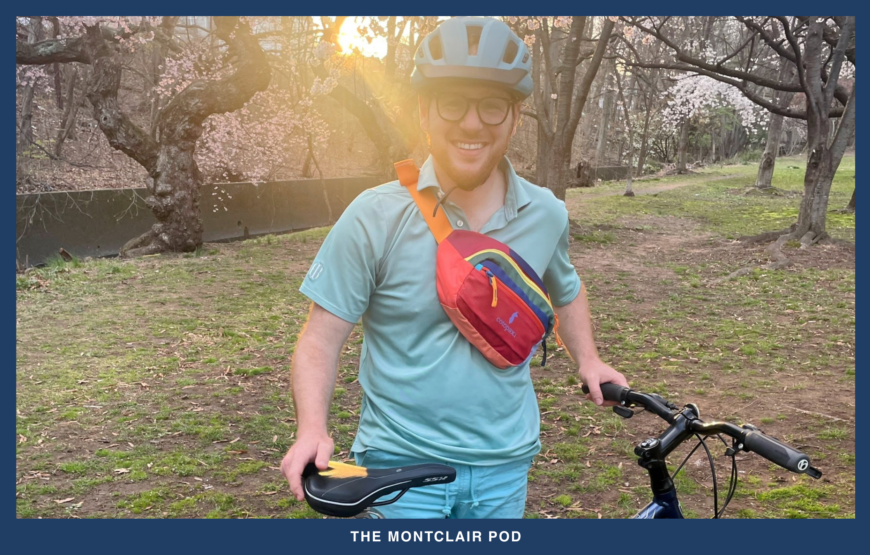
Jacob Nieman took the helm as Montclair’s Complete Streets director earlier this year, a surprising move after the town’s first director, Laura Tochio, lasted only five months. But Nieman’s long history in local government and planning makes him uniquely suited to the role. Growing up in a highly suburban town in Middlesex County, he remembers feeling cut off and limited without a car. “I loved going down to Princeton,” he said, “because as a teenager who didn’t really have access to a car, I could walk around, go to shops, go to restaurants.” Those experiences, combined with his planning and policy background, shaped his understanding of how streets can prioritize people, not just cars.
Since arriving in Montclair, Nieman has been eager to make a difference. He believes local government works when people participate and hopes to bring that spirit, along with practical changes, to make streets safer and more accessible for everyone.
Residents may have noticed a revolving door in Montclair’s local government, from superintendents to department heads. Nieman acknowledged that perception but emphasized his dedication. “I’m thrilled to have the opportunity to do this sort of work that I’m so passionate about and have the skills I believe are necessary to make it effective and long-lasting,” he said. When asked if he plans to stay, he was clear: “I’m not going anywhere. I’m in it for the long haul. And I’m serious about getting this done.”
Listen to this week’s episode of the Montclair Pod as Jacob Nieman and other local experts discuss infrastructure plans for Montclair and ways to make the town’s streets safer, more accessible, and more enjoyable for both pedestrians and drivers.
Designing Streets for Safety
Earlier this year, Jacob Nieman stepped into the role of Montclair’s Complete Streets director, bringing years of local government experience and a strong background in urban planning. “The goal and the mandate for the role is to eliminate traffic fatalities and fatal injuries on Montclair streets,” Nieman said. “It’s pretty simple. The simplicity belies the difficulty of doing that, but that’s the objective, that’s the goal.”
Nieman emphasized that achieving this goal won’t happen overnight. “It’s not a flip of a switch and suddenly we’re safe. It’s a process,” he said, explaining that a major part of that process involves incorporating the principles of Complete and Green Streets into everyday municipal operations. That means ensuring the planning board, zoning board, and any projects affecting roads take these principles into account.
He also highlighted the importance of integrating safety improvements into routine infrastructure projects. “Building into the regular repaving program a process by which not only are we making sure the street comes out smooth and clean, but also that the intersections are made safer for pedestrians,” he said. Nieman stressed the need for micro-mobility infrastructure as well, including bike lanes for families and accessible routes for people using wheelchairs.
“I live on a short one-block street and on that street is a senior care facility. I regularly see folks riding their wheelchairs in the street because there isn’t a safe sidewalk. But the street isn’t safe either right now because there’s no space set aside for them. And so it’s only because it’s one block that they’re able to do that. They really shouldn’t have to,” Nieman said.
His approach makes clear that Montclair’s streets should work for everyone, not just cars, and that achieving that will require careful planning, attention to detail, and community support.
Stop Signs and Speed Humps
Residents have raised concerns about dangerous intersections, including South Mountain and Gates, where stop signs are limited despite frequent accidents. Farnoosh described the area as “dangerous,” noting her son’s bus stop is right there and pointing out that while the town had added several stop signs along Gates Avenue, delays remain in implementing safety measures. She asked why it can take so long for solutions to move from recognition to action. Nieman is well aware of the intersection and the anxiety it causes. Having lived on Gates Avenue, he understands firsthand the challenges of navigating that stretch. “I also know this was an area of concern,” Nieman said. “There’s a plan in place to add speed humps on Gates Avenue, so work is happening.”
He explained that delays often stem from multiple factors. Limited resources, the logistics of acquiring and installing signage, and seasonal constraints on roadwork all play a role. Certain interventions, like stop signs or speed humps, also require engineering studies to verify they are the correct measures. “Municipalities and other authorities have to create a basis for the decisions they make. They need to show their work, and that process can take time,” Nieman said.
Another challenge, he noted, is communicating progress to the public. Often, studies and planning happen behind the scenes, and residents may perceive inaction even when work is underway. “One of my first days on the job, I met with a township engineer and the director of community services to discuss a project. Not 12 hours later, I got a frustrated email saying nothing had been done, even though plans were already in motion,” Nieman said.
To address this, he is developing a tool he calls the “Domino’s Pizza Tracker” for traffic safety projects. The goal is a public-facing system where residents can see the stage of each project, from analysis to implementation, making the process more transparent and helping the community understand that action is being taken, even if the results are not immediate.
Brace for Potholes
Drivers may also notice more potholes than usual this year. Nieman said the winter’s temperature swings have created ideal conditions for road damage. “It’s going to be a rough year for potholes,” he said. When water seeps into cracks in the pavement and repeatedly freezes and thaws, it expands and weakens the asphalt until it breaks apart. “The freeze-thaw cycle is going to be brutal,” Nieman said, adding that residents should expect to see more potholes and other infrastructure issues as the season changes.
Potholes are not only a nuisance for drivers but also one of the reasons streets often need to be repaved, along with unexpected sewer and water problems. Even with careful planning, emergencies can force crews to dig into newly resurfaced streets. “There’s a heck of a lot of coordination there,” Nieman said of the municipal utilities. But water main breaks or sewer failures don’t wait for the right timing. The situation becomes even more complicated with outside companies like PSE&G, which notify the township about planned work but ultimately operate independently. “They do coordinate in the sense that they tell us where they’re going to be,” Nieman said. “But they are an organization that’s answerable to people other than the municipality.” That often means these companies are only required to restore the specific section they disturbed rather than repaving the entire roadway.
Prioritizing Equity Across Montclair
Equity is a central focus for Montclair’s Complete Streets program, particularly given the town’s history of uneven infrastructure investment. Farnoosh asked how Nieman plans to ensure safety improvements reach all wards, including historically underinvested areas like the South End and the Fourth Ward.
Nieman explained that a key tool is a prioritization matrix. “One of the primary responsibilities of the position, and one of the things I’m doing is coming up with a prioritization matrix. That prioritization matrix takes data we have about crash, known injuries, known risk factors, and underrepresented communities, and it gathers all this information, plugs it in, and tells us where to focus our energies and efforts. And that’s how we are going to figure out where we need to focus on,” he said, noting that the matrix works in conjunction with the Safe Streets for All grant and guidance from consultants at Michael Baker International.
The matrix identifies the most dangerous areas across town. “Frankly, it’s all over. Every ward has streets that are dangerous to pedestrians and those who use the road in their car on their bike. And so we need to have interventions across town because the risks are across town,” Nieman said. The tool also considers key transit infrastructure and traffic generators. “It’s also taking into account where the transit stations are, right? Where bus stops are, train stations, traffic generators like houses of worship and schools to make sure that wherever those entities are, parks, that we’re focusing our attention there so our interventions are the most impactful,” he explained.
Not all interventions are equally effective, Nieman emphasized. “You could put a bike lane on a given residential street, but it’s not necessarily going to be helpful to as many people as perhaps putting it on Harrison Avenue, a street with a lot of speeding and a long stretch of straight road that sees a lot more traffic. And so that prioritization matrix is really going to allow us to focus on where it’s most needed, regardless of the means of the part of town,” he said.
As for who is pushing hardest for changes, Nieman joked that the pressure comes from just about every direction. “I wouldn’t say there’s one that’s out lobbying the other,” he said. “I think they’re all pretty equally yelling at me.” Rather than avoiding those conversations, Nieman said he welcomes them and is trying to make himself visible and accessible to residents across Montclair. Recently, he walked along Grove Street with a group advocating for bike infrastructure to see the conditions firsthand. “I wanted to see what they see when they’re walking their streets,” he said. Residents from across town have reached out with concerns and ideas, from proposals for greenway connections between Canterbury Park and Glenfield Park in the South End to safety concerns in Upper Montclair, where some residents say it can be difficult to cross busy roads like Alexander Avenue. For Nieman, hearing those perspectives directly is part of understanding how transportation issues play out block by block.
Fewer Cars, Safer Streets
Public transit is a key part of Montclair’s strategy for safer streets and fewer cars. Nieman said every person who takes a bus or train reduces traffic and emissions. “Anyone taking a bus, riding on a train, is a person who’s not in a private automobile,” he said.
While discussions often focus on the cost of operating transit, Nieman said the broader benefits are overlooked. “We do a really good job of figuring out what the cost of public transit is,” he said. “But we have a really poor ability to quantify the positive externalities of it.” Fewer cars on the road mean less congestion, cleaner air and safer streets to name a few.
Transit also matters for equity. Not all residents own a car, and reliable service can make it easier to get to work, school or errands. Limited weekend train schedules, for example, can push people to drive elsewhere.
Montclair, a Place for People
Nieman emphasized that the goal of transportation and infrastructure improvements is about more than just getting around, it’s about making Montclair a town people want to spend time in. “Places for people are really places that are attractive and desirable to spend time in,” he said. Montclair may not be the easiest town for cars, with traffic and limited parking, but that’s part of what makes it appealing to pedestrians, cyclists and visitors. Streets like Church Street, Walnut Street and the South End are vibrant because they prioritize people over vehicles.
Keeping Montclair “a place for people” also has economic benefits. Nieman explained that reducing traffic, emissions and noise improves quality of life while boosting the value of commercial properties. “Any increase in the commercial rateable base means less money coming out of residential property taxes,” he said. Improved accessibility, whether through public transit, bikes or scooters, will make it easier for people to live, work and visit here. In Nieman’s view, a town designed around people, not just cars, benefits residents, businesses and the community as a whole.
The Church Street Dilemma
When asked about the future of Church Street, Nieman said the street is already doing a lot of things right. “It’s got a great wide sidewalk, which is a really undervalued thing in urban design and town design,” he said. That space allows for sidewalk cafes, small shops, and leisurely strolls, making it a place people want to spend time.
At the same time, Church Street remains a one-way street with traffic lanes, and Nieman does not anticipate that changing. He said decisions like making the street pedestrian-only would ultimately be up to the mayor and council, but he noted there are many models for creating dynamic, people-focused streets. “You don’t have to be pedestrian only at two in the morning when places need to get deliveries, but it can be at certain peak times,” he said. Nieman emphasized the importance of prioritizing people over cars, noting that spaces designed for pedestrians tend to be more vibrant and enjoyable than those dominated by vehicles.
Speed Cameras
Nieman addressed the topic of speed cameras, noting upfront that automated enforcement is currently illegal in New Jersey. “The state legislature both passed a law disallowing it and allowed a prior pilot program to expire back in 2014,” he said. Any decision to implement speed cameras in Montclair would ultimately be up to the mayor and council.
He said automated enforcement could complement traditional traffic enforcement, which is limited by manpower. “One cop sitting in their car can do only so many traffic stops at any given moment, and they can only be in so many places at any given moment,” Nieman said. Automated systems, by contrast, operate continuously and can enforce speed limits and stop signs more consistently. He acknowledged concerns about data privacy and the potential misuse of information, noting that the debate is just beginning.
Still, Nieman emphasized the effectiveness of automated enforcement where it has been implemented elsewhere. “In situations where automated enforcement occurs, in communities where they’ve done it, there has been significant reductions in speeding, violating stop signs and traffic lights,” he said. “It is a very effective means of changing driver behavior.”
For Nieman, every project, whether a new bike lane, a pothole repair, or expanded transit, is part of a bigger picture: a Montclair that is safer, more accessible, and designed for people, not just cars. By prioritizing residents over vehicles and coordinating thoughtfully, he hopes to make streets, sidewalks, and public spaces vibrant places where the community can thrive.