Your Guide to the Montclair Farmers Market: Hours, Vendors and What to Know Before You Go
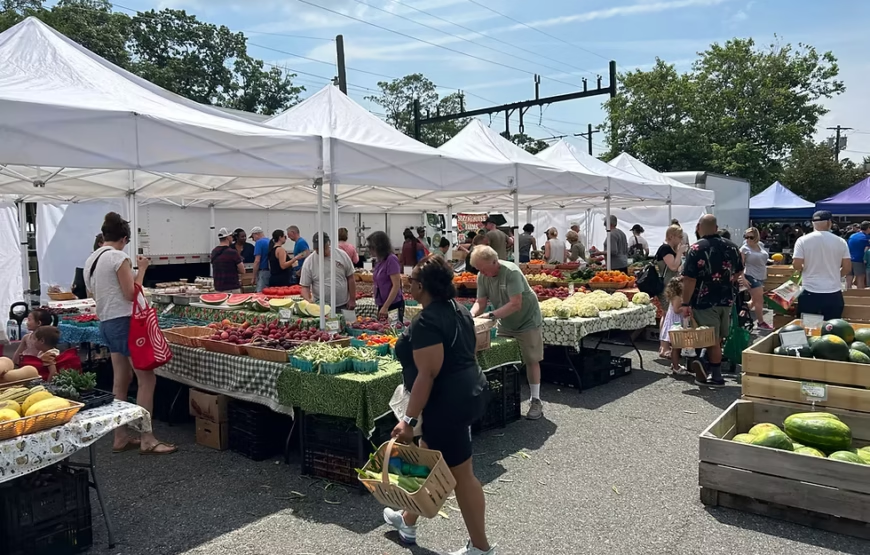
If you are trying to figure out when the Montclair farmers market is open, where to park or whether it is worth fighting for a spot on a Saturday morning, here is everything you need. The market runs nearly year round at the Walnut Street train station, and it has been a fixture of downtown Montclair since 1993.
When and where is the Montclair farmers market?
The market sets up every Saturday at 86 Walnut St., in the parking lot of the Walnut Street train station. During the summer season, from June through November, it runs from 8 a.m. to 2 p.m. In the winter season, from December through May, hours shift to 9 a.m. to 1 p.m.
It is open rain or shine, and vendors will tell you that is not just policy, it is habit. Montclair shows up for its farmers market regardless of forecast, and the only thing that shuts it down is a call from the market manager in genuinely extreme weather. If that happens, the market posts the cancellation on its website and social channels.
Parking is easier than the crowds might suggest. There is free parking across the tracks in the train station lot, plus metered street parking along Walnut Street and nearby blocks. Read the signage before you leave your car, since some of the surrounding streets have posted restrictions that are easy to miss on a Saturday morning rush.
Beyond the food stalls, the market regularly hosts nonprofit and community organization tables and, depending on the week, live music. Neither is guaranteed every Saturday, but both show up often enough, especially during the summer season.
Who started the Montclair farmers market?
Montclair’s farmers market got its start because one resident asked for it. In 1993, Gray Russell put together a group of Montclair business owners, then went in front of the Montclair Township Council alone to make the case himself. At the time, he said, downtown was struggling. “The store owners and the building owners were concerned that they didn’t have enough shoppers,” Russell said. His pitch was to bring a farmers market into the business district on Saturdays, betting that shoppers would spill into the surrounding stores after they finished at the market. The council said yes, and Montclair became one of the first towns in New Jersey to run one.
The pitch he made to the council, Russell says, was narrower than what he actually cared about. “My goal was really to protect farmland in New Jersey and family farms in New Jersey, both of which were endangered and in fear of being lost, going extinct, and extinct is forever,” he said. “New Jersey is the Garden State,” he added, but by the early 1990s that farmland was being paved over fast. “Once you’ve paved over that farmland, it’s gone.” He was also part of the Cornucopia Network of New Jersey, a Montclair-based environmental group pushing for the same thing: sustainable and organic food production close to home.
The market has moved twice since then. “That little parking lot is where we started the market,” Russell said of its first home, a small lot at the bottom of the crescent near where the Wellmont Theatre now sits off South Fullerton Avenue. After a few years it outgrew that spot and moved to what is now the parking deck on Glen Ridge Avenue, where it stayed roughly a decade. By then, Russell’s original pitch had worked almost too well; downtown had become busy enough that the town needed those parking lots back, so the market moved again. The market then settled into its current home at the Walnut Street train station, where it has now been for more than 20 years.
More than three decades later, Russell is still involved, and still very much in charge. He now serves as president of the market’s Board of Trustees and describes himself as one of its original co-founders, on hand for all 34 seasons since 1993. What started as one resident’s pitch to a township council is now one of New Jersey’s longest-running farmers markets, and, by his account, one of its fastest-growing. That growth is easiest to see in what is actually for sale.
What can you buy at the Montclair farmers market?
Expect the full range of a serious farmers market, and more of it every year. “We’ve grown by 50 percent in the past four years,” Russell said. “We’ve grown by a quarter, just in the past year and a half.” The market now runs more than 50 vendors most Saturdays, about seven farmers growing produce, and closer to 45 “foodies,” the market’s own term for the bakers, picklers, spice sellers and prepared food vendors who round out the stalls. New vendors, he says, are “dying to get in.”
The meat selection goes well beyond standard chicken and beef. Mary Elizabeth, a vendor who has been coming to the market for years as part of her family’s business, sells what she describes simply as “quality meats and pet products,” including ostrich, bison and pasture-raised chicken alongside heritage-breed pork. Her stand draws a mix of customers, from people carefully weighing whether to spend six dollars on chicken feet to others who will buy ten bones in a single visit.
On the produce side, Circle Brook Farm, run by John Krueger, brings organic fruits and vegetables to the market, andTree-licious Orchards specializes in orchard fruit. Foragers show up too. Shoppers have described stumbling on a vendor who forages wild mushrooms and, in season, ramps, the kind of find that makes a trip to this market feel different from a grocery run.
Spices come from further afield. Lynley Jones, founder of Adventure Kitchen, sources much of her inventory from small, women-owned partner farms overseas, including fennel seed from India and berbere seasoning from a family farm in Ethiopia. Her frozen spice pops, made with the same spices she sells at her stand, are only available at the market through September, though they are also available for local home delivery the rest of the year.
Baked goods and prepared foods have their own following. Jed’s Bread sells fresh, local artisanal loaves, and Pickle Licious covers everything from mild to seriously sour if pickles are your thing. Unionville Vineyards, a New Jersey winery, brings bottles to the market for anyone looking to pair dinner with something local, and Stefan’s Specialty Foods leans into Polish staples like pierogi, kielbasa and stuffed cabbage. Crepes Chantal, run by French expat Chantal Bolivar, has built enough of a following that a line forms most Saturdays.
The variety changes enough season to season that longtime visitors say you never quite know what you will walk away with. Come with a list if you need one, but leave room to be talked into something you did not plan on buying. That range of vendors is also why the market’s benefit programs matter, since fresh food access is the whole point for a lot of shoppers here.
What Tariffs and Climate Change Mean for the Montclair Farmers Market
Tariffs mostly miss the market’s growers and land instead on its foodies. Weather is the bigger, steadier problem for everyone.
Russell traces the tariff gap back to a rule built into the market from the start: growers can only sell what they grow in New Jersey or the surrounding region, and nothing imported can be sold as local. “They’re not affected by, let’s say, by tariffs or by import,” he said. “They’re growing the food here in New Jersey or from our area, our region. We actually allow some imports from elsewhere in America, but nothing can be sold that is from another country.” That distinction, in his view, is part of the market’s appeal when prices spike elsewhere. He points to a recent nationwide egg shortage as an example, driven by a bird flu outbreak that hit large-scale operations hard. “That mostly affects factory farms,” he said, “when large amounts of birds are contained together is how that flu spread so quickly.” Montclair’s growers, working at a much smaller scale, largely avoided it. “Our farmers have not seen those price jumps,” he said. Vendors who import ingredients, like Adventure Kitchen’s spices, are a different story, absorbing tariff timing the growers do not have to think about.
Climate volatility is the more constant challenge. Russell described a pattern New Jersey’s own climate models have flagged for years. “What New Jersey’s models show, and the way that climate is playing out in the Mid-Atlantic, and particularly right in our area, are showing extended periods of dry spells, extended periods of drought or near drought, interspersed with more intense precipitation events,” he said. “So both of those things are not good for farmers.” Growers have adapted where they can, using covered crops, grow tunnels and greenhouses to extend the season on both ends and buffer some of that unpredictability. It cuts both ways, he said. Warmer weather arriving earlier and lingering later has actually lengthened the growing season in New Jersey, even as the same shift brings harsher droughts and storms. “Weather has always been a problem for all agriculture and all farmers,” he said. “It’s just that with climate change… in some ways it’s a help to them because it has extended the growing season… But in other ways it is a detriment, with the extended droughts and more frequent intense precipitation events.” Too much water or too little, he said: “Farmers don’t like that.”
Does the Montclair farmers market accept SNAP or WIC?
Yes. The market accepts NJ SNAP, the Supplemental Nutrition Assistance Program, the WIC Farmers’ Market Nutrition Program and the Senior Farmers’ Market Nutrition Program, three state and federal benefit programs that help cover the cost of fresh food for eligible families, parents with young children, and seniors.
Those benefits are paired with Good Food Bucks, a dollar-for-dollar match funded through a grant from Partners for Health, a Montclair philanthropic organization, distributed by City Green, a Clifton-based food distribution nonprofit, and topped up by the market’s own Board of Trustees. Russell describes the mechanic in plain terms: a SNAP recipient swipes their card for $20 at the market’s manager table and walks away with $40 to spend at any stall. “We give them $40 of monopoly money that they can spend just at the Montclair Farmers Market,” he said, though the match is restricted to produce and cannot go toward prepared foods or sweets. In 2025 alone, SNAP and FMNP shoppers redeemed more than 28,000 dollars in Good Food Bucks at the market.
That accessibility is part of why the market functions more like a public resource than a boutique Saturday outing, and it is one reason it fits so naturally into the food scene growing up around it.
What else is near the Montclair farmers market?
The market sits inside the larger Walnut Street corridor, a stretch that has quietly become one of Montclair’s most essential food destinations. A short walk away is Ray’s Luncheonette, the diner that has anchored the neighborhood for more than 60 years and remains exactly what a neighborhood breakfast spot should be.
Down toward Lackawanna Plaza, do not confuse the Saturday farmers market with Ironbound Farm Market, a separate, permanent shop that opened inside Lackawanna Station in 2025. Ironbound follows what is known as a farm stop model, meaning food comes directly from small-scale farmers on consignment rather than farmers setting up their own stalls each week. It is a useful backup if you miss the farmers market on a given Saturday, but it is a genuinely different shopping trip, not a substitute for the market itself.
Between the two, Walnut Street now offers something rare for a town this size: a genuine, walkable food district built around local sourcing, any day of the week. Which raises the real question for a lot of Montclair shoppers: with everything else competing for the weekend budget, is the market actually worth the trip?
Is the Montclair farmers market worth it?
For a lot of Montclair families, yes, but with real trade-offs. Shoppers who have been coming for decades describe watching their own habits shift over time, a gradual squeeze from Montclair’s overall cost of living, not from the market itself, that picked up further after the pandemic. “I try to stick to the basics now and I’m watching my pennies a little bit more,” said Veronica, a South End resident who has shopped at the market for about 30 years, describing a shift she’s felt over the past 10 to 12 years.
Russell, who has watched the market keep growing every year he has run it, says he has not seen shoppers pull back even as costs have risen elsewhere in town. What keeps people coming, in his view, is not the price. “People don’t come for the cost savings,” he said. “They come because first of all, they like being able to talk to the person who grew and made their food.” That, he added, is a lost art in the 21st century.
That is arguably the strongest case for the market, whatever your budget. It is one of the few places in Montclair where buying what you need and supporting a local farmer or small business owner happen in the same transaction. Whether you are there for the ostrich, the crepes or the mushrooms you cannot find anywhere else in town, the money is going to someone who lives close enough to say hello to.
So this Saturday, skip the extra stop at the grocery store and see what is actually at the market first. Bring cash for the smaller stalls, bring your SNAP or WIC card if it applies to you, and give yourself an extra hour you did not think you needed.
Image credit: Good Food Bucks