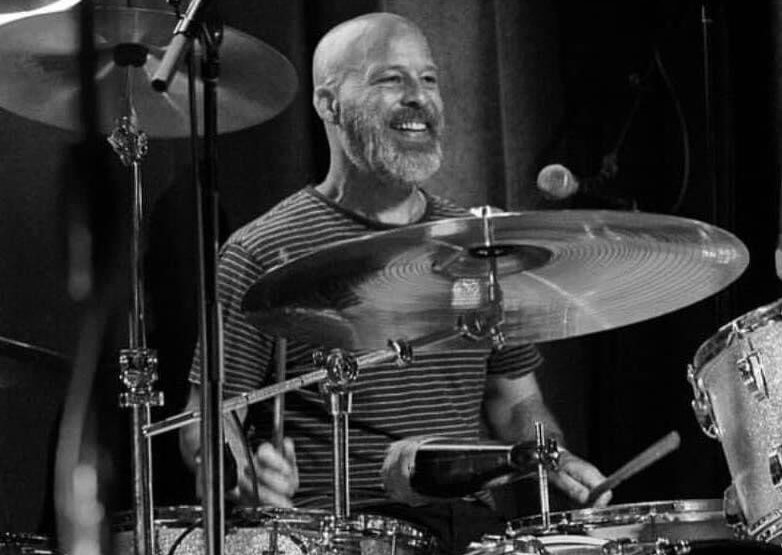
In 2012, Kevin March moved to Montclair the way a lot of musicians move to New Jersey from Brooklyn: skeptically.
He was a New York musician with New York contacts — drummer for Guided by Voices, veteran of the Dambuilders and Shudder to Think, he’s toured, played on film scores and is generally considered one of the great indie drummers. Suburban New Jersey was not obviously the next chapter. But Montclair had other ideas. March would within a couple of years become General Manager of School of Rock Montclair, where he has since taught thousands of students and built one of the most respected programs in the franchise. More recently, he co-founded Rocking for Inclusion, a nonprofit that brings together neurodiverse and neurotypical musicians in a working band, which just played the Stone Pony no less.
“I did come resisting because I was in New York and a musician and all my contacts were there,” he told the Montclair Pod this week. “But I came out here, it’s been amazing for me, it’s been amazing for our family and the school, and our daughter went through the whole school district and now on to college.”
He laughs when he says it. Because what happened next was exactly the kind of thing you couldn’t have planned: the random dog walks that become collaborations, the backyard gigs that turn into reunions, the nonprofit that plays the Stone Pony. Montclair, March has concluded, is a creative island. And he has become one of its most essential citizens.
From York, PA to Berklee to the Dambuilders
March grew up in York, Pennsylvania, the same town that produced the members of Live, the arena rock behemoths who became massive in the nineties. He studied at Berklee College of Music and actually graduated. “One of those rare things,” he jokes. He came out the other side joining a band almost immediately: the Dambuilders.
“That is the band that started my whole adventure as a professional musician,” he said. The Dambuilders signed to East West Records in the nineties, toured with Weezer, Third Eye Blind, and Better Than Ezra, and had a minor alternative hit with “Shrine.” March recently did two reunion shows with them.
It was through the Dambuilders that March’s path first crossed with Robert Pollard’s. “Guided by Voices opened up for the Dambuilders in 1993,” he said. “So I met Robert Pollard at that time.” The connection would pay off — but not for nearly another decade.
From the Dambuilders, March moved to New York in 1996, doing session work and playing with Shudder to Think. He joined a band called Those Bastard Souls, fronted by Dave Shouse of the Grifters, and opened for Guided by Voices on the “Do the Collapse” tour. Pollard kept watching him play. March kept not quite joining the band.
Then, around 2001, having toured with Leona Ness opening for the Barenaked Ladies, March decided to dial it back as a professional drummer. He got into Johnson & Wales culinary school in Providence, Rhode Island, where he was born, and was almost ready to pack it in.
“I get a call from Guided by Voices’ manager that Bob wanted me to call him at the studio they were recording at,” he said. “And I called him and he asked me to join the band and I didn’t have to move to Dayton or anything. I didn’t have to audition. He had seen me play.”
March called his wife. Her response: “Well, that’s a no brainer.”
He joined GBV around 2001, learned a set list of about 60 songs, and found himself in a band with one of the most devoted audiences in indie rock. “I was like, wow, I made it,” he said. “That feeling of, you know, as a kid in my bedroom playing drums to Kiss records or whatever and imagining what it’s like to be in a band like that. And here I was in the band.”
He stayed until 2005, then joined School of Rock in New York when the organization was still called Paul Green School of Rock Music. (Yes, he also plays drums on the film score to the Jack Black movie School of Rock — Craig Wedren of Shudder to Think composed it, and March was in the drum chair.)
Montclair, the Long Way Around
March arrived in Montclair in May 2012, just before his daughter was to start kindergarten. He wasn’t necessarily looking for work, he just wanted to play drums for fun. Through Alma Schneider, who runs Parents Who Rock, he formed a cover band called the Blastaways for a backyard fundraiser. At that gig he reconnected with Chris Matthews, the original guitarist from Shudder to Think. (“We were never in Shudder to Think at the same time,” March noted. The full band reunion was happening in Los Angeles that same day.)
The town kept producing these unlikely intersections. A contact from School of Rock’s corporate marketing team mentioned that the Montclair location might be looking for help. School of Rock Montclair was five minutes from his house. He met the owners (including Matt Sandoski, who was doing live sound for Citizen Cope at the time) and started working there around 2013. By 2015 he became its General Manager, a role he holds today.
Then, mid-transition into Montclair life, the phone rang again. Robert Pollard called and asked him back into Guided by Voices.
“All of a sudden I come to Montclair,” March said. “And then I’m connected with a lot of things I have been doing, teaching. Now I’m back with Guided by Voices. It kind of came full circle.”
Teaching the Mirror
One of March’s most striking qualities as an educator is the language he uses to describe what he’s actually doing when he teaches. It isn’t about technique, exactly. It’s about reflection.
“I want to give to this student all of my knowledge and support to help them become something,” he said, “essentially show their potential back to them, like as if it were a mirror, like, there! I can see the potential. And you want to develop that in the student so that they can start to believe it.”
The proof of this philosophy has a name: Blu DeTiger. March taught her at the original School of Rock in New York when she was around seven or eight years old. A bass-and-drums sibling pair, Blu and her brother Rex were in the program March suggested to Blu’s mom that Blu should play bass.
“If you look her up, she’s quite successful,” he said, with notable understatement.
DeTiger is now one of the most celebrated young bassists in pop music. In 2024, she became the first woman and youngest musician to receive a Fender signature bass (the Limited Player Plus x Blu DeTiger Jazz Bass). She played at CBGB at age seven with School of Rock. March was there.
“You never know what’s gonna happen,” March said. “And in the creative world, everything has potential.”
This philosophy extends to how March talks about failure. On the inevitability of things not working out, March cited a Rick Rubin aphorism: “Failure is the information you need to get where you need to go.” And when something goes sideways live? “You don’t stop. You have to get through that. But then you learn from that and then that helps you build upon that.”
These surprising moments, he added, are often the most human thing on a recording. “The thing that was unintended, but it feels in the moment, in the present, live, improvisational. It’s okay to have something you didn’t intend or you didn’t think was that great, but it also makes what was done really well even better.”
Rocking for Inclusion
The newest dimension of March’s creative life and perhaps the most affecting is Rocking for Inclusion, the nonprofit he co-founded about a year and a half ago with one of his adult students, Andres Ortiz, who has autism, and Ortiz’s family.
“He had this dream,” March said. “He wanted to create a real band like some of the bands that are out there touring. And over several years we talked about it and then over time, we were able to create a band and the nonprofit with his parents.”
The band brings together neurodiverse and neurotypical musicians. The mission, as March describes it: “Including everybody – neurodiverse, neurotypical, whatever it might be. When you play music, everything goes away.”
The band recently performed at the Stone Pony in Asbury Park.
“It was amazing. So many people came out to support and to see them on a stage. And I’ve played the Stone Pony, but to see them on that stage, showing them what’s possible and the dream of the drummer, Andreas Ortiz, coming to fruition at that. I don’t know if I even thought we could pull together. But we just never gave up. He never stopped talking about it.”
After the show, he told the band: “Look what you guys just did. You played at a park a year ago, and now you’re playing at the Stone Pony.”
The Creative Island
Ask March what Montclair means to him creatively and he points to a chain of connections that would seem improbable anywhere else. He met the writer of this article (Mike Schreiber) at Ray Ketchum’s studio, Magic Door Recording, a world-class operation built by an illustrator-engineer-drummer who happens to live in town. He bumped into him again on a dog walk. Now he’s on the podcast.
“That is the essence of the creative world here in Montclair,” March said. “How people are connected.”
He rattles off the ecosystem: music meetups for industry professionals, Montclair Film, TV and commercial work, visual art studios, Montclair State University programs, the Montclair Art Museum. His own father, Stephen March, just had a painting accepted into a juried show here in town. He’s working on a new collaboration with Nick Lashley, who was originally Alanis Morissette’s guitarist, a partnership that has unlocked March as a songwriter in ways he hadn’t anticipated. He’s tentatively calling their project The Honest Noise.
“The noise in your head that’s trying to get through is the way I look at it,” he said, “to tell you honestly, you want to do something. So do it.”
There’s something almost Montclair-specific about that ethos: the proximity of people doing serious, adult creative work, combined with a town small enough that you meet them on a dog walk. “In Montclair,” March said, “you’re actually able to connect with so many people in the different mediums of art.”
What’s Coming
Crawlspace of the Pantheon, GBV’s 44th studio album, drops May 29. March and the band are already working on the record after that. The Dambuilders continue to reconvene on a small scale. And on Tuesday, May 26, March performs solo in New York City opening up at a Thin Lizzy tribute show. It’s a deliberately uncomfortable choice, he explains. Teachers at School of Rock ask students to take risks. March feels obligated to demonstrate that he does the same.
“Are we nervous? Do we get anxious? Whatever it might be that you’re going through, the answer is yes,” he said. “But that’s the fun.”
School of Rock Montclair’s performance season heats up in June, with student bands playing at Just Jake’s most weekends across six or seven different performance themes. Rock 101 students — newer beginners — will perform at the Nishuane Mayfair on May 9th from 11 a.m. to 4 p.m., with an instrument petting zoo.
Montclair Pride is the community event March is most looking forward to. He goes every year. “Every time I’m at Pride, people are just smiling and feel so great.”
Montclair keeps providing the intersections. He keeps showing up.
“You’ll be surprised who they are when you’re around town,” he said. “That’s one of the greatest things about Montclair.”