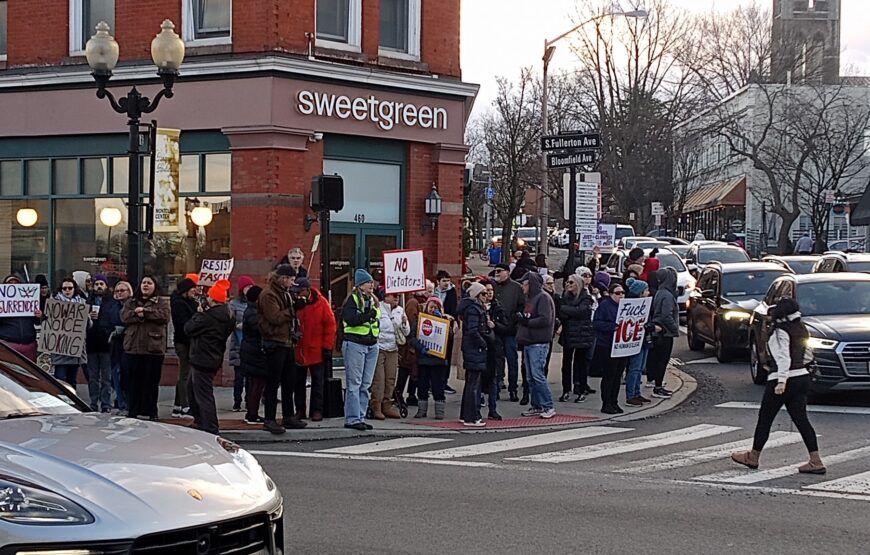
Photo Source: The 50501 Movement
As the national conversation grows around the impact and harsh tactics of U.S. Immigration and Customs Enforcement (ICE) in communities across the country, it’s important to understand how Montclair is affected. We are joined by Masiel Rodriquez-Vars, executive director of the Montclair Fund for Educational Excellence (MFEE). For more than 30 years, MFEE has supported Montclair Public Schools by raising private funds for students, teachers, and families, many of whom are immigrants. We also spoke with her at the Montclair Film Festival during the screening of Brenda, where she highlighted the courageous journey of Brenda and her family, who immigrated to Montclair after fleeing gang violence in their home country.
While Montclair hasn’t experienced the large-scale ICE raids seen in other cities, the agency’s presence has left families anxious about what could possibly happen at bus stops, on public transportation, or during routine trips to grocery stores leaving them particularly vulnerable.
🎧 The full conversation is available on this week’s episode of The Montclair Pod. Below is a summary of the interview.
A Community on Edge
Like many families in immigration proceedings, Rodriquez-Vars said they are “really scared, nervous and anxious.” Everyday tasks such as going to work, grocery shopping, or picking up children now carry a different weight amid increased ICE activity locally and nationwide. Even without highly visible enforcement in Montclair itself, she said “it certainly creates an enormous amount of fear in folks right now,” with anxiety shaping daily decisions and routines.
She described families who have moved to communities with larger immigrant populations only to experience such intense stress that they “don’t want to leave their homes and have decided to just hunker down,” a choice she noted is unsustainable because “if you’re not working you can’t feed your family.” Some residents are avoiding certain grocery stores, food pantries, or sending only one family member out while others stay behind. Reports of ICE activity, including unconfirmed sightings near Toni’s Kitchen, have further heightened tensions. Rodriquez-Vars said that whether or not every report is verified, the broader impact is clear: entire communities are on guard, and the climate appears intended “to really sow fear,” not only among immigrants but “among all of us.”
Enforcement Without Raids
Rodriquez-Vars said Montclair has not seen the kind of large-scale, highly visible ICE raids reported in cities like Newark or Jersey City. Because the township does not have as large an immigrant population, “we’re not seeing in Montclair a raid coming in at different places,” nor the kind of random enforcement activity reported in other parts of the country. Still, she emphasized that the absence of public raids does not mean the community is untouched. From what local advocates know, detentions here tend to be more targeted, with ICE identifying individuals and seeking them out directly.
Those detained, she said, are often people who are complying with immigration procedures. “It’s what you hear. People going in for their check-ins,” she explained, including individuals attending interviews tied to open asylum cases who were then taken into custody. Some had previously held protected status or were released at the border on parole, but in the cases she has seen firsthand, all had pending asylum claims. “These are folks who really should not have ever been picked up and put in detention,” she said, adding that while individuals retain legal rights, “we’ve seen firsthand that those legal rights are not being attended to.”
Fear Beyond the Classroom
Children are deeply affected by the current immigration climate, even when schools themselves are working hard to provide stability. What she finds most heartbreaking is that many students feel they and their families are being intentionally demonized and pushed out of a country they “really struggled so hard to come to.” She said children are acutely aware that the promise of “life and liberty” does not feel real to them right now, and many no longer see the United States as a safe place. While student experiences vary, she said the broader anti-immigrant sentiment, “so rooted in hate,” is inevitably sowing fear among the children.
At the same time, she credited Montclair school leaders for taking proactive steps. In early 2025, the district adopted clear protocols outlining what to do if ICE appears, including a strict policy of not allowing anyone into a school without a judicial warrant and first consulting legal counsel. Rodriquez-Vars noted the distinction between judicial and administrative ICE warrants is critical, since an administrative warrant does not authorize entry into a school. These measures help create structure and reassurance within school buildings.
Standing With Immigrant Families
MFEE plans to publish a list of concrete ways residents can assist local families, and she encouraged people to look to faith communities such as The Unitarian Universalism Congregation and Union Congregational Church, which have been active partners. One idea under consideration is a volunteer network to drive or accompany individuals to bus stops or appointments, since “that can go a long way to making you feel a little less anxious.”
For immigrants who are fearful, including those who are fully documented or even citizens, Rodriquez-Vars pointed to trusted legal and support organizations. MFEE works closely with Catholic Charities in Newark, which provides legal services and refugee assistance, as well as other regional groups that help guide families and connect them to resources. Locally, she said families with children in Montclair schools are welcome to reach out directly for support and referrals, emphasizing that no one should feel they have to simply “keep their heads down” and navigate the uncertainty alone.
Fear and Separation in the Community
Six people in the Montclair community have been detained, with some families navigating months-long separations while loved ones remain in custody. In several cases, caregivers have been in detention for six months, leaving children “absolutely traumatized” and going to school without having seen their father in months. While Montclair has not experienced home raids, the affected families are local, and the detentions have largely occurred during check-ins or other immigration appointments. Even without visible sweeps, the community is witnessing “the lack of dignity and lack of humanity in the ways that people are being treated by this system.”
She also addressed the surge of unverified ICE sighting reports circulating online. Some reports have been credible, others not, making it difficult to balance informing the community with avoiding panic. After attending a rapid response training led by Cosecha, she said residents should look for identifying markers such as ICE, ERO, or DHS insignia, document precise locations, and verify information before sharing it widely. Ultimately, she said the climate of fear feels intentional, and in some heartbreaking cases, families who once fled persecution are now choosing to return to the very countries they escaped because “the situation here is so bad.”
Donate to MFEE and support Montclair students here.