No. He did not.
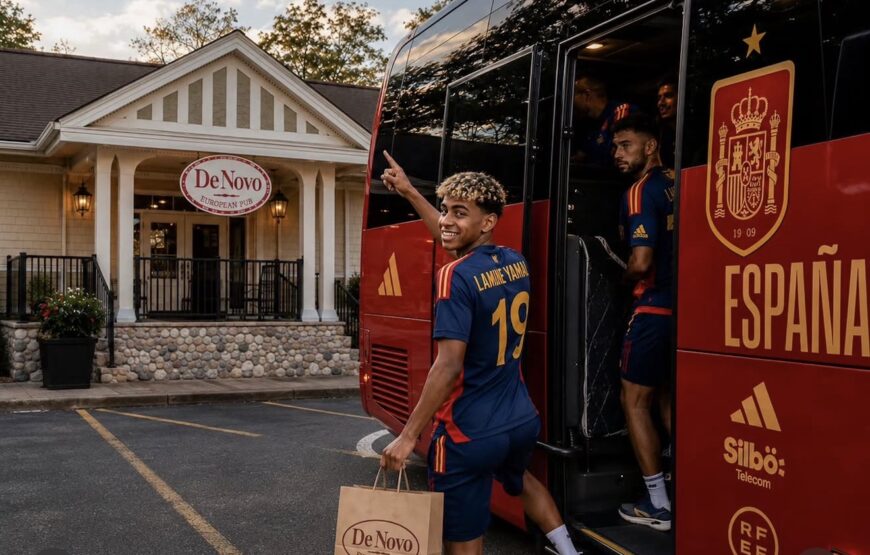
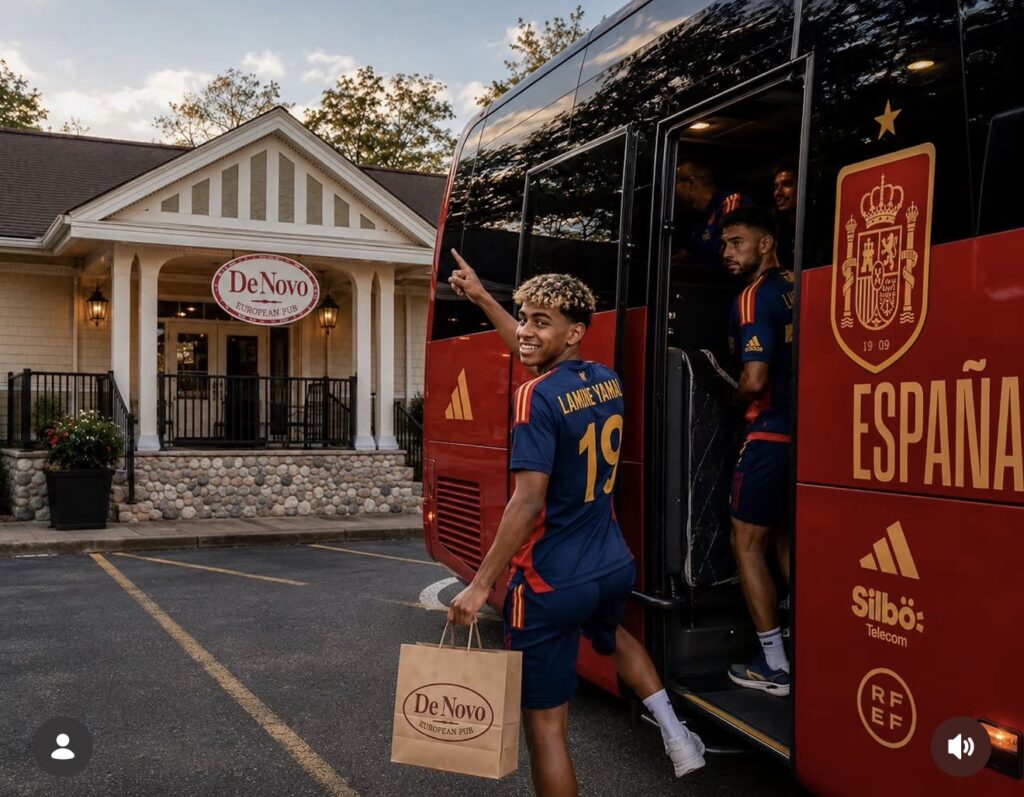
But if you scrolled past the restaurant’s Instagram this week, you might have believed it. The 19-year-old superstar Lamine Yamal from Spain was pictured hopping off the team bus in front of the Italian spot in Upper Montclair, takeout bag in hand, mid-wave. Over 3,600 people “liked” the post.
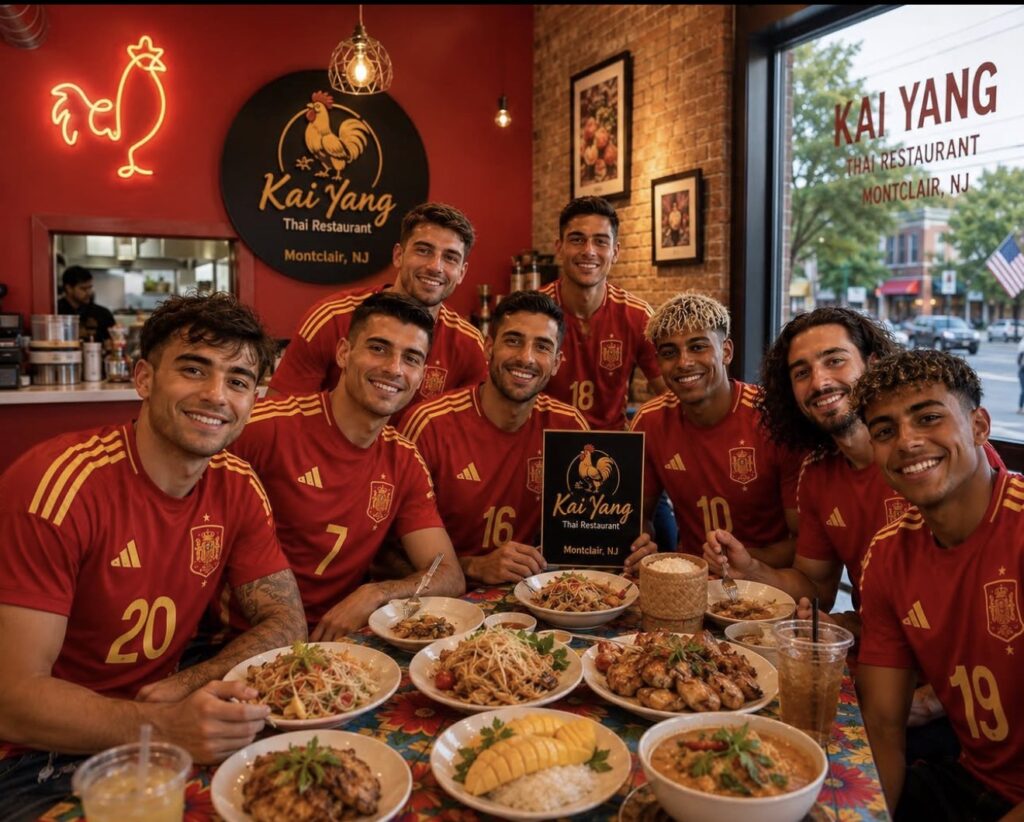
Then there was a photo of Spain’s national team, red kits and all, crowded around a table piled with pad thai at Kai Yang, a Thai restaurant downtown.
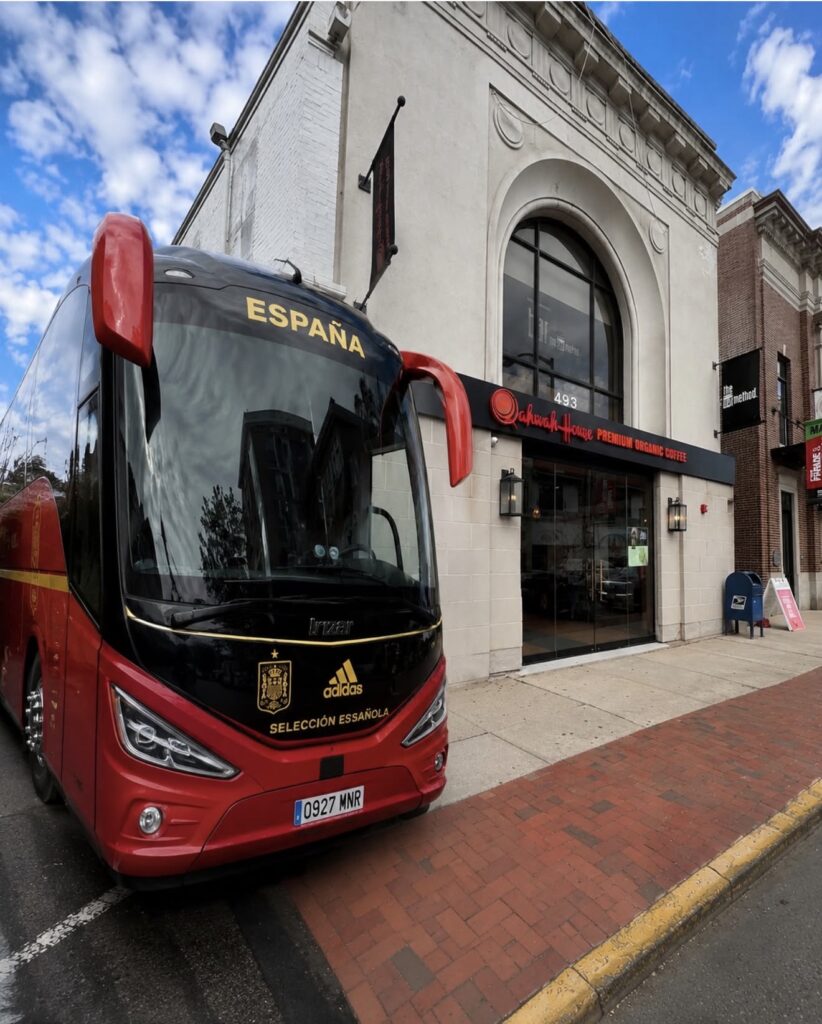
Then another of the team España bus parked outside Qahwah House, a Bloomfield Avenue coffee shop.
None of it happened. All three images were AI-generated.
The Tells
Once you know to look, the work of artificial intelligence is not hard to spot. The Spain crest on the team bus reads “Selección Essañola,” which is not words in any language, Spanish included. The neon rooster sign glows behind a group of players whose faces have that slightly-too-symmetrical, slightly-too-smooth quality that AI image generators still can’t quite shake. Yamal’s jersey number and kit details don’t match what he’s actually worn this tournament. The framed photos on the wall of one restaurant are just soft, textureless blurs, the kind of background detail generative tools tend to gloss over because nobody’s looking that closely.
Why now
Montclair, like plenty of towns near World Cup host cities, spent the summer bracing for a tourism windfall. Watch parties, foot traffic, a jersey-clad crowd spilling out of downtown restaurants. Some of that happened. A lot of it didn’t materialize the way businesses hoped, and that gap between expectation and receipts is, I’d guess, exactly the gap these images were built to paper over. A fake photo of a national team endorsing your restaurant is a lot cheaper than the marketing spend it would take to actually get one.
I get the impulse. I don’t think anyone posting these thought they were doing something dangerous. It’s a bit, a wink, a bid for engagement in a summer where everyone’s phone was full of soccer content anyway. But “harmless bit” and “legally exposed” aren’t mutually exclusive, and this is a case where they overlap more than most people posting these images probably realize.
To be clear, we’re not throwing stones from outside the glass house. We play with AI imagery too. We built one for a recent episode showing Mike and me standing in the middle of Bloomfield Avenue looking up at a banner of Mike doing pilates while Bigfoot looks on and the Norwegian team jogs by. Absurd, obviously fake, and not trying to be anything else.
The difference is purpose, and it happens to be the same line the law actually draws. Our image doesn’t imply an endorsement from anyone. It exists to illustrate editorial commentary about this exact phenomenon, not to suggest a business, a sponsorship, or a real person’s involvement in anything. A podcast using an absurd AI image to illustrate a juxtaposition is editorial use. A business using one to imply that a national team stopped by for dinner is commercial use, and that’s the category the law treats very differently.
I don’t think anyone posting these thought they were doing something dangerous. It’s a bit, a wink, a bid for engagement in a season where everyone’s phone was full of soccer content anyway. But “harmless bit” and “legally exposed” aren’t mutually exclusive, and this is a case where they overlap more than most people posting these images probably realize.
Why this isn’t just a harmless bit
FIFA runs one of the most aggressive brand-protection operations of any organization on earth, and it doesn’t reserve that enforcement for big companies. Earlier this year, a small business owner in the Fort Worth area got their entire Facebook account banned from posting for a month after FIFA flagged a single post that used the hashtag #WorldCup — nothing more. FIFA reported the post for trademark infringement over that hashtag, and the business owner was locked out of the platform for roughly a month. Local chamber of commerce officials say most small business owners have no idea the restrictions are this broad.
That’s from a hashtag. These Montclair images go considerably further: real team branding, a real (AI-recreated) team bus, and the actual name and likeness of a real, extremely famous athlete, all arranged to imply an endorsement that never happened.
That combination pulls in more than one area of law:
Trademark and false endorsement. FIFA’s brand protection strategy leans on more than logo use. It also pursues cases built on the false impression of sponsorship or endorsement, arguing that even without explicitly claiming to be an official sponsor, an ad can still imply a commercial connection to the tournament. A photo suggesting the Spanish national team dined at your restaurant does exactly that. FIFA has largely built its 2026 enforcement approach on existing tools like the Lanham Act, rather than a special host-country statute, along with contractual control over venues and cooperation from local authorities. This isn’t hypothetical: FIFA sued Puma in 2022 over marks combining “Puma” with “World Cup,” and won. Willful trademark infringement can carry serious financial consequences under the Lanham Act.
Right of publicity. Separate from FIFA’s own trademarks, Lamine Yamal has his own legal right to control commercial use of his name, image, and likeness. Using an AI-generated version of a real, named athlete to suggest he personally visited and endorsed a business is the kind of thing image-rights holders and players’ agents pursue on their own, independent of anything FIFA does.
Ambush marketing. Ambush marketing is industry shorthand for a business creating the impression of an official relationship with a tournament without paying for it, and it doesn’t require using FIFA’s logo at all. An AI photo of the team bus parked outside your door is about as textbook an example as it gets.
None of this requires a business to have acted with malice. The line the law actually cares about is personal use versus commercial use — the moment a business uses a mark or an implied association to attract customers or drive sales, it’s commercial use, and unauthorized commercial use is what triggers liability. A restaurant posting “look who stopped by” content to its business account, even as a joke, sits pretty squarely on the commercial side of that line.
The irony
Here’s the part that makes this more than a legal curiosity. The entire premise of these posts is that the World Cup was bringing a wave of business restaurants in and around Montclair wanted a piece of. But by many accounts, the local economic bump fell short of what businesses were promised when they leaned into World Cup programming. So the actual sequence of events is: the World Cup didn’t deliver the traffic that was hoped for, and in response, at least a few businesses generated fictional evidence that it had, a step that carries more legal risk than the disappointing reality it was meant to paper over.
The Montclair Pod reached out to Kai Yang, Qahwah House, and De Novo for comment on the origin of these images.